




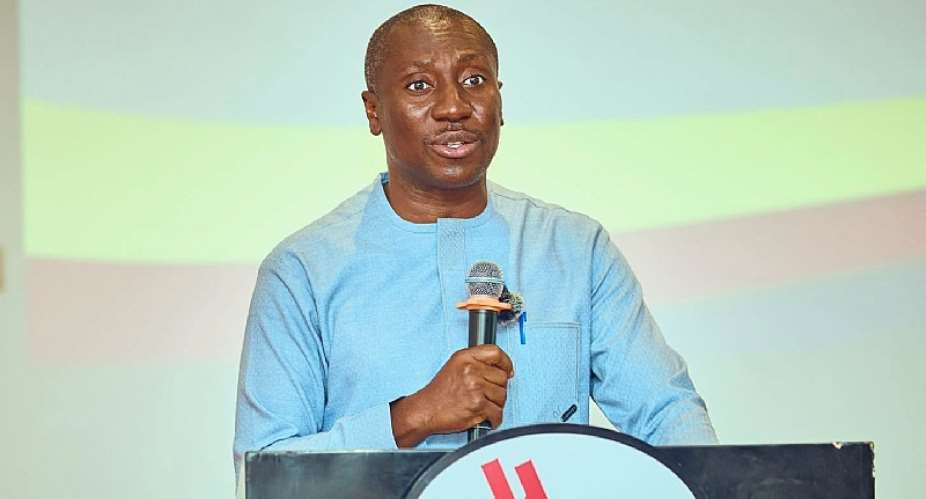
The management of the Electricity Company of Ghana (ECG) has commended Minority Leader Alexander Afenyo-Markin for his contributions to the company during his brief tenure as Board Chairman, highlighting his efforts to strengthen financial accountability, procurement controls and operational efficiency.
The commendation was referenced in an invitation from ECG Managing Director Kwame Kpekpena, dated September 15, 2026, inviting Mr Afenyo-Markin to a luncheon in honour of former managing directors and board chairpersons of the company.
Mr Afenyo-Markin attended the event at the Accra Marriott Hotel on September 23, 2026, where he shared his assessment of ECG’s financial and operational challenges and outlined reforms he believes are necessary to secure its long-term sustainability.
He served as Board Chairman from September 29, 2024, to January 6, 2025, after his appointment in July 2024.
Despite the relatively short period, the Minority Leader said the experience gave him valuable insight into the institutional, financial and operational pressures confronting the power distributor.
He maintained that ECG’s difficulties were structural and systemic, arguing that they could not be resolved sustainably through partisan exchanges, repeated financial interventions or tariff increases that shift the burden of inefficiencies onto consumers.
Tariff increases cannot replace reforms
Mr Afenyo-Markin said successive electricity tariff adjustments between April 2025 and September 2026 resulted in a cumulative increase of approximately 28.7 per cent, based on published average regulatory adjustments.
He acknowledged that tariff adjustments could be necessary in a properly regulated electricity market but cautioned that they should not replace prudent financial management, efficient revenue collection and institutional accountability.
He argued that higher electricity bills directly affect household welfare, production costs, employment and the competitiveness of businesses.
“The Ghanaian consumer must not become the permanent financier of inefficiencies that the electricity sector has failed to confront,” he stressed.
The Minority Leader said the position was consistent with arguments he had presented on behalf of the Minority before the Public Utilities Regulatory Commission (PURC) during its multi-year tariff review in November 2025.
ECG records financial improvements but losses persist
Mr Afenyo-Markin acknowledged improvements in ECG’s financial and operational performance, citing figures presented at the company’s Annual General Meeting in July 2026.
According to the figures he referenced, ECG’s revenue increased from approximately GH¢19.03 billion in 2024 to GH¢22.11 billion in 2025, representing growth of 16.2 per cent.
The company’s reported loss after tax also declined from approximately GH¢8.26 billion to GH¢2.52 billion, an improvement of about 69.5 per cent.
New electricity connections increased by 31.3 per cent to 222,979, while prepaid customers accounted for approximately 53.5 per cent of the customer base.
However, he cautioned against interpreting the reduction in reported losses as evidence of a complete financial turnaround.
He attributed a substantial portion of the improvement to foreign exchange gains of approximately GH¢12.16 billion arising from the appreciation of the Ghana cedi against foreign-currency-denominated obligations.
He argued that such accounting gains should be distinguished from improvements in electricity sales, cash collections and underlying operational efficiency.
Mr Afenyo-Markin further cited electricity purchase costs of approximately GH¢34.8 billion in 2025, compared with revenue of GH¢22.11 billion, resulting in a reported gross loss of about GH¢12.7 billion.
System losses, he said, declined only marginally from 27.05 per cent in 2024 to 26.88 per cent in 2025, a reduction of 0.17 percentage points.
“The true test of reform is not simply whether accounting losses decline, but whether ECG consistently reduces system losses, improves revenue collection, controls expenditure and generates sufficient cash to meet its obligations,” he said.
Calls for digitalisation and stronger revenue protection
The Minority Leader identified technical and commercial losses as major threats to ECG’s financial sustainability, citing faulty meters, inaccurate billing, illegal connections, unbilled consumption, weak collection systems and inadequate reconciliation procedures.
He argued that the company must ensure that electricity distributed is accurately measured, properly billed and paid for.
To address the challenges, he recommended stronger revenue collection and reconciliation systems, better-resourced field enforcement teams, consistent sanctions against electricity theft and closer collaboration with local assemblies, traditional authorities and communities.
He also proposed an integrated technological framework to improve revenue protection.
The proposed measures include a unified customer database to eliminate fragmented records and duplicate accounts; smart prepaid and remotely monitored meters to improve consumption measurement; and Geographic Information System (GIS) mapping to identify customer locations, distribution assets and areas vulnerable to illegal connections.
He further called for integrated digital payment systems with automated reconciliation, advanced data analytics and artificial intelligence to detect unusual consumption patterns, as well as real-time management dashboards to support timely corrective action.
Mr Afenyo-Markin said the proposed systems should be supported by effective data governance, cybersecurity safeguards, independent audits and clear accountability for implementation.
“ECG must move decisively from merely identifying revenue losses after they occur to building systems capable of preventing, detecting and addressing them before they become entrenched,” he said.
Three priority interventions proposed
Mr Afenyo-Markin outlined three major interventions he believes are necessary to strengthen ECG’s finances and address wider challenges in the electricity sector.
The first is the strict enforcement of the revised Cash Waterfall Mechanism to ensure that electricity-sector revenues are collected transparently, reconciled accurately and distributed according to established and auditable rules.
He called for regular publication of validated collection and disbursement information, effective regulatory oversight and accountability for deviations from approved allocation arrangements.
The second recommendation is a review and renegotiation of legacy power purchase agreements where commercially and legally feasible.
He said particular attention should be given to excessive capacity-payment obligations, inflexible take-or-pay provisions and contractual arrangements that no longer adequately reflect Ghana’s electricity demand and supply requirements.
He also called for more flexible arrangements, including appropriately structured take-and-pay provisions, while stressing the need to respect existing contractual rights, financing arrangements and the reliability of electricity supply.
The third proposal is an automatic settlement mechanism for electricity bills and verified arrears owed by ministries, departments, agencies and other public institutions.
He suggested that the Ministry of Finance establish an enforceable system involving authorised monthly deductions or budgetary offsets, backed by transparent billing, verification and reconciliation procedures.
“The State cannot credibly demand financial discipline from ECG while permitting public institutions to accumulate unpaid electricity obligations,” he argued.
Procurement controls and accountability
Mr Afenyo-Markin also highlighted procurement and inventory management as critical areas requiring reform.
He said he became concerned during his tenure about arrangements under which suppliers could present shipping documents, including bills of lading, in circumstances where ECG had not adequately verified the physical delivery and acceptance of contracted goods.
He clarified that his concern was not with the use of bills of lading, which are legitimate international trade documents, but with the financial exposure that could arise when payment obligations were triggered without adequate verification of delivery, quantity, specifications and condition.
He said he led efforts at board level to strengthen the link between contractual completion, payment obligations and verified acceptance of goods at ECG’s designated facilities.
According to him, the safeguards were intended to minimise exposure to delivery delays, port and storage charges, possible loss or damage, and disputes over the conformity of supplies.
He maintained that procurement reform should be treated as an essential component of ECG’s financial recovery rather than a separate administrative matter.
The Minority Leader also welcomed the need for stronger inventory controls, compliance with procurement regulations and improved operational oversight.
Energy-sector debt remains a national concern
Mr Afenyo-Markin warned that ECG’s financial difficulties extended beyond the company and posed risks to the wider electricity value chain and national economy.
He argued that unpaid obligations to power producers and other sector participants could constrain investment, delay maintenance, undermine infrastructure upgrades and increase pressure on government finances.
He also pointed to the financial burden associated with contractual obligations, including capacity payments under certain power purchase agreements.
Citing an International Monetary Fund assessment for 2026, he referenced a projected energy-sector financial shortfall of approximately US$1.1 billion, which he said highlighted the scale of the challenge.
He cautioned that periodic financial bailouts could provide temporary relief but would not resolve the underlying problems without corresponding institutional reforms.
“Financial support without corresponding institutional discipline risks perpetuating the very inefficiencies it is intended to remedy,” he said.
Calls for sustained reforms
Mr Afenyo-Markin said ECG’s financial recovery would depend on sustained efforts to reduce system losses, improve revenue collection, control expenditure, strengthen procurement safeguards and meet contractual obligations.
He called for full implementation of the Loss Reduction Programme, introduced in 2023 under the Akufo-Addo-Bawumia administration, alongside improved metering, electricity-theft detection and integrated revenue-management systems.
He stressed that the company’s long-term sustainability would require a shift away from excessive reliance on tariff increases and periodic government support towards stronger governance, measurable performance and financial discipline.
“The objective must be an ECG that collects what it is legitimately owed, spends what it receives responsibly, honours its obligations predictably and delivers reliable electricity at a fair and sustainable cost,” he said.
He expressed appreciation to Mr Kpekpena and the ECG management team for the invitation, expressing hope that the discussions would contribute to efforts to improve the company’s financial position, operational performance and service to Ghanaians.

 'Stop excessive financial demands before sharing information with us' — Interior...
 EC will serve national interest, not partisan politics – Deputy Chair Dr Kwaku A...
 I expect no preferential treatment from EC for myself as President, my party or ...
 Afenyo Markin meets management, proposes reforms to turnaround struggling ECG
 ECG management commends Afenyo Markin for reforms during short stay as Board Cha...
 Mahama tasks new EC deputy chairpersons to uphold impartiality
 Attorney-General urges court to reject Adu-Boahene’s no-case submission
 Nyaho Medical Centre ordered to report to CID over expired data protection certi...
 Mahama swears in new Electoral Commission deputy commissioners


