




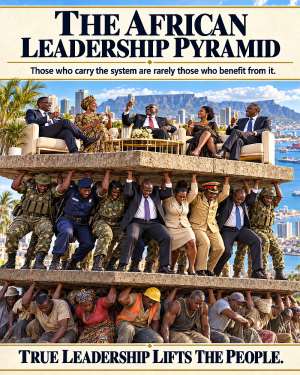
The image of the African leadership pyramid presents a disturbing but familiar portrait of power, privilege and inequality across the continent. It depicts society as a three-tiered human structure in which those who carry the heaviest burden receive the smallest share of national prosperity.
At the top, a small group of elegantly dressed elites sit comfortably on a concrete platform, drinking champagne and laughing against the backdrop of a beautiful modern city. They appear prosperous, relaxed and disconnected from the hardship beneath them. This is the Africa often displayed at international conferences: glittering skylines, luxury developments, impressive economic statistics and confident speeches about transformation.
Yet beneath that carefully presented image lies a more troubling reality.
Directly below the elites are soldiers, police officers, civil servants, political operatives and members of the professional class. They struggle to support the platform on which the privileged few sit. They represent the institutions and individuals who establish, defend and maintain the political system.
At the bottom are construction workers, artisans, market women, farmers and ordinary labourers. Bent under the combined weight of the two levels above them, they form the foundation of the entire structure. They work the hardest, carry the greatest burden and receive the least reward.
The message accompanying the image is simple but profound: those who help to establish and maintain the leadership system in many African countries are often not the people who benefit most from it.
This captures one of the central contradictions of African politics. Political power, which should be an instrument of public service, has too often become a pathway to personal enrichment. State contracts may be distributed according to political connections, public resources captured by privileged groups, and the language of national development used to conceal widening inequality.
The comfort enjoyed at the top is financed by the labour, taxes and sacrifices of those below. Citizens are repeatedly asked to endure economic hardship in the national interest, yet the political leaders demanding those sacrifices frequently refuse to live by the same standards. Ordinary people are told to tighten their belts while those in authority appear to loosen theirs.
The middle layer of the pyramid is particularly important because no unjust system survives through the actions of political leaders alone. It requires the cooperation of institutions and individuals who enforce decisions, administer policies, defend reputations and discourage resistance.
This layer includes security personnel, civil servants, party activists, senior administrators, professionals and political communicators. Many of them understand the inequalities within the system and may even suffer under its weight. However, some continue to defend it because they receive limited access, influence, protection or privilege.
They are often given just enough benefit to secure their loyalty, but rarely enough authority to change the structure. Consequently, institutions created to protect the public can become shields for the powerful. Watchdogs become defenders of the status quo, and public servants may feel pressured to serve partisan interests rather than the common good.
At the bottom are the people who keep the nation alive: the Ghanaian farmer who produces food despite rising input costs; the fisherman in Elmina confronting declining catches; the market woman struggling with taxes and unstable prices; the trotro driver navigating poor roads; the kayayo carrying heavy loads to survive; the factory worker trying to support a family; and the unemployed graduate moving from one application to another in search of an opportunity.
These are the citizens who vote under the scorching sun and in the rain. They pay direct and indirect taxes on food, fuel, transport, electricity, water and almost everything they purchase. They endure inflation, unemployment, inadequate healthcare, poor sanitation and unreliable public services. Yet when the national cake is shared, they are frequently left with crumbs.
This condition is neither just nor sustainable. No society can remain stable indefinitely when those who create its wealth are denied its benefits. A structure whose foundation is continuously weakened will eventually become unsafe for everyone—including those celebrating at the top.
Ghana and the rest of Africa therefore need a different model of leadership. The pyramid must be inverted so that government, public institutions and national resources serve the people rather than forcing the people to sustain a privileged political class.
National policy must reward production instead of political connections. Public institutions must be accountable to citizens rather than merely loyal to governments. Security agencies must protect constitutional rights, while public officials must recognise that authority is a responsibility entrusted to them—not a personal entitlement.
Development must also be measured by more than impressive buildings, international rankings and headline economic figures. Its true test must be found in the daily experiences of ordinary citizens.
Can families afford nutritious food? Can young people find dignified employment? Can farmers earn fair returns for their labour? Can small businesses obtain affordable financing? Can citizens receive quality healthcare and education without falling into poverty? Can hardworking people reasonably expect their lives to improve?
These are the questions that should define national progress.
True leadership is not about sitting comfortably on the shoulders of the people. It is about lifting people, expanding opportunities and ensuring that the burdens and benefits of nation-building are shared fairly.
Until that transformation occurs, Africa’s development story will remain a champagne toast for a privileged few while the majority continue to groan beneath the weight of a system they built, financed and sustained—but rarely enjoyed.


 'Stop excessive financial demands before sharing information with us' — Interior...
 EC will serve national interest, not partisan politics – Deputy Chair Dr Kwaku A...
 I expect no preferential treatment from EC for myself as President, my party or ...
 Afenyo-Markin meets management, proposes reforms to turnaround struggling ECG
 ECG management commends Afenyo-Markin for reforms during short stay as Board Cha...
 Mahama tasks new EC deputy chairpersons to uphold impartiality
 Attorney-General urges court to reject Adu-Boahene’s no-case submission
 Nyaho Medical Centre ordered to report to CID over expired data protection certi...
 Mahama swears in new Electoral Commission deputy commissioners
 PTAAM-Africa calls for government probe into alleged World Cup visa fraud


