




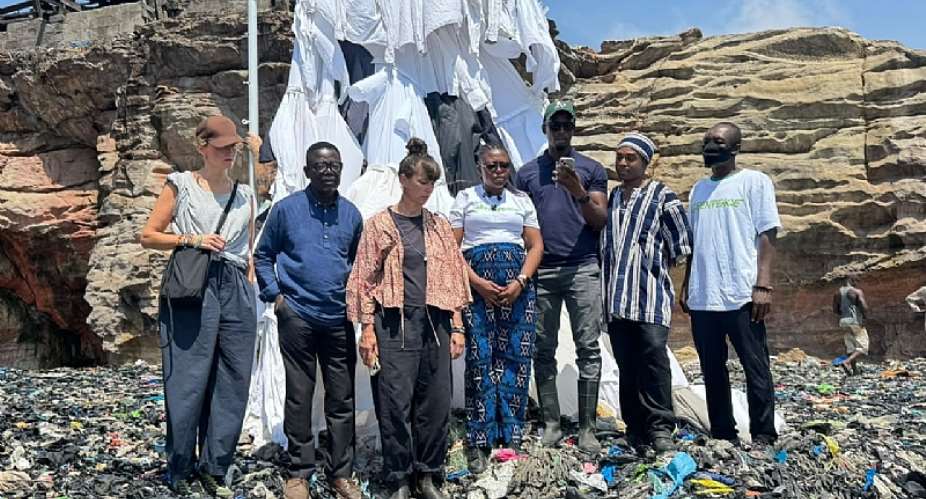
Greenpeace Africa has identified garments bearing labels of major international fashion brands including H&M, Primark and Marks & Spencer among textile waste collected from beaches, markets and dump sites in Accra.
The findings emerged from a new Greenpeace brand audit covering 201 discarded garments collected between October 2 and 5 from James Town Beach, Kantamanto Market and Agbogbloshie.
The environmental organisation unveiled the findings on Wednesday, October 7, 2026, at James Town Beach, where it also launched a six-metre installation made from hundreds of discarded garments to draw attention to the growing volume of textile waste in Ghana.
Other brands identified in the samples included Next and other brands from the United Kingdom, United States and Sweden.
Greenpeace, however, stressed that identifying a brand label on a discarded garment does not by itself establish who exported or discarded that particular item.
The audit forms part of the organisation’s wider campaign against what it describes as “waste colonialism” and the environmental and economic consequences of the global fast-fashion industry.
Speaking at the event, Hellen Kahaso Dena, Project Lead for the Pan African Plastics Project at Greenpeace Africa, said the organisation was concerned that unusable clothing was being brought into Ghana under the broader second-hand clothing trade.
She said discussions with traders at Kantamanto had highlighted the scale of unusable clothing entering the market, claiming that about 40 percent of what comes in is waste.
Dena stressed that Greenpeace was not calling for an outright ban on second-hand clothing, acknowledging the importance of the trade to livelihoods in Ghana.
“What we do not want is for fashion brands in the global north to actually use that loophole to continue dumping,” she said.
She called on the Ghanaian government to ban what Greenpeace describes as “dead waste”, referring to textile imports that cannot be reused, repurposed or resold.
Dena also urged government to strengthen support for Ghana’s local fashion and textile industries, arguing that Ghana has the capacity to develop its own fashion economy while creating more opportunities for local producers and artisans.
Greenpeace Links Textile Waste To Environmental And Health Risks
Sam Quashie-Idun, Head of Investigations at Greenpeace Africa, said the latest investigation followed earlier research by the organisation into the environmental consequences of discarded clothing in Ghana.
He said Greenpeace visited James Town Beach, Kantamanto and Agbogbloshie to collect samples and speak with people involved in the second-hand clothing trade.
According to Quashie-Idun, the organisation found brands including H&M, Primark and Next, among others, during the exercise.
He linked the growing volume of discarded clothing to concerns over plastics and microplastics, particularly because many garments contain synthetic fibres.
Quashie-Idun also referenced Greenpeace’s 2024 report, Fast Fashion, Slow Poison, which found that 89 percent of 164 discarded garments tested at three dumpsites in Greater Accra contained synthetic fibres.
The earlier research also examined air pollution at three public washhouses in Old Fadama where textile waste was burned as fuel.
Quashie-Idun said the testing detected benzene, a known carcinogen, with levels at some washhouses reportedly reaching 200 times European safety standards.
The findings from the earlier research, however, relate to samples collected in 2023 and are separate from the 201-garment audit presented at Wednesday’s event.
Greenpeace Calls For Producer Responsibility
Isabelle McAllister, a Greenpeace spokesperson from Sweden, said responsibility for textile waste should not end once clothing leaves European markets.
She called for stronger Extended Producer Responsibility (EPR) regulations requiring fashion companies to take responsibility for their products throughout their life cycle.
McAllister said existing approaches could allow companies to pay relatively small fees without adequately supporting the communities dealing directly with the resulting waste.
She also rejected calls for an outright ban on second-hand clothing imports, saying the trade remains important to Ghana’s economy.
Instead, she called for better-quality garments and a reduction in global overproduction.
“We don’t want to see a total ban on import here,” she said. “The quality needs to be better and we have to stop the overproduction.”
McAllister said the situation in Ghana should also serve as a warning to countries in the global north, where textile waste systems are increasingly under pressure.
Installation Turns Textile Waste Into A Warning
The Greenpeace event also featured the unveiling of the “Fast Fashion, Lasting Damage” installation, created from discarded garments collected from Ghana’s textile waste stream.
The six-metre installation depicts a model wearing a dress whose massive skirt extends onto the ground and blends into hundreds of discarded garments.
The piece was designed and crafted by The Revival, an upcycling collective based at Kantamanto Market.
Greenpeace said the installation was intended to connect the polished image of fashion promoted globally with what happens to unwanted clothing after it enters countries such as Ghana.
McAllister said the installation was meant to bring those two sides of the fashion industry together, showing the contrast between fashion as presented on catwalks and social media and the waste left behind in communities.
Petition Calls For Ban On Unusable Textile Waste
As part of the campaign, Greenpeace and its partners also submitted a petition signed by more than 25,000 people to the Ministry of Trade, Agribusiness and Industry.
The petition calls for a ban on unusable textile waste and greater responsibility from fashion companies for the waste associated with their products.
Greenpeace is also calling for transparent grading and trading practices, stronger producer responsibility mechanisms, investment in Ghanaian textile production and support for traditional craftsmanship, repair and reuse.
The organisation says such measures should be developed with traders and workers whose livelihoods are directly connected to the clothing economy.
For Greenpeace, the issue is not simply about discarded clothes on Ghana’s beaches and dumpsites, but about who bears the economic and environmental cost of a global fashion system increasingly driven by high production and consumption.

 'Stop excessive financial demands before sharing information with us' — Interior...
 EC will serve national interest, not partisan politics – Deputy Chair Dr Kwaku A...
 I expect no preferential treatment from EC for myself as President, my party or ...
 Afenyo-Markin meets management, proposes reforms to turnaround struggling ECG
 ECG management commends Afenyo-Markin for reforms during short stay as Board Cha...
 Mahama tasks new EC deputy chairpersons to uphold impartiality
 Attorney-General urges court to reject Adu-Boahene’s no-case submission
 Nyaho Medical Centre ordered to report to CID over expired data protection certi...
 Mahama swears in new Electoral Commission deputy commissioners
 PTAAM-Africa calls for government probe into alleged World Cup visa fraud


