




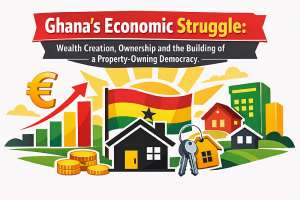
No nation can be truly free if it does not own the foundations of its prosperity.
Economic independence is not declared; it is built.
The struggle for ownership is the struggle for freedom in material form.
A country rich in resources remains poor in power if it cannot turn assets into ownership.
Capital lives not only in vaults, but in minds, institutions and productive courage.
Ghana's economic history is, in many ways, a history of control—over trade, finance, land, labour and natural resources. From the colonial era to the present, the commanding heights of the economy—import and export trade, banking, cocoa, gold and oil—have been shaped by a recurring struggle over who owns, finances, regulates and ultimately benefits from these sectors. In one period, foreign firms dominated them; in another, the state moved to occupy the same space. Yet in both eras, indigenous Ghanaian entrepreneurs often remained too weakly capitalised, too thinly networked or too insufficiently empowered to become decisive players.
This article is organised in six parts. Part I examines the history of foreign domination of Ghana's import-export trade, banking sector, cocoa, gold and oil industries. Part II analyses how the Ghanaian state sought to replace or regulate foreign control through public institutions, nationalisation and policy intervention. Part III turns to the era of indigenous Ghanaian entrepreneurship, highlighting notable local business pioneers, the structural and social barriers they confronted, and the reasons local ownership still remains fragile in several strategic sectors. Part IV considers the New Patriotic Party's ideal of a property-owning democracy and the emergence of a new generation of Ghanaian business leadership in finance, industry and services. Part V argues that land—especially customary land—could become a foundational instrument for financing local development and widening entrepreneurship if managed through stronger institutions such as land trusts, land valuation systems and land banks. Part VI turns to education, human capital and technological change, arguing that no project of national ownership can succeed unless Ghana develops the skilled people needed to lead industry, digital transformation and higher-value production.
This article is written not only as a historical reflection, but also as a personal meditation on Ghana's unfinished economic journey. It has been inspired in part by Akenten Appiah-Menka's The River in the Sea (2010) and by my grandfather Kwadwo Asafo Akwauah's Prelude to Ghana's Industrialisation (1959). Each work, in its own way, wrestles with the same enduring question: why a country so rich in land, enterprise, talent and natural resources has struggled to build a broad and durable class of indigenous owners in the commanding heights of its economy. What follows is therefore offered in a spirit of reflection as much as argument—an effort to think historically about power, ownership, entrepreneurship and the institutional foundations of Ghanaian prosperity.
Part I: The Era of Foreign Domination
Foreign domination of Ghana's economy was not accidental. It was built into the colonial structure of production and exchange. The Gold Coast was integrated into the world economy primarily as a supplier of raw materials and a consumer of imported manufactured goods. That arrangement created a durable pattern: foreign firms controlled shipping, wholesale trade, finance, insurance and export channels, while local producers remained concentrated in the lower-value segments of the economy.
Import and Export Trade
In the colonial and early post-colonial eras, large foreign trading houses such as UAC and UTC occupied the commanding position in Ghana's import and export system. They imported finished goods, distributed them through urban retail and wholesale networks, and exported cocoa and other produce through global commercial channels they already controlled. The result was a classic enclave trading structure: Ghana generated value at the point of production, but foreign firms captured much of the margin through shipping, warehousing, finance, processing and distribution.
Banking Sector
The earliest banks in the Gold Coast were created not to finance indigenous enterprise but to lubricate colonial commerce. The Bank of British West Africa, which later became Standard Chartered, opened in Accra in 1896; Barclays followed through its colonial banking lineage in the early twentieth century. For decades, these expatriate banks served foreign firms and the colonial administration, handled trade finance, and managed government accounts, while local Africans had only limited access to credit.
This imbalance helped inspire the establishment of the first major indigenous commercial bank, Ghana Commercial Bank, in 1953, and the creation of the Bank of Ghana in 1957. But before independence, the structure of banking power remained overwhelmingly foreign: credit was concentrated in sectors tied to trade and expatriate commerce, not in broad-based Ghanaian capital formation.
Cocoa
Cocoa became the backbone of the Gold Coast economy, but the international marketing of cocoa was dominated by European firms. Farmers produced the crop, yet foreign merchant houses and overseas manufacturers exerted decisive influence over prices and export channels. The 1937–38 cocoa hold-up emerged after expatriate firms were accused of collusive price-fixing, prompting farmers to withhold cocoa in one of the earliest mass protests against economic domination in colonial Ghana.
The crisis led to the Nowell Commission and ultimately to the creation of a statutory marketing structure, first through wartime produce control and then through the Cocoa Marketing Board in 1947, the forerunner of COCOBOD. This marked an important turning point: foreign commercial domination in cocoa would thereafter be constrained by the state, even if farmers themselves still lacked direct control over export marketing.
Gold, Ashanti Trade and the Origins of the Gold Coast
The history of the Gold Coast and Ashanti is, above all, a history of gold. No account of foreign domination in Ghana is complete without placing gold at the centre of the story. Long before colonial rule, the area that later became known to Europeans as the Gold Coast was already tied into regional and international systems of exchange because of its abundant gold resources. Much of that wealth came from the forest and inland Akan states, including the wider political world from which Asante later emerged as the most formidable power. Gold dust circulated as both a medium of exchange and a source of state wealth, and routes linking the interior to the coast enabled inland producers and merchants to trade with coastal brokers and, eventually, European buyers. The name “Gold Coast” itself was not accidental: it reflected the fact that European traders came first and foremost because of gold. Portuguese mariners arriving in the fifteenth century sought direct access to this trade, and the forts they built on the coast, beginning with Elmina, were established initially to secure and protect commercial access to gold rather than to exercise territorial rule.
Asante's rise made this gold economy even more politically consequential. By consolidating power in the forest zone and controlling key commercial routes between the interior and the coast, the Asante state became one of the principal forces in the movement of gold toward coastal markets. European powers therefore became interested not simply in a stretch of coastline, but in the rich interior systems that supplied it. Even when the Atlantic economy expanded into slave trading and, later, into palm products, timber and cocoa, gold remained foundational to how Europeans understood the territory and why they competed so intensely for influence there. In historical terms, then, white commercial and later imperial interest in what became Ghana was rooted first in mineral wealth. The struggle over forts, treaties, trade routes and eventually political control cannot be fully understood unless one recognises that the attraction of gold—much of it connected to Akan and especially Ashanti-linked inland commerce—was one of the original engines of European engagement with the country.
Part II: The Era of State Domination
After independence, successive Ghanaian governments concluded that political sovereignty without economic control was incomplete. The state therefore moved to displace foreign dominance through national institutions, state-owned enterprises, monopoly marketing boards, import licensing, public banking and strategic participation in mining and petroleum. This shift was driven by developmental ambition, anti-colonial nationalism and the need to retain more value within the domestic economy.
Import and Export Trade Under the State
From the early 1960s, the Ghanaian state used import licensing, foreign exchange control and state trading corporations to reduce the hold of foreign merchants over commerce. The Ghana National Trading Corporation became a key instrument in this policy. The strategy was rooted in import substitution industrialisation and the belief that the state had to control trade in order to direct national development. Yet over time, shortages, bureaucratic inefficiencies and foreign exchange crises weakened this model, leading eventually to liberalisation under the Economic Recovery Programme in the 1980s.
Banking Under the State
Between independence and the early reform era, the state acquired controlling interests in most commercial banks and established development finance institutions such as the National Investment Bank and Agricultural Development Bank. The aim was to redirect credit toward agriculture, industry and indigenous participation. In principle, this represented a decisive break from the expatriate banking model. In practice, however, politicised lending, weak supervision and inefficiency often undermined the developmental promise of state banking, making later financial sector reforms almost inevitable.
Cocoa Under the State
Cocoa became the clearest example of state domination. Through the Cocoa Marketing Board and later COCOBOD, the state fixed producer prices, supervised licensed buying companies, controlled quality assurance and maintained a monopoly over export marketing. This system helped preserve Ghana's reputation for premium cocoa and gave the state a stable fiscal instrument. But it also meant that farmers and local processors remained largely excluded from direct participation in international marketing and higher-value downstream processing.
Gold Under the State
In the gold sector, Ghana pursued state participation through nationalisation and the creation of state mining institutions, including the State Gold Mining Corporation. This was meant to reverse the colonial pattern in which mineral wealth had been controlled by foreign capital under laws that vested mineral rights in the colonial state and its corporate partners. However, state control struggled against the capital intensity of large-scale mining, ageing infrastructure and managerial weaknesses. By the 1980s and 1990s, liberalisation reopened the sector to foreign capital, which returned with the technology and investment the state could not provide at scale.
Oil Under the State
Oil arrived much later, but the logic was similar. Ghana created GNPC to secure state participation in petroleum exploration and production, and after the Jubilee discovery in 2007 the country adopted legal frameworks such as the Petroleum Revenue Management Act and local content rules to ensure that the new oil economy would not become a purely foreign enclave. Even so, the upstream sector has remained heavily dependent on international oil companies for capital, technical expertise and operational control.
Part III: The Era of Indigenous Ghanaian Entrepreneurs
If Part I tells the story of foreign domination and Part II the story of state domination, Part III is about a third, often underappreciated current in Ghana's economic history: the rise of indigenous Ghanaian entrepreneurs who attempted to build large businesses in their own right. These were men and women who tried to move beyond petty trade and small-scale commerce into manufacturing, transport, finance, distribution and industry. Their efforts demonstrated that Ghanaians could create substantial enterprises, yet they also exposed how difficult it has been for local capital to survive and scale within an economy long shaped by colonial structures, state intervention, uneven access to finance and inherited commercial hierarchies.
Among the notable pioneers were figures such as Akenten Appiah-Menka, remembered not only as a politician and statesman but also as a symbol of indigenous enterprise; B. A. Mensah, who built BAMCO and later International Tobacco Ghana into one of the most important local industrial ventures of his era; J. K. Siaw, founder of Tata Brewery, which became the first wholly Ghanaian-owned brewery and a landmark in post-independence industrial ambition; and Edward Osei Boakye, widely remembered as Boakye Mattress, whose United Mattress and Foam Company helped pioneer local manufacturing in a field previously reliant on imports and demonstrated how Ghanaian entrepreneurship could combine industrial production, brand-building and regional expansion. Their stories matter because they show that indigenous Ghanaian entrepreneurship did not begin today. It has deep roots in the decades after independence, when local entrepreneurs sought to break into sectors that had long been dominated by expatriate merchants, foreign manufacturers and state-controlled institutions.
Timber, Agribusiness, Food and the Newer Entrepreneurial Tradition
The indigenous entrepreneurial story also extends into timber, one of Ghana's major export industries after cocoa. Historical work on the timber trade shows that African commercial initiative played a meaningful role even in the early decades of the industry, although European shipping, finance and export channels often limited how far local actors could climb the value chain. Within that broader timber tradition, families and business figures associated with enterprises such as those linked to B. M. Kufuor came to represent a class of Ghanaian commercial capital rooted in forestry, logging, lumber and furniture production. Their place in the story matters because it reminds us that indigenous enterprise in Ghana has never been confined to retail trade or small-scale manufacturing alone; it has also reached into the resource-processing sectors where value addition and industrial capability are most important.
A similar pattern can be seen in agribusiness and food. Kwabena Darko, through Darko Farms, built one of the most important indigenous poultry and agro-industrial businesses in Ghana, earning a reputation as the country's “Poultry King” and demonstrating that local entrepreneurship could achieve scale in food production, breeding, feed and processing. In a later generation, the rise of Pizzaman-Chickenman, founded by Christian Boakye-Yiadom and Ebenezer Essuman-Amankwah, represents another chapter in this evolving tradition: a young, urban, brand-driven entrepreneurial model rooted not in inherited foreign networks but in Ghanaian initiative, improvisation, consumer insight and rapid domestic scaling. Taken together, these examples show that the indigenous entrepreneurial question in Ghana is not only about old industrial pioneers, but also about whether each generation can create new firms that move from local hustle to institutionalised business power.
Yet the challenge facing local entrepreneurs has never been only economic in the narrow sense. It has also been social and structural. Indigenous Ghanaian business people have often had to navigate fragmented domestic markets, weak long-term financing, unstable industrial policy, politicised patronage systems and at times mutual distrust across regional, ethnic and class lines. In practice, these conditions have made it difficult to accumulate capital patiently over generations, build strong interlocking business networks and sustain large family or community-based commercial institutions. Where trust networks are shallow and policy environments are volatile, indigenous businesses tend to remain vulnerable, especially when compared with merchant communities that have historically relied on tighter transnational family networks, stronger supplier relationships and more durable systems of trade finance.
This helps explain, in part, why business communities of Lebanese, Syrian and Indian origin have remained visibly influential in Ghanaian commerce and industry over many decades. A careful historical analysis does not reduce this to ethnicity alone, nor should it slide into caricature. The more persuasive explanation lies in the institutional advantages that migrant merchant networks often possessed: access to external capital, cross-border family partnerships, experience in import distribution, strong commercial discipline, and the ability to connect local markets to international suppliers and financiers. In sectors such as trade, manufacturing, finance and segments of resource-linked commerce, these networks frequently occupied strategic positions that indigenous Ghanaian firms found difficult to match at scale. The result has been a persistent asymmetry in which local Ghanaian entrepreneurship exists, and sometimes thrives, but too often remains underrepresented in the highest-value segments of banking, gold services, cocoa processing, oil support services and large-scale distribution.
The lesson is not that Ghana should reject foreign capital or ignore the contribution of migrant business communities. Rather, it is that a healthy national economy requires a stronger indigenous entrepreneurial class capable of participating competitively in strategic sectors. The long-term task is therefore to build the institutional conditions—finance, law, skills, infrastructure, procurement access and industrial policy—through which Ghanaian-owned firms can move from the margins to the commanding heights of the economy. That imperative leads directly into the political economy of property-owning democracy.
Part IV: The Fourth Republic, Property-Owning Democracy and the NPP's Golden Age of Business
For the New Patriotic Party and the wider Danquah-Busia-Dombo tradition, property-owning democracy has long represented more than a slogan. It expresses a philosophy of dispersed ownership, private initiative and broad-based participation in wealth creation. In this view, the strongest guarantee of economic freedom is not dependence on the state, but the widening of productive ownership among citizens—through businesses, farms, industry, finance, land, shares and skills. Applied to Ghana's strategic sectors, the doctrine suggests that national development becomes more durable when Ghanaians are not merely employees, consumers or voters, but owners, investors and builders of enterprise.
Contemporary Ghana offers several examples of this expanding indigenous business class. In industry and large-scale enterprise, figures such as Ibrahim Mahama, through Engineers & Planners and Dzata Cement; Joseph Siaw Agyepong, through the Jospong Group; Samuel Amo Tobbin, through the Tobinco Group; and Osei Kwame Despite, through a diversified portfolio spanning media, food processing and finance, illustrate how local firms can build scale, create jobs and move into sectors once thought to be beyond the reach of Ghanaian capital. In finance, institutions such as Databank, CalBank and Fidelity Bank, together with the leadership associated with figures such as Ken Ofori-Atta, Frank Adu Jnr and Edward Effah, show that indigenous Ghanaian enterprise can also succeed in sophisticated areas of banking, investment and capital markets.
To describe this as a 'golden age of business' is therefore meaningful, but only if the phrase is used with care. Ghana has not yet fully resolved the old structural imbalance between foreign capital, state power and local ownership. What has changed, however, is that there is now a more visible class of Ghanaian entrepreneurs with the ambition, scale and institutional credibility to compete in sectors that were historically closed or weakly accessible to indigenous capital. The policy challenge is to ensure that these examples do not remain exceptional individuals, but become the foundation of a broader national class of entrepreneurs capable of transforming production, finance and trade at scale.
Part V: Land, Customary Authority and the Financing of Local Development
If property-owning democracy is to become more than a political aspiration, then Ghana must confront one of the deepest questions in its economic life: how to convert widely held but weakly mobilised assets into productive capital for local development. Land is central to that challenge. In Ghana, roughly four-fifths of land is held under customary ownership by stools, skins, clans and families, which means that the country already possesses a vast indigenous asset base. The problem is not the absence of assets, but the absence of institutions capable of documenting, valuing and responsibly leveraging those assets for entrepreneurship, housing, agribusiness and local industry.
A practical starting point lies in strengthening customary land administration rather than bypassing it. Ghana's legal framework already recognises stool, skin and family lands, while institutions such as Customary Land Secretariats and the Office of the Administrator of Stool Lands exist to improve documentation, revenue management and accountability. The challenge is to deepen their technical capacity, integrate valuation and record-keeping systems, and align customary authority with modern development finance. When customary land systems are transparent, well-documented and trusted, they can provide a more secure foundation for investment than the fragmented and dispute-prone arrangements that often discourage both local enterprise and community development.
This is where traditional authority could become economically transformative. If the Asantehene and other prominent chiefs were to champion professionally managed land trusts for stool and community lands, they could help shift land from being a passive store of value into an active platform for local development. Such trusts would not mean alienating communal land or stripping communities of customary rights. Rather, they would mean placing identified parcels under transparent governance structures, supported by proper valuation, planning and community consent, so that land could be used more strategically to attract investment, support industrial sites, expand housing, or back local enterprise initiatives. The relative strength of land administration in Asanteman has often been cited as evidence that more orderly customary governance is possible.
From there, the next institutional step would be the development of credible land valuation systems and, over time, land banks or land-backed development facilities that could help local entrepreneurs access finance. The idea is not that land alone solves the credit problem. Evidence from Ghana shows that collateral matters, but documentation, cash flow and lender confidence matter too. Still, where land rights are clearer, records stronger and valuation more credible, land can play a far greater role in unlocking credit for SMEs, farmers, manufacturers and community enterprises than it does today. A well-designed system could allow communities to leverage land values without reckless dispossession, while giving banks and development institutions a more reliable basis for lending into productive sectors.
In that sense, land reform in Ghana should not be understood only as a matter of registration, dispute resolution or real estate transactions. It should also be understood as part of a national strategy for indigenous capital formation. If customary authorities, public regulators, local financial institutions and development planners can work together to build trusted land-based financing mechanisms, then local communities would gain a new route into enterprise creation and asset ownership. That would give concrete institutional meaning to property-owning democracy: not merely the defence of existing property, but the deliberate expansion of productive ownership among ordinary Ghanaians.
Part VI: Education, Human Capital and the Next Productive Economy
No serious project of indigenous enterprise can succeed without a corresponding project of human capital formation. If Ghana is to move from raw extraction to higher-value production, and from dependency to ownership, then the country must invest not only in firms and finance, but also in the education, technical training and institutional imagination of its people. In that sense, the history of education in Ghana is not a side story to economic development. It is part of the central struggle over who will own, manage and transform the economy in the decades ahead.
In this sense, what is often described as a lack of capital is also, in part, a human resource problem. The word capital itself comes from the Latin caput, meaning “head.” That etymology is revealing. Capital is not only money in the bank or machinery in a factory. It is also what resides in human heads: managerial competence, technical skill, financial literacy, production discipline, innovation capacity and the ability to organise people and systems productively over time. A country may possess land, minerals and even cash, yet still suffer a capital shortage in the deeper developmental sense if it lacks enough trained people to design enterprises, run institutions, manage risk, absorb technology and convert opportunity into sustained productivity. To speak of a shortage of capital, therefore, is often also to speak of a shortage of adequately developed human beings—of the quality of the head as much as the contents of the vault.
This tradition runs deep. Achimota School was founded in 1927 with the ambition of producing an educated African leadership class capable of combining intellectual, moral and practical training in the service of society. The later establishment of the University of Ghana extended that project into higher education and nation-building, helping to produce administrators, scholars, professionals and public leaders for the emerging state. However, the larger developmental question has always been whether education in Ghana should merely credential citizens, or whether it should systematically create the skills, disciplines and productive capacities required for industrial and technological transformation.
That question also explains why educational financing has mattered so much in Ghana's political economy. The Cocoa Marketing Board scholarship tradition, and later COCOBOD's support for schools, student bursaries and educational infrastructure, reflected a broader recognition that the wealth generated from strategic sectors had to be reinvested in human capital. In this respect, the logic behind CMB scholarships was not charity; it was nation-building through the conversion of commodity earnings into educational opportunity. The later introduction of Free Senior High School can be read in a similar way: as a mass mechanism for widening access to secondary education and lowering one of the most important barriers to human capital accumulation.
Today, that developmental challenge has entered a new phase. Digitisation is changing how states govern, how firms compete and how workers create value. The growing significance of artificial intelligence makes the matter even more urgent. Ghana's emerging digital and AI ambitions underscore a simple truth: countries that fail to educate their people for the digital age will struggle to control the productive economy of the future. Human capital policy must therefore move beyond access alone toward a deeper emphasis on digital literacy, technical competence, creative problem-solving, research and industry-linked skills.
This is especially important in Ghana's gold belt. For too long, mining communities such as Obuasi, Tarkwa and others have been associated primarily with extraction, environmental degradation and the distortions of illegal mining, or galamsey. But the long-term answer cannot be policing alone. It must also include education, skills conversion and the creation of lawful, high-value alternatives. Ghana should be thinking strategically about how to train more young people in goldsmithing, watchmaking, jewellery design, metallurgy, assay services, gemstone setting, branding and luxury manufacturing. If Birmingham could build a Jewellery Quarter and Switzerland could build globally recognised clusters around precision craft and watchmaking, there is no reason Ghana's mining towns cannot develop their own specialised ecosystem rooted in local gold, local talent and local enterprise.
That vision would require institutions as well as skills. Properly regulated gold exchanges in Obuasi, Tarkwa and other mining communities could help formalise trade, improve price discovery, support legal traceability and create stronger local value chains around refining, fabrication and export. Combined with technical institutes, design schools, apprenticeship systems and better links between miners, refiners, jewellers and financial institutions, such an approach could turn part of Ghana's gold economy away from informal survivalism and toward a more sophisticated industrial ecosystem. In that way, education would cease to be merely social policy and become a direct instrument of industrial strategy, local wealth creation and national ownership.
Taken together, the six phases traced in this article—foreign domination, state domination, indigenous entrepreneurial struggle, the contemporary search for a property-owning democracy, the strategic mobilisation of land for local development, and the long project of education and human capital formation—reveal the unfinished nature of Ghana's economic project. The question is no longer simply whether foreigners or the state should control the commanding heights of the economy. The more urgent question is whether Ghana can build a sufficiently broad, confident and competitive class of local entrepreneurs, workers, technicians and innovators to anchor national prosperity in Ghanaian ownership, backed by institutions capable of converting local assets, human skill and technological capacity into productive capital. That is the deeper promise behind property-owning democracy: not rhetoric alone, but the steady creation of conditions in which many more Ghanaians can own, build, finance, design and expand the enterprises that will define the country's future.
About the author: Kwadwo Kusi-Frimpong is a specialist in law, finance, financial crime, governance and regulation. He has worked with banks and financial institutions in the United Kingdom, Switzerland and the Netherlands. He has appeared on TV3 and contributes to Ghana Broadcasting Corporation programmes including News, Market Avenue and Talking Point. He studied Political Science and Philosophy at the University of Ghana, obtained a Graduate Diploma in Law and an LL.M. from the University of Law (formerly the College of Law), and holds a postgraduate degree in Financial Strategy from Saïd Business School, University of Oxford.


 'Stop excessive financial demands before sharing information with us' — Interior...
 EC will serve national interest, not partisan politics – Deputy Chair Dr Kwaku A...
 I expect no preferential treatment from EC for myself as President, my party or ...
 Afenyo-Markin meets management, proposes reforms to turnaround struggling ECG
 ECG management commends Afenyo-Markin for reforms during short stay as Board Cha...
 Mahama tasks new EC deputy chairpersons to uphold impartiality
 Attorney-General urges court to reject Adu-Boahene’s no-case submission
 Nyaho Medical Centre ordered to report to CID over expired data protection certi...
 Mahama swears in new Electoral Commission deputy commissioners
 PTAAM-Africa calls for government probe into alleged World Cup visa fraud


