




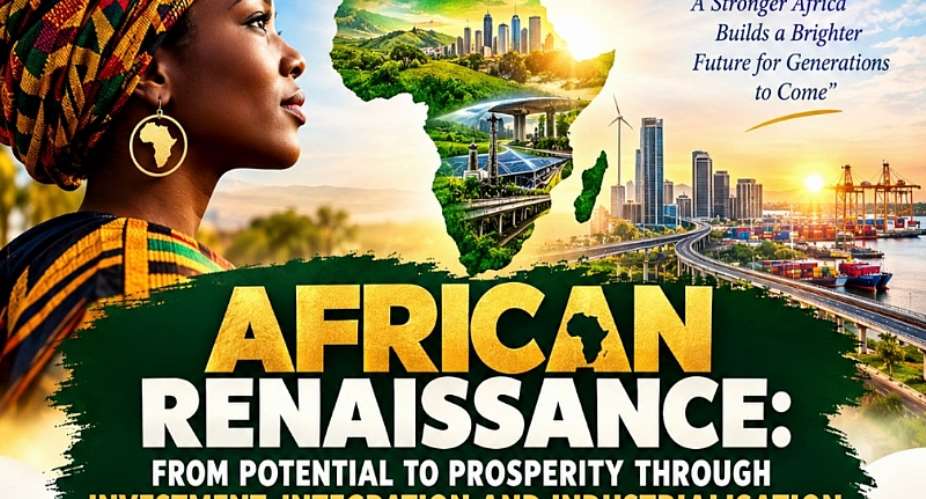
Africa stands at a defining moment in its history. Across the continent, a new generation of leaders, entrepreneurs, investors, innovators, academics and citizens is increasingly asking a fundamental question: How can Africa move from being a continent of enormous potential to one of sustained prosperity? The question is neither rhetorical nor merely aspirational. It speaks directly to the continent’s developmental choices and to the kind of economic future Africa intends to build. Africa possesses extraordinary natural resources, a youthful population, vast agricultural potential, strategic minerals, significant energy resources, expanding markets, entrepreneurial capacity and a rapidly evolving digital economy. Yet potential, by itself, does not create prosperity. Resources must be converted into productive capacity; markets must be connected; capital must be mobilised and strategically deployed; knowledge must be transformed into innovation; and political ambition must be translated into effective institutions, competitive enterprises and systems capable of delivering measurable and sustainable outcomes. “Africa’s greatest resource is not what lies beneath its soil, but what it chooses to build with what lies within its people.” — Dr. Nana Okogyedom Adoofi I
The idea of an African Renaissance therefore represents far more than cultural renewal or historical revival. It is a call for a fundamental transformation of Africa’s economic, institutional, technological and developmental trajectory. It speaks to an Africa that recognises the value of its assets, defines its strategic priorities, builds its capabilities and increasingly shapes its own economic destiny. The Renaissance must be about moving from dependency towards productive self-reliance; from fragmented economies towards deeper integration; from the export of raw materials towards value creation; and from dependence on externally generated knowledge and technology towards the development, ownership and application of African knowledge and solutions. It is, ultimately, a call for Africa to become a more active architect of its own future rather than a passive recipient of external economic forces.
At the heart of this transformation are Investment, Integration and Industrialisation. Investment provides the capital required to unlock opportunity, expand productive capacity and finance the infrastructure and enterprises upon which sustainable economic transformation depends. Africa therefore needs to mobilise and effectively deploy domestic savings, pension and sovereign funds, diaspora resources, private equity, development finance and responsible foreign investment towards sectors capable of generating long-term economic value. The critical question is no longer simply how much investment Africa can attract, but what kind of investment Africa needs, where it goes, what productive capacity it creates, who benefits, and how effectively it contributes to long-term transformation.
Integration, on the other hand, provides the scale, connectivity and economic space necessary for African economies to compete in an increasingly interconnected global economy. Many African economies operate within relatively limited domestic markets; their collective strength, however, can be considerably greater when they function as components of a more integrated continental marketplace. The African Continental Free Trade Area provides an important framework for advancing this ambition. Yet integration must move beyond agreements, protocols and declarations towards practical economic cooperation. This requires more efficient borders, harmonised standards and regulations, interconnected infrastructure, stronger regional value chains, digital connectivity, financial cooperation and the efficient movement of goods, services, capital and skills. A more integrated Africa is an Africa better positioned to create scale, deepen markets, strengthen bargaining capacity and build competitive continental enterprises.
Industrialisation, in turn, is the bridge between Africa’s resources and Africa’s prosperity. For decades, much of the continent’s relationship with the global economy has involved the export of primary commodities and the importation of higher-value manufactured goods. The African Renaissance requires a different trajectory. Africa must increasingly process its minerals, transform its agricultural products, manufacture essential goods, develop competitive industries and participate more meaningfully in sophisticated regional and global value chains. Industrialisation, however, is not simply about constructing factories. It is about building productive ecosystems that connect agriculture, energy, finance, technology, logistics, skills, manufacturing and markets. It is about creating the conditions under which African resources generate African value, African enterprises become globally competitive and African workers participate in increasingly sophisticated production systems.
Yet investment, integration and industrialisation cannot succeed in isolation. They depend upon innovation, infrastructure, capable institutions and inclusion. Innovation provides the knowledge, technology and creativity required to improve productivity and competitiveness. Infrastructure provides the physical and digital foundations upon which economies operate, and markets connect. Institutions provide the governance, regulatory credibility, policy continuity and accountability necessary to sustain long-term transformation. Inclusion ensures that the benefits of economic progress extend beyond aggregate economic indicators to young people, women, entrepreneurs, workers, communities and future generations. Together, these dimensions transform the three principal drivers of the Renaissance, investment, integration and industrialization, into a broader and more coherent continental development architecture.
This transformation also requires a redefinition of the relationship between the state, business and society. Governments and public institutions have a responsibility to create credible policy environments, strengthen institutions, provide strategic public goods and establish the conditions in which enterprise can flourish. Business leaders and investors have a responsibility to identify opportunities that create productive value, expand employment, deepen markets and build competitive enterprises. Financial institutions must become more effective channels for long-term productive capital. Universities and research institutions must generate knowledge that responds to Africa’s economic and social challenges. Entrepreneurs must turn ideas into enterprises and enterprises into scalable solutions. Regional and continental institutions must facilitate cooperation and integration. Civil society and citizens, meanwhile, must participate in shaping the development priorities and accountability mechanisms that determine the future of their societies.
The conversation must consequently shift from “What does Africa have?” to “What will Africa build with what it has?” This is perhaps the defining question of the African Renaissance. Africa’s natural resources are valuable, but their greatest significance lies in what they can enable the continent to produce. Africa’s youthful population is an asset, but its demographic strength becomes transformative only when young people have access to education, skills, capital, technology and meaningful economic opportunity. Africa’s markets are substantial, but their true power will emerge when they become more integrated, productive and accessible. Africa’s technological potential is significant, but its long-term impact will depend upon the continent’s capacity to develop, own and deploy technology rather than merely consume it.
The African Renaissance is therefore a project of transformation rather than a declaration of optimism. It requires ambition matched by execution, resources matched by strategy, and vision matched by institutions capable of delivering results. It demands leaders who can think beyond electoral, institutional, and national cycles; businesses prepared to invest beyond short-term gains; financial systems capable of supporting long-term productive activity; universities capable of generating relevant knowledge; and citizens equipped to participate meaningfully in economic transformation. The challenge is not simply to grow African economies, but to transform the structures through which wealth is created, distributed, and sustained.
The central challenge before Africa is therefore clear: to convert potential into productive capacity, productive capacity into competitiveness, and competitiveness into shared prosperity. Investment can provide the capital. Integration can provide the scale. Industrialisation can provide the productive engine. Innovation can provide the competitive edge. Infrastructure can provide the connectivity. Institutions can provide the foundation and continuity. Inclusion can ensure that the resulting prosperity is broadly shared. These are not independent policy choices; they are mutually reinforcing dimensions of a single continental transformation agenda.
The seven dimensions of this agenda: Investment, Integration, Industrialisation, Innovation, Infrastructure, Institutions and Inclusion will provide the intellectual and strategic architecture for the discussion that follows. Each represents a distinct challenge, but none can be pursued effectively in isolation. Investment without integration may remain fragmented. Integration without industrialisation may expand markets without sufficiently expanding productive capacity. Industrialisation without innovation may struggle to remain competitive. Innovation without infrastructure may fail to achieve scale. Infrastructure without capable institutions may not deliver its intended developmental value. Institutions without inclusion may fail to translate economic transformation into broadly shared opportunity. The strength of the African Renaissance will therefore lie not simply in advancing each of these dimensions individually, but in connecting them into a coherent strategy for continental transformation.
The journey from potential to prosperity is consequently not automatic. It is a process that requires deliberate choices, strategic leadership, patient capital, institutional commitment, entrepreneurial courage and continental cooperation. The Africa that emerges from this process must be capable not only of producing more, but of producing more value; not only of trading more, but of trading more competitively; not only of attracting capital, but of deploying it strategically; not only of possessing resources, but of transforming them; and not only of participating in the global economy, but of increasingly shaping its own position within it.
This is the promise of the African Renaissance: not an Africa waiting to be transformed, but an Africa determined to transform itself; not an Africa defined by the magnitude of its potential, but by the scale of what it chooses to build with that potential. “The African Renaissance will not be measured by the greatness of Africa’s potential, but by the prosperity Africa creates when its capital, markets, industries, knowledge and people are brought together with purpose.” — Nana Okogyedom Adoofi
The subsequent parts will examine the seven strategic pillars of this transformation: Investment, Integration, Industrialisation, Innovation, Infrastructure, Institutions and Inclusion, and consider how, individually and collectively, they can help move Africa from promise to productivity, from productivity to competitiveness, and from competitiveness to sustainable and shared prosperity.


 I accept Israel Kwadwo Safo as leader of Kristo Asafo and Kantanka family – Adwo...
 Govt to launch $18.8m REWARD project to boost rice production in November, cut $...
 Ghanaian doctor makes history as first African inducted into world's highest avi...
 Ibrahim Mahama urges stronger support for Ghanaian entrepreneurs as Dzata Cement...
 PAC orders CWSA to engage IGP over GH¢300,000 police water debt
 CPP launches nationwide membership drive, targets Ghanaian youth and professiona...
 Study reveals how climate disasters fuel child marriage, teenage pregnancy
 GJA gives Armed Forces 14 days to probe alleged assaults on journalists at La Pl...
 'Law should not hasten the death of an enterprise which proper intervention may ...
 Government spends GH¢917m on No-Fees-Stress support for 321,807 students


