




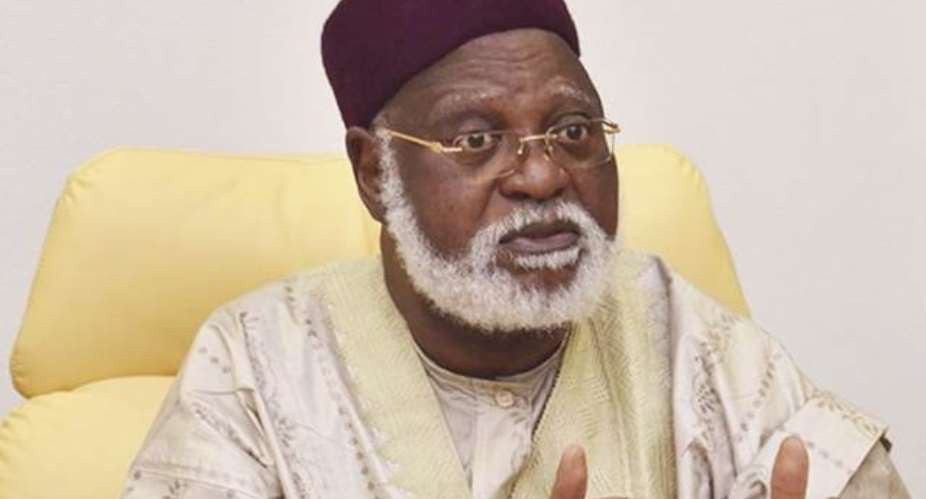
There is something deeply unsettling about seeing a former Nigerian Head of State become the face of an Indian hospital’s medical-tourism campaign while Nigeria’s doctors are once again threatening industrial action over the conditions under which they are expected to save lives.
The image of General Abdulsalami Abubakar recovering from knee-replacement surgery at Krishna Shalby Hospital in Ahmedabad, Gujarat, might ordinarily have been nothing more than a private medical matter. But the hospital’s decision to use footage and photographs of the former military ruler in promotional material for its international-patient services has transformed it into a potent symbol of Nigeria’s healthcare predicament. The promotional material also featured Vice President Kashim Shettima, who visited Abubakar during his hospital stay.
The episode has understandably provoked anger. Activist Omoyele Sowore seized on the images to question why Nigerian leaders who have occupied positions of enormous influence have not done enough to build a healthcare system capable of treating them and other Nigerians at home. Lawyer and political commentator Aloy Ejimakor went further, describing the use of Abubakar’s image as a “diplomatic insult” and a national embarrassment. But beyond the understandable emotion lies a much more serious question: what does it say about a country when its former leaders can leave for India for specialized treatment, while the doctors who remain at home are preparing to withdraw their services because agreements on their welfare and working conditions have not been fully implemented?
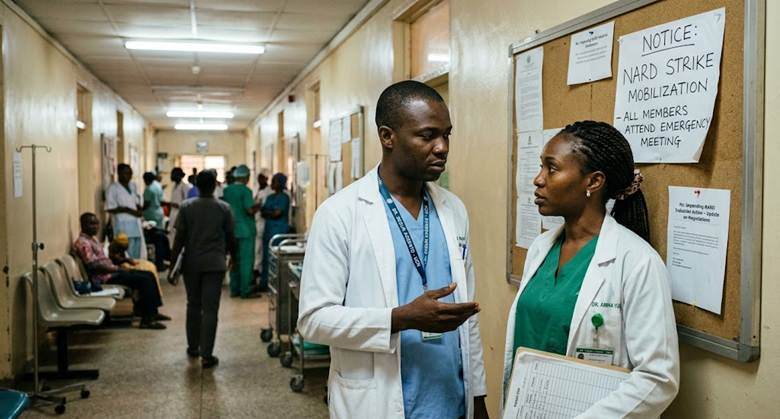
That question is particularly urgent because the Nigerian Association of Resident Doctors, NARD, has already issued the Federal Government a 14-day ultimatum. Following its 46th Annual General Meeting in Calabar, the association said that unless outstanding agreements on remuneration, career progression, professional allowances and working conditions were implemented, further industrial action could follow. The ultimatum took effect on October 1, 2026.
This should not be treated as another routine labour dispute.
Every time resident doctors go on strike, the consequences are measured not merely in working hours lost but in delayed diagnoses, postponed surgeries, abandoned clinics, overwhelmed emergency units and, potentially, lives lost. And when doctors finally return to work, they return to the same hospitals, the same equipment shortages, the same overcrowded wards and, in many cases, the same unresolved grievances. NARD says the current crisis is aggravated by the continuing migration of doctors and other health professionals. In 2025, the association reported that the number of resident doctors had fallen from about 15,000 in 2014 to roughly 8,000. By June 2026, another NARD report put the number of resident doctors who had left Nigeria over 15 years at about 13,000. Separate figures cited by the Nigerian Medical Association and other stakeholders have painted an equally disturbing picture of the wider medical workforce.
The phenomenon popularly called “Japa” is no longer simply a matter of young Nigerians seeking better salaries abroad. It is becoming a threat to the viability of the national health system.
A country invests years educating a doctor. The taxpayer, parents and institutions bear the cost of primary education, secondary education, university, medical school, internship and residency training. Then another country offers better working conditions, better equipment, safer hospitals, more predictable salaries and clearer career progression—and Nigeria watches the doctor leave. The tragedy is compounded when the same country that loses its doctors then spends foreign exchange importing medical services from the countries to which its professionals have migrated.
Nigeria’s medical-tourism bill tells the story. In April 2025, Coordinating Minister of Health and Social Welfare Muhammad Ali Pate said the country loses an estimated $2 billion every year to medical tourism. He described the figure as a reflection of gaps in confidence, access and quality in the domestic healthcare system. Two billion dollars is not an abstract number. It represents hospitals that could be modernised, diagnostic machines that could be purchased, specialists who could be retained, residency programmes that could be strengthened and research institutions that could be developed. It also represents an opportunity cost.
If Nigeria can spend billions of dollars sending patients abroad, it should be able to build an environment in which a significant proportion of those patients would rather remain at home. This is where the Abdulsalami Abubakar episode becomes more than a story about one former Head of State. It exposes a troubling contradiction in Nigeria’s political culture. Leaders frequently speak about patriotism, national development and the need to patronize Nigerian institutions. Yet when serious personal health needs arise, the confidence in those institutions can disappear.
There is, of course, nothing inherently wrong with a Nigerian receiving treatment abroad. Medical freedom is a legitimate personal consideration, and no responsible person should be condemned for seeking the best available treatment for a serious condition. Some highly specialized procedures may genuinely require facilities or expertise that are unavailable locally. The issue is different when medical tourism becomes systemic, when political and economic elites routinely look abroad because they do not trust the institutions their own policies have produced, and when successive governments fail to regard that loss of confidence as an emergency. It is particularly difficult for ordinary Nigerians to accept when the people responsible for governing the country appear to have one healthcare system for themselves and another for everyone else. The public therefore has every reason to demand better.
To be fair, the present administration cannot be accused of doing absolutely nothing. There have been genuine attempts to address structural weaknesses in the health sector. The government has pursued the Nigeria Health Sector Renewal Investment Initiative and a Sector-Wide Approach intended to coordinate health financing and reform. The Basic Health Care Provision Fund is being used to support primary healthcare, while the government says thousands of facilities have received direct funding and hundreds have been revitalized.
There have also been efforts to expand the health workforce. The Federal Government reported that more than 37,000 health workers had been employed between 2023 and 2025, with more than 75 per cent in clinical cadres. It also said it had expanded training, strengthened the Health Workforce Registry and developed a health workforce migration policy. The National Health Fellows Programme, meanwhile, has deployed fellows across Nigeria’s 774 local government areas to help strengthen accountability and grassroots health delivery. Government reports also point to improvements in some maternal and child-health indicators and increased utilisation of primary healthcare services.
The Federal Government has also attempted to respond to doctors’ welfare complaints. The Ministry of Health reported payments toward outstanding arrears arising from the upward review of CONMESS and CONHESS, as well as special recruitment waivers for federal tertiary institutions to expand the health workforce. In January 2026, the government cited an annual increase of about N90 billion in health-worker allowances as evidence of its commitment to industrial harmony.
These efforts deserve recognition. But the persistence of the crisis shows that programmes and announcements are not enough. What Nigeria needs is continuity, implementation, accountability and a much stronger political commitment to healthcare.
The first priority must be to avert another NARD strike. The Federal Government should sit down with the doctors, identify every outstanding agreement, attach a responsible institution and deadline to each item, and publish a transparent implementation timetable. Industrial disputes in healthcare should not be allowed to deteriorate until strike action becomes the only language both sides understand.
Secondly, government must address the reasons doctors leave. Salary is important, but it is not the only issue. Doctors need functioning hospitals, adequate equipment, accommodation in difficult postings, security, opportunities for specialist training, predictable promotion, professional respect and protection from violence. A doctor working 24 or 36 hours because there are too few colleagues cannot be expected to remain indefinitely simply because government tells him that he is serving his country.
Thirdly, Nigeria needs a deliberate medical-retention strategy. If richer countries are prepared to pay Nigerian-trained doctors salaries that Nigeria cannot match, the government must compete intelligently rather than pretending the problem does not exist. This could include rural and specialist allowances, performance-based incentives, housing support, funded postgraduate training, research grants, better pension arrangements and credible career pathways.
Fourthly, the country must invest in specialist centres of excellence. Nigeria does not need to reproduce every hospital in London, Dubai or Ahmedabad. It should identify areas in which Nigerians routinely travel abroad—orthopaedics, oncology, cardiology, neurosurgery, renal medicine, fertility treatment, transplant medicine and advanced diagnostics—and develop credible centres around them. The objective should be to create hospitals that Nigerians trust, not merely hospitals that politicians can commission.
The private sector must also be brought into this effort. The government has already acknowledged the importance of public-private partnerships, and there are examples of private Nigerian hospitals investing in advanced diagnostics and specialist services. The state should provide the regulatory stability, infrastructure and incentives that allow such investments to expand, while ensuring that healthcare does not become accessible only to the very rich.
Above all, Nigeria must stop viewing health expenditure simply as consumption. It is an investment in national productivity. A healthy population is more economically productive. A well-equipped hospital employs people, develops expertise, attracts patients and retains foreign exchange. A strong medical research system creates innovation. A respected residency programme produces specialists who can train the next generation. And a healthcare system that citizens trust becomes part of the country’s national confidence.
This is why political leadership matters. If Nigerian leaders continue to fly abroad whenever they need complex medical attention, they may unintentionally send a powerful message to citizens: do not trust your own country. That message can be devastating.
A nation cannot build confidence in its institutions when those at the top routinely bypass them. Political leaders should therefore be among the strongest patrons of Nigerian healthcare—not because they should be forced to receive inadequate treatment at home, but because their confidence, investment and example can help create institutions worthy of that confidence.
The Abdulsalami episode should consequently not become another fleeting social-media controversy. The photographs will disappear from timelines. The outrage will subside. Another political story will replace it. But the underlying problem will remain unless Nigeria chooses to confront it. The former Head of State’s treatment in India is not the real scandal. The real scandal would be if, after all the outrage, nothing changes.
Nigerian doctors are warning that they are exhausted. They are telling the government that many of their colleagues have left. They are warning that those who remain are carrying unsustainable workloads. They are demanding that promises already made be honoured. And they are threatening industrial action because repeated assurances have not produced sufficient confidence. At almost the same time, Nigerians have watched a former commander-in-chief appear in promotional material for a foreign hospital after receiving treatment abroad.
The symbolism could hardly be more powerful. Nigeria can do better. Its leaders can do better. Its policymakers can do better. Its health administrators can do better. And, crucially, the country can treat its doctors not as an endless resource to be stretched until they break, but as the foundation of the healthcare system. The solution is not to shame every Nigerian who seeks treatment abroad. It is to make leaving unnecessary wherever it is medically possible.
Government must therefore grapple with the health crisis with greater urgency and compassion. It must listen to doctors before they strike, retain professionals before they emigrate, repair hospitals before they collapse, fund primary healthcare before preventable illnesses become emergencies, and invest in specialist care before Nigerians spend their scarce foreign exchange seeking it elsewhere.
The ultimate test of Nigeria’s health reforms should not be how many initiatives have been announced or how many meetings have been held. It should be much simpler: can an ordinary Nigerian walk into a Nigerian hospital and receive safe, timely and dignified treatment? Can a Nigerian doctor build a rewarding career without having to leave the country? And can a former Nigerian leader confidently choose a Nigerian hospital when he needs specialized care?
Until the answer to those questions is yes, the country’s health-sector renewal remains unfinished business. The image of General Abdulsalami Abubakar recovering in an Indian hospital may have embarrassed Nigeria. But embarrassment can sometimes be useful if it produces introspection. The country should seize this moment—not to condemn an individual patient, but to confront the system that made foreign treatment appear preferable in the first place. Nigerian leaders certainly can, and must, do much better.


 I accept Israel Kwadwo Safo as leader of Kristo Asafo and Kantanka family – Adwo...
 Govt to launch $18.8m REWARD project to boost rice production in November, cut $...
 Ghanaian doctor makes history as first African inducted into world's highest avi...
 Ibrahim Mahama urges stronger support for Ghanaian entrepreneurs as Dzata Cement...
 PAC orders CWSA to engage IGP over GH¢300,000 police water debt
 CPP launches nationwide membership drive, targets Ghanaian youth and professiona...
 Study reveals how climate disasters fuel child marriage, teenage pregnancy
 GJA gives Armed Forces 14 days to probe alleged assaults on journalists at La Pl...
 'Law should not hasten the death of an enterprise which proper intervention may ...
 Government spends GH¢917m on No-Fees-Stress support for 321,807 students


