




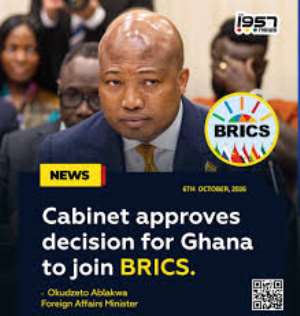
Ghana’s decision to prepare an application for membership of the BRICS grouping represents an important development in the country’s foreign economic policy. The move reflects Ghana’s desire to diversify its international partnerships, expand economic opportunities and strengthen cooperation with emerging economies. However, BRICS membership should not be viewed simply as another diplomatic achievement. Its real significance will depend on whether Ghana can translate membership into investment, trade, industrialisation, technology transfer and improved access to development finance.
BRICS has evolved from its original grouping of Brazil, Russia, India, China and South Africa into a considerably larger economic and development platform involving several emerging economies. It is not a conventional trade bloc or a supranational organisation. It does not automatically provide members with financial assistance or preferential trade arrangements. Consequently, Ghana’s expected benefits must be understood as opportunities that require deliberate economic policy rather than automatic rewards.
Membership could provide Ghana with greater access to investors from some of the world’s major emerging economies. Ghana needs significant investment in infrastructure, manufacturing, energy, agriculture, technology and mineral processing. A stronger relationship with BRICS economies could expand the pool of potential investors and create competition among international partners.
Closely related to investment is industrialisation. Ghana possesses considerable natural resources, including gold, bauxite, manganese, lithium and agricultural commodities such as cocoa, oil palm, cashew, shea nuts etc. Yet the country continues to face the structural challenge of exporting many commodities in relatively unprocessed form while importing higher-value manufactured products. BRICS cooperation could provide opportunities for technology, capital and markets that support domestic processing and manufacturing. But capital markets were, and are still available to Ghana before this plan to join the BRICS.
For example, Ghana should be looking beyond the export of cocoa beans towards cocoa processing and chocolate production; beyond bauxite extraction towards alumina and aluminium production; and beyond the extraction of minerals towards refining and downstream industrial activities. If BRICS engagement contributes to these transformations, membership could have substantial economic value. Developing the industrial and manufacturing sectors of the economy should be a principal reason for joining the BRICS as it has not worked without such partnerships.
Ghana has traditionally maintained strong economic relationships with Europe, North America and other African markets. Expanding trade with large emerging economies could provide additional markets for Ghanaian goods and services. It could also reduce excessive dependence on a relatively narrow group of external markets.
BRICS may also create opportunities in development finance. The New Development Bank, associated with the BRICS framework, has financed infrastructure and development projects in emerging economies. However, Ghana should avoid the assumption that joining BRICS automatically guarantees access to cheap financing. Financing would depend on institutional arrangements, project quality, eligibility and the commercial and developmental considerations of the relevant institutions.
BRICS countries have increasingly discussed the use of national currencies and alternative mechanisms for cross-border transactions. Having access to an alternative international payment platform will ease a lot of burden on businesses and firms. For Ghana, greater diversification of payment arrangements could eventually provide additional options for international trade. However, this should not be confused with an immediate replacement of the US dollar or the international financial system.
BRICS provides developing countries with an additional platform for discussing reform of global governance institutions. Ghana has historically advocated greater representation for developing countries in international institutions. Participation in BRICS could therefore strengthen Ghana’s engagement in debates concerning the IMF, World Bank, United Nations and global financial architecture.
Nevertheless, the potential benefits come with significant risks that should never be underestimated. The first is geopolitical complexity. BRICS brings together countries with very different political systems, economic interests and foreign-policy priorities. Ghana has deep relationships with the United States, European Union, United Kingdom, IMF and World Bank, while some BRICS members have significant geopolitical disagreements with Western powers. Ghana would therefore need to practise careful diplomatic balancing.
This is particularly important in relation to financial sanctions and international compliance. Ghanaian banks and businesses operate within a global financial system in which sanctions, correspondent banking relationships and international regulatory standards matter. Ghana must ensure that increased economic cooperation with BRICS members does not inadvertently expose its financial institutions or businesses to unnecessary compliance and sanctions risks.
There is also the risk of worsening trade imbalances. Greater engagement with large manufacturing economies could result in increased imports into Ghana without a corresponding increase in Ghanaian exports. If Ghana simply becomes a larger market for manufactured goods from BRICS countries, membership could deepen rather than resolve existing structural weaknesses. Ghana needs to develop a competitive export sector and not rely on relatively cheap manufactured import goods.
This makes Ghana’s export strategy crucial. The central question should not be how much Ghana can import from BRICS economies, but what Ghana can competitively export to them. Membership must therefore be linked to an aggressive strategy for value addition, industrialisation and export development.
There is also a danger that Ghana could become primarily a supplier of raw materials to BRICS economies. Foreign investment in mining and agriculture is welcome, but investment that extracts resources without generating substantial domestic processing, employment, technology transfer and local supply-chain development would have limited transformational impact. That must be monitored closely.
Ghana should therefore approach BRICS membership not as an end in itself but as part of a broader economic transformation strategy. A practical roadmap could rest on seven pillars.
First, establish a Ghana–BRICS Economic Strategy Unit. The Ministry of Finance, Ministry of Trade and Industry, Ministry of Foreign Affairs, Bank of Ghana and Ghana Investment Promotion Centre should jointly identify specific commercial opportunities in each BRICS economy. The objective should be to move from broad diplomatic engagement to a pipeline of bankable projects, investors and export opportunities.
Second, negotiate around value addition rather than raw-material extraction. Every major BRICS investment agreement in mining, agriculture or energy should be assessed against clear domestic-development criteria: local processing, Ghanaian participation, technology transfer, skilled employment, local procurement and export potential. Ghana should seek partnerships that build domestic productive capacity rather than simply increase extraction.
Next, create a BRICS Export Acceleration Programme. Ghanaian firms need assistance to meet the standards, certification, logistics and distribution requirements of large emerging markets. The programme should identify specific products with export potential, including processed cocoa, cashew products, pharmaceuticals, processed foods, aluminium products, gold jewellery, textiles and selected services and match them with specific BRICS markets.
Then, make infrastructure and energy central to the strategy. Ghana cannot industrialise competitively with unreliable and expensive power, inefficient logistics and high transport costs. Any engagement with BRICS development-finance institutions should therefore prioritise productive infrastructure: innovative power generation and transmission, quality ports, modern railways, industrial parks, irrigation, digital infrastructure and logistics corridors.
Use BRICS to support technology transfer. Ghana should seek partnerships in areas such as renewable energy, electric mobility, agricultural technology, pharmaceuticals, digital payments, artificial intelligence, manufacturing equipment and mineral processing. Investment agreements should contain mechanisms for training Ghanaian workers, developing local suppliers and transferring technical capabilities.
Protect macroeconomic and financial stability. Ghana should explore alternative payment mechanisms cautiously rather than pursuing de-dollarisation as an ideological objective. The Bank of Ghana should assess the implications of local-currency settlement, bilateral payment arrangements and BRICS-related financial mechanisms for foreign-exchange liquidity, monetary policy, correspondent banking and financial-sector risk.
Preserve strategic diversification. Ghana should not allow BRICS engagement to undermine its existing relationships with the IMF, World Bank, United States, European Union, United Kingdom, African Development Bank, ECOWAS and AfCFTA. The objective should be to increase Ghana’s options, not replace one external dependency with another.
The implementation of this strategy should also be measurable. Ghana could publish an annual Ghana–BRICS Economic Scorecard covering new investment, exports, local-content participation, jobs created, technology-transfer agreements, infrastructure financing, manufacturing capacity and the balance of trade with BRICS economies. This would make it possible to distinguish genuine economic gains from diplomatic rhetoric.
Ultimately, Ghana should approach BRICS through a strategy of economic multi-alignment. BRICS should complement, rather than necessarily replace, Ghana’s relationships with its traditional development and trading partners. The strategic objective should be straightforward: use every major international partnership to advance Ghana’s economic transformation.
If Ghana can use BRICS engagement to attract productive investment, expand exports, acquire technology, develop infrastructure, process its natural resources and enter international value chains, membership could contribute meaningfully to the development of the country. If, however, it becomes primarily a diplomatic label while Ghana continues exporting raw materials and importing finished goods, the economic benefits will be much more limited.
The real question, therefore, is not whether BRICS membership is inherently beneficial or harmful. The question is how Ghana uses the opportunity. Ghana should enter the BRICS discussion with clearly defined national economic interests: increased exports, value addition, industrialisation, technology transfer, employment, infrastructure development and financial diversification. The success of the policy should ultimately be measured not by the prestige of membership, but by what it delivers for Ghana’s productive capacity and economic transformation.
BRICS can open doors. But Ghana must have the economic strategy, institutions and productive capacity to walk through them.
Emmanuel Kwabena Wucharey
Economics Tutor, Policy Advocate and Religion Enthusiast


 From the Acropolis, Rubio calls on Europe to emerge from ‘slumber’
 Mahama proposes financing scheme to help Ghanaians complete unfinished houses
 'Free SHS not in crisis; it was suffering under you and we reviewed it' – Haruna...
 Mahama orders sanctions for officials who fail to enforce building safety rules
 2026 World Cup: Minority alleges how GTA charged $7,000–$14,000 for visa process...
 Mahama announces GHS1bn for revolving National Housing Fund
 PAC orders CWSA to recover GH¢2.5m public debt within 30 days
 Former NPP chairman Samuel Odoi-Sykes dies
 Stop taping, gluing damaged cedi notes for re-issuance – BoG tells Ghanaians
 NPP keeps pressing the self-destruction button by doing things anyhow – Akwatia ...


