




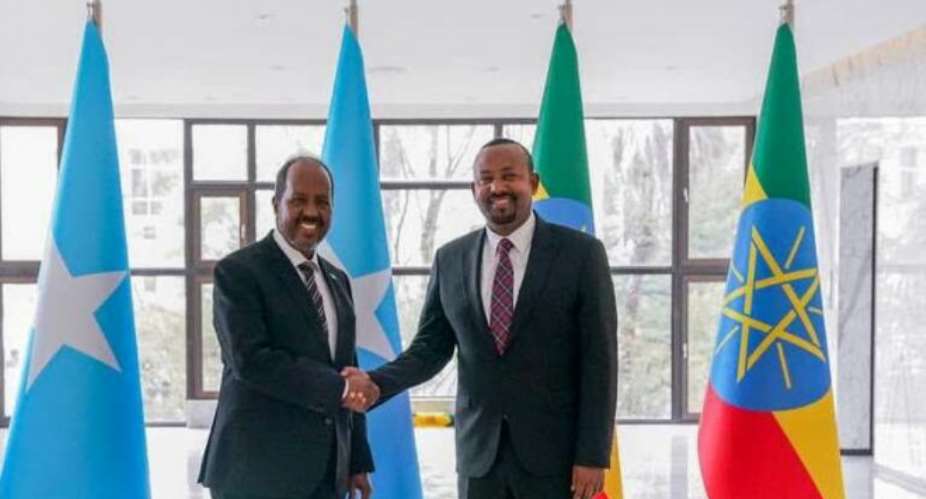
The political developments unfolding across the Horn of Africa raise serious questions about the role of Somali President Hassan Sheikh Mohamud in the growing tensions between Ethiopia, Eritrea, Sudan, and Egypt.
President Hassan Sheikh has repeatedly moved between the capitals of these countries, meeting their leaders at critical moments. He meets Ethiopian Prime Minister Abiy Ahmed in Addis Ababa, then travels to Egypt to meet President Abdel Fattah el-Sisi, Eritrean President Isaias Afwerki, and Sudanese leader Abdel Fattah al-Burhan. This pattern raises an important question: Is Hassan Sheikh simply pursuing Somalia's diplomatic interests, or is he playing a deeper role in the regional intelligence and political competition?
One possible interpretation is that Hassan Sheikh has become a valuable source of political information for Abiy Ahmed. From this perspective, his meetings with Egypt, Eritrea, and Sudan could provide Addis Ababa with insight into the positions, concerns, strategies, and intentions of governments that are increasingly at odds with Ethiopia.
This does not necessarily mean that Hassan Sheikh is formally an intelligence officer. Rather, the question is whether his diplomatic movements and access to regional leaders allow him to function, intentionally or unintentionally, as an important channel through which information reaches Addis Ababa.
The timing makes the question even more significant. Ethiopia's relationship with Eritrea has deteriorated sharply, while Ethiopia's dispute with Egypt over the Nile and the Grand Ethiopian Renaissance Dam remains unresolved. At the same time, Egypt, Eritrea, Sudan, and Somalia have been strengthening their political coordination on issues involving the Red Sea, regional security, sovereignty, and Ethiopia's growing interest in obtaining reliable access to the sea.
Somalia is not a distant observer in this confrontation. Ethiopia and Somalia share a border, and Ethiopia's search for access to the Red Sea directly affects Somalia's national security calculations. Therefore, every meeting Hassan Sheikh holds with Abiy Ahmed, Sisi, Afwerki, or al-Burhan deserves close public scrutiny.
The central question is not simply which side Hassan Sheikh supports. The more important question is: what information is being exchanged behind these diplomatic doors, and whose strategic interests ultimately benefit from it?
For a Somali president, maintaining diplomatic relations with all neighboring countries is understandable. But diplomacy becomes politically sensitive when a leader appears to move between opposing regional camps while simultaneously having access to confidential discussions involving each side.
Could Hassan Sheikh be acting as a mediator? Could he be protecting Somalia's interests? Or could he be providing Abiy Ahmed with political intelligence about Ethiopia's regional opponents?
These questions deserve answers from the Somali government.
Until concrete evidence emerges, claims that Hassan Sheikh is formally working as an intelligence operative for Abiy Ahmed remain allegations rather than established facts. But the frequency and timing of his regional engagements make the issue worthy of serious journalistic investigation.
The Horn of Africa is entering another period of strategic uncertainty. Ethiopia, Eritrea, Egypt, and Sudan are competing over security, water, territory, ports, and influence. Somalia sits at the center of many of these disputes because of its geography and its long coastline.
In such an environment, the Somali public has the right to ask a simple question:
When President Hassan Sheikh travels from one regional capital to another, whose interests is he carrying with him—and whose interests are being served when he returns?
Ali Hassan, an investigative and a freelance journalist writes from Bielefeld, Germany.

 East Legon: 'Why do you allow containers everywhere in such an expensive area?' ...
 I gave each NPP delegate GH¢400 for transport - Nana Akomea
 Investors favour 364-day treasury bill as bids hit GH¢474m
 Police probe three children found dead in abandoned vehicle boot at Tamale zoo
 Mahama will win fight against waste in one year — Mahama Ayariga
 'Ghana’s rape law does not recognise men as rape victims' — Young Lawyers Associ...
 Boakye Agyarko urges NPP members to close ranks after national delegates confere...
 Four injured in alleged military brutalities in Bunkpurugu
 Ayariga questions change from ‘24 hour markets’ to ‘district model markets’
 Ayariga challenges BoG to cite law behind arrests over cedi money bouquets


