




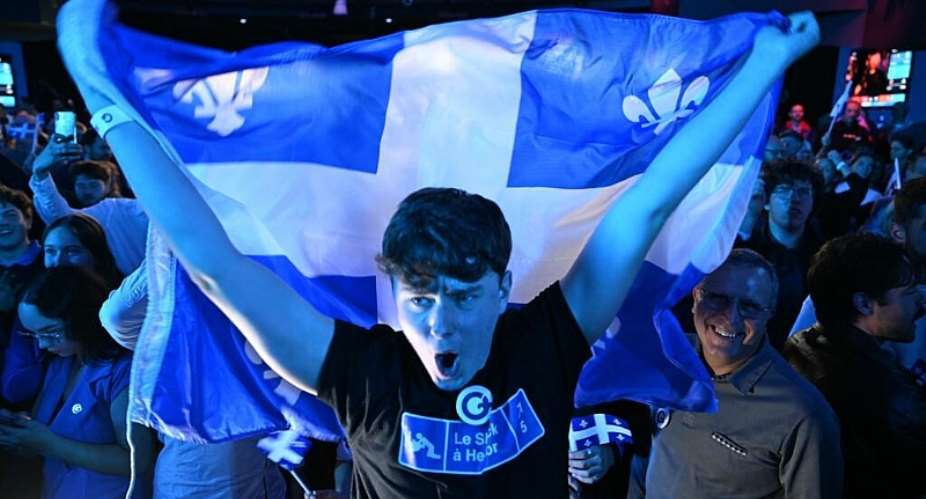
Separatists won provincial elections in Quebec on Monday, with a promise to hold a vote on leaving Canada after US President Donald Trump leaves office, testing Prime Minister Mark Carney's message of national unity.
But the Parti Quebecois fell short of a majority government in Canada's French-speaking province, offering some solace for the federalist camp.
The PQ win still upends Canada's political landscape as the country confronts a trade war and annexation threats leveled by the United States.
It also comes just two weeks before Canada's oil-producing province of Alberta, an economic powerhouse, holds a vote on whether it wants to begin the process of leaving Canada.
Read more Carney says Alberta 'essential' to Canada as separatist push advances
The results make PQ leader Paul St-Pierre Plamondon, a 49-year-old lawyer known by his initials PSPP, Quebec's next premier.
At a jubilant victory party in Montreal, he invoked "the courageous struggle" francophones have endured in a part of the world increasingly dominated by English speakers. Paul St-Pierre Plamondon, leader of the separatist Parti Quebecois (PQ), will be the next premier of Canada's French-speaking province
That struggle "will find meaning when (francophones) obtain their own country," he said.
"We deserve it," he added, calling a referendum a chance "to decide what our national future will be."
Independence after Trump?
Carney congratulated PSPP, saying that "building a stronger Quebec is core to our mission of building a stronger Canada."
The prime minister is popular in Quebec, and the separatist win was not seen as a repudiation of his stance toward Trump, whose confrontational policies have infuriated Canadians.
Instead, the PQ's rise after more than a decade in opposition has been tied to frustration over affordability and an enduring desire to protect the French language in a majority anglophone country.
Surveys suggest that only about 30 percent of Quebecers want independence, but PSPP has maintained he will call a referendum on leaving Canada, just not while Trump is in office.
He has said a decision on Quebec's independence "requires conditions that allow for an informed and calm debate."
That shouldn't be "hijacked by the theatrics of an unpredictable president," he added, ruling out a referendum until at least 2029.
Read more Trump threatens EU with tariffs over 'laughable' Canada association plan
Quebec has held two previous votes on leaving Canada. Federalists won comfortably in 1980, but the 1995 result was excruciatingly close, with just 50.58 percent voting to stay in Canada.
First-time voter Alexia Gomez, 19, invoked tensions with the United States when she told AFP she opposed an independence referendum.
"If Quebec becomes independent it would make us politically, economically and militarily vulnerable," she said.
Lydie Periard, a 22-year-old student, said she was "very worried" by the PQ's victory, condemning what she termed the party's "populist" stance on immigration. The PQ has backed immigration cuts, particularly for non-French speakers.
The PQ replaces a party, known as the Coalition for Quebec's Future (CAQ), that advocated strongly for the province's distinctive culture within Canada, without supporting separatism.
Lacking a majority, the PQ will struggle to advance its separatist agenda.
The two largest opposition parties after Monday's vote, the Liberals and Conservatives, both declared they would never back a referendum on independence.
'Abolish the monarchy?'
PSPP may not have majority backing for an independent Quebec, but his plans to target the British monarchy appear far more popular.
Canada is part of the British Commonwealth. King Charles III, Canada's head of state, is represented in Ottawa by the governor general. Lieutenant governors represent the monarchy in the provinces, including Quebec.
In a 2025 Leger poll, 87 percent of Quebecers said they felt no attachment to the British monarchy, and only 31 percent expressed a favorable view of King Charles.
PSPP has said his government could cut off funds for the lieutenant governor, calling it a "masquerade that wastes money."
(FRANCE 24 with AFP)

 East Legon: 'Why do you allow containers everywhere in such an expensive area?' ...
 I gave each NPP delegate GH¢400 for transport - Nana Akomea
 Investors favour 364-day treasury bill as bids hit GH¢474m
 Police probe three children found dead in abandoned vehicle boot at Tamale zoo
 Mahama will win fight against waste in one year — Mahama Ayariga
 'Ghana’s rape law does not recognise men as rape victims' — Young Lawyers Associ...
 Boakye Agyarko urges NPP members to close ranks after national delegates confere...
 Four injured in alleged military brutalities in Bunkpurugu
 Ayariga questions change from ‘24 hour markets’ to ‘district model markets’
 Ayariga challenges BoG to cite law behind arrests over cedi money bouquets


