




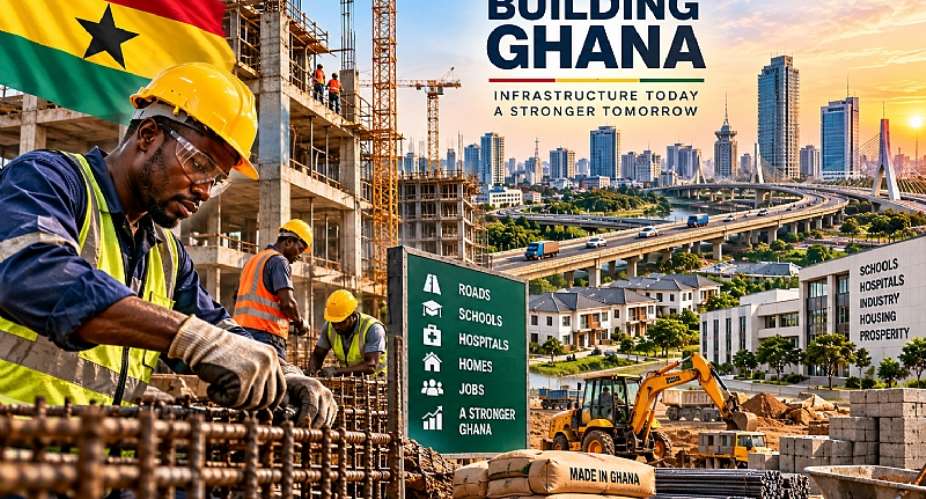
Ghana's construction industry is one of the most important drivers of national development. From roads, schools and hospitals to factories, offices and housing, construction supports economic activity while creating opportunities for engineers, architects, contractors, artisans and thousands of workers.
Its impact extends far beyond construction sites. The sector creates demand for cement, steel, paint, aluminium, timber, electrical products, plastics, furniture, machinery and transportation services. As Ghana's population grows and urbanisation accelerates, demand for housing and infrastructure will continue to increase.
Yet the industry faces serious challenges that threaten its ability to support Ghana's economic transformation.
One of the biggest problems is the high cost of construction. Many specialised materials, machinery, fittings and equipment are imported, making projects vulnerable to exchange-rate movements. High interest rates further increase costs because contractors frequently depend on bank financing to purchase materials, mobilise equipment and pay workers.
Delayed government payments create another major difficulty. When contractors complete certified work but wait months for payment, interest accumulates, suppliers remain unpaid and projects can eventually stall. Government should therefore ensure that credible financing exists before awarding major public contracts. An abandoned project represents public money trapped in an asset producing little or no benefit.
Regulation also needs improvement. Ghana has professional bodies, local authorities and several institutions responsible for aspects of the built environment, but stronger coordination and consistent enforcement are required. A comprehensive construction industry regulatory framework could strengthen contractor licensing, classification, safety, professional development and quality standards.
Ghana should also invest in its large informal construction workforce. Experienced masons, carpenters, plumbers, electricians, welders and other artisans should have opportunities to obtain formal competency certification and continuous technical training.
Technology is rapidly changing construction. Building information modelling, drones, digital surveying, artificial intelligence and project-management software can improve efficiency and reduce waste. Public infrastructure projects could also be monitored through digital platforms showing contractors, contract values, completion dates, payments, project progress and approved variations.
Another opportunity lies in local building materials. Ghana should strengthen research into safe and commercially viable products using locally available resources, including clay, laterite, bamboo, recycled materials and agricultural residues. Increasing domestic production of paint, roofing materials, pipes, cables, tiles, doors and other construction products would create jobs while reducing dependence on imports.
Land administration remains another obstacle. Competing claims, multiple sales and lengthy disputes increase the risks and costs of property development. Greater digitisation of land records and faster title registration could improve investor confidence.
Environmental sustainability must also become central to construction. Energy-efficient buildings, solar power, rainwater harvesting, natural ventilation and climate-resilient drainage can reduce long-term costs and environmental damage.
Most importantly, Ghana should use its enormous infrastructure requirements to develop strong indigenous construction and engineering companies. Foreign contractors will continue to play an important role, particularly in complex projects, but major investments should deliberately transfer skills, technology and opportunities to Ghanaian companies and professionals.
Construction must therefore be seen as more than building roads and houses. It connects manufacturing, finance, technology, employment and industrialisation.
Every road, factory, hospital, school and housing project should build more than physical infrastructure. It should develop Ghanaian skills, businesses and productive capacity.
That is how construction can become not merely evidence of Ghana's development, but an engine that drives it.


 Investors favour 364-day treasury bill as bids hit GH¢474m
 Police probe three children found dead in abandoned vehicle boot at Tamale zoo
 Mahama will win fight against waste in one year — Mahama Ayariga
 'Ghana’s rape law does not recognise men as rape victims' — Young Lawyers Associ...
 Boakye Agyarko urges NPP members to close ranks after national delegates confere...
 Four injured in alleged military brutalities in Bunkpurugu
 Ayariga questions change from ‘24 hour markets’ to ‘district model markets’
 Ayariga challenges BoG to cite law behind arrests over cedi money bouquets
 Trump targets tax-free diesel as Republicans approach midterms
 Manhyia South MP charged over alleged GH¢9.85m loss to SIC Life


