




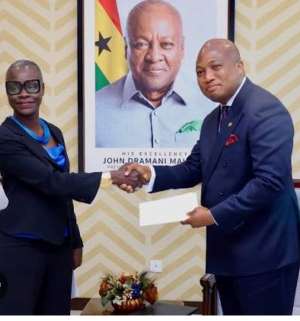
When a French ambassador in Accra speaks of reparatory justice, the statement carries more weight than diplomatic courtesy. French Ambassador Diarra Dimé-Labille has again reaffirmed that France is open to good-faith dialogue on the justice agenda Ghana has championed internationally. The question for Ghana and the wider African reparations movement is whether this openness will become action.
The background matters. France abstained from the UN General Assembly resolution led by Ghana on the transatlantic slave trade, even though more than 120 countries voted in favour. Paris did not reject the resolution's intent. The ambassador explained that France and other EU member states sought a more consensual wording aligned with established classifications under international law. She also stressed that France recognises slavery as a crime against humanity within its own legal framework.
That explanation reflects the ambassador's profile. She is a lawyer who began her career as a trainee at the International Criminal Tribunal for Rwanda and later served as legal adviser at the French Embassy in The Hague. Her instinct is to treat reparations as a question of legal architecture, and she has been candid that establishing a clear legal basis for reparations at the global level remains complex.
Her broader framing is where the real debate lies. She has argued that reparatory justice goes beyond financial compensation and also involves reforms to global financial systems, debt considerations, education and further historical research.
Ghana's own envoy, Ekwow Spio-Garbrah, has made a similar point, noting that reparations include the return of looted cultural artefacts and formal apologies from former colonial powers. On those two points, restitution and acknowledgment, Paris and Accra may have the most common ground.
France has also signalled that it is prepared to contribute to future discussions, including a proposed coalition of states exploring practical pathways to reparatory justice, and that it supports the return of African cultural artefacts. Those are useful commitments, but they remain commitments.
My assessment is this. Diplomatic language about "dialogue" costs nothing. What Africa should ask of France is specificity: a timeline for artefact restitution, a clear position on debt and financial-system reform, and a willingness to back future UN texts with a vote, not an abstention. The ambassador has said France has made concrete commitments that will guide its actions. Ghana, the African Union, and the diaspora should hold France to that.
Reparatory justice is not a favour to be granted. It is an obligation to be discharged, and Paris now has to show that its reaffirmation is more than a restatement.
Mustapha Bature Sallama
Medical/ Science Communicator,
Private Investigator, Criminal Investigation and Intelligence Analysis,
International Conflict Management and Peacebuilding. (USIP)
[email protected]
+233555275880
References
MyJoyOnline, "France reaffirms commitment to dialogue on reparatory justice following UN resolution." Supports France's abstention, the EU position on wording, and France's readiness to join a coalition of states and support artefact returns. https://www.myjoyonline.com/france-reaffirms-commitment-to-dialogue-on-reparatory-justice-following-un-resolution/
GhanaWeb, "France reaffirms commitment to dialogue on reparatory justice following UN resolution." Supports the 120+ votes in favour, France recognising slavery as a crime against humanity in its legal framework, and the complexity of a global legal basis for reparations. https://www.ghanaweb.com/GhanaHomePage/NewsArchive/France-reaffirms-commitment-to-dialogue-on-reparatory-justice-following-UN-resolution-2030741
ModernGhana, "France Reaffirms Commitment to Dialogue on Reparatory Justice: Ambassador Dimé-Labille Speaks Out." Supports the framing of reparatory justice beyond financial compensation. https://www.modernghana.com/news/1487095/france-reaffirms-commitment-to-dialogue-on-reparat.html
MyJoyOnline, "French Ambassador outlines new focus on trade, education and investment in Ghana." Supports the points on debt, financial-system reform, education and historical research, and that UNGA resolutions are not legally binding. https://www.myjoyonline.com/french-ambassador-outlines-new-focus-on-trade-education-and-investment-in-ghana/
Ghana News Agency, "Diarra Dimé-Labille: A West African diplomat bridging law, history and a new era of Ghana-France relations." Supports her background at the ICTR and as legal adviser in The Hague. https://gna.org.gh/2026/04/diarra-dime-labille-a-west-african-diplomat-bridging-law-history-and-a-new-era-of-ghana-france-relations/
GhanaWeb, "Presidential envoy on reparations calls on French ambassador ahead of June conference" (May 6, 2026). Supports Ekwow Spio-Garbrah's remarks on artefacts and apologies. https://www.ghanaweb.com/blogs/ernestsenanudovlo/Presidential-envoy-on-reparations-calls-on-French-ambassador-ahead-of-June-conference-18008
GBC Ghana Online, "France, Ghana business communities seek stronger economic ties." Supports the ambassador's "dialogue in good faith" and "concrete commitments" language. https://gbcghanaonline.com/news/business/ghana-france-business-ties/2026


 Investors favour 364-day treasury bill as bids hit GH¢474m
 Police probe three children found dead in abandoned vehicle boot at Tamale zoo
 Mahama will win fight against waste in one year — Mahama Ayariga
 'Ghana’s rape law does not recognise men as rape victims' — Young Lawyers Associ...
 Boakye Agyarko urges NPP members to close ranks after national delegates confere...
 Four injured in alleged military brutalities in Bunkpurugu
 Ayariga questions change from ‘24 hour markets’ to ‘district model markets’
 Ayariga challenges BoG to cite law behind arrests over cedi money bouquets
 Trump targets tax-free diesel as Republicans approach midterms
 Manhyia South MP charged over alleged GH¢9.85m loss to SIC Life


