




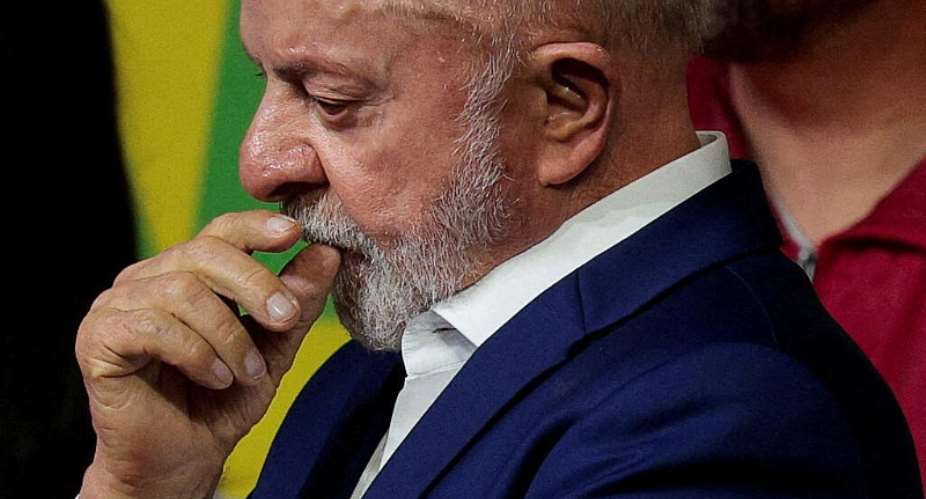
As right-wing governments backed by Washington rise to power across Latin America, Brazil now looks like it will be the next domino to fall.
Far-right Senator Flavio Bolsonaro led the first round of Brazil's presidential election on Sunday, with President Luiz Inacio Lula da Silva, a veteran left-wing leader and former trade unionist, trailing narrowly behind him. With neither candidate winning an outright majority, an October 25 run-off will determine who will lead the country of more than 214 million people over the next four years.
Bolsonaro's father Jair is serving a 27-year sentence for having plotted a coup d'état after losing the 2022 presidential election to Lula. His eldest son, whom the former president anointed as his ideological successor a few scant months ago, has promised a pardon if he emerges triumphant in the second round.
While less than two percentage points separated the leading candidates, the results were a shock to supporters of Lula's centre-left Workers' Party (PT); opinion polls had put Lula ahead of his rival in the days leading up to the vote. And with a handful of other right-wing candidates knocked out in the first round, the second round seems as though it's Bolsonaro's to lose.
Even if Lula does manage to mobilise enough of the more than one in five voters who abstained in the first round, the presidential palace of Planalto was not the only prize being contested in Sunday's elections.
Across the country, congressional and gubernatorial elections have also seen the country lurch sharply to the right, with Bolsonaro's far-right Liberal Party (PL) likely to emerge as the leading force in the lower-house Chamber of Deputies, as well as the Senate.
Despite his decades-long legacy of social-democratic policies that have lifted tens of millions of people out of poverty, Lula seems to have struggled to mobilise his base in the face of a far right that has succeeded in welding together a coalition of the country's business elite and rising lower-middle classes.
Read more Flavio Bolsonaro: In the name of the father, sons, and holy ideology
Thomas Zicman de Barros, a fellow at the centre for political research at Sciences Po university in Paris, said the younger Bolsonaro has maintained his father's appeal to voters frustrated by the status quo.
“Despite the fact that his father is now in prison, and the fact that Flavio Bolsonaro himself and the whole family are involved in many scandals in Brazil, they still succeed in embodying some kind of anti-establishment feeling,” he said.
“And Lula, despite the fact that he comes from a trade union background, and he was kind of a populist – and I don't use the word in a pejorative sense – nowadays he embodies the establishment, and the very defence of a liberal democratic system that we have, that … has its flaws, its blind spots.”
Read more Brazil's Lula gears up for 'last dance' with run for fourth presidential term
For some Brazilians, the man who previously served two terms as president from 2003 to 2011 remains deeply entrenched in the system, despite his leftist credentials.
Felipe Krause, a former Brazilian diplomat and the head of Oxford University's Brazilian Studies Programme, said the global cost-of-living crisis and mounting levels of household debt had eaten into the economic gains made under Lula's most recent term in office.
“Interestingly, if you actually look at the economy, there's kind of a mixed situation,” he said. “You do have relatively low unemployment and income is even rising to some extent, but prices are really high – and I think most of all, there's a lack of a sense of hope for prosperity in the future.”
Krause said that Lula, who first won office in 2002 on a platform of social welfare reforms that earned him a strong following among Brazil's poorest communities and organised working class, had failed to keep up with the social and economic changes sweeping the country.
“In my view, the Lula camp hasn't really appreciated how the country has changed relative to Lula's first two terms – and how the country in fact has changed due to the success of Lula's own policies,” he said.
“You now have this rising middle class, which is far more interested in entrepreneurialism, a pro-market individualistic approach – and far less interested in the social protections, the formal employment, the labour unions and all those things that the Lula camp is used to offering.”
Zicman said that, for many people in Brazil's lower-middle classes juggling more than one job in an expanding gig economy, Bolsonaro's campaign pledge to lower taxes and – borrowing a phrase from Argentina's far-right libertarian President Javier Milei – “take a chainsaw to bureaucracy”, may well have resonated.
“We've had transformations in labour relations all over the world, but notably in what we might call the Global South,” he said. “So nowadays, many precarious workers don't even dream of having more stable jobs … They might sell some services or products [on] the internet.”
Zicman said a new sense of distrust is also permeating Brazil's politics. “There is this 'self-made person' spirit, that is, on one hand, individualistic – some might call it neoliberal subjectivity. That might explain why some people are now thinking, 'I don't trust the government anymore, I don't think that the left, if it gets to power, [will] be capable of transforming my situation.'”
Whether or not the far right would be any more capable of doing so, he said, is a matter of sharply divided opinion.
“The far right is not necessarily lying to those people, because it is delivering what it promises: That is, 'I will do nothing, and then you, by your own merit, you will succeed,'” he said.
“The lie – and this is my personal opinion – is that most people won't succeed.”

 Govt releases GH¢9.1 billion covering six quarters of DACF to MMDAs - Ayariga
 Manhyia South MP charged over alleged GH¢9.85m loss to SIC Life
 'I didn’t know the process would be that fast' – Nana B explains missing NPP swe...
 'Who is Karbo to defy my orders?' – Buttey fumes over NPP conference clash
 'Kojo Bamba can’t stop NDC' – Gbande warns NPP against shielding anyone from arr...
 Fire destroys property building in Koforidua
 Mahama pardons 863 convicted persons, 11 from death sentence
 National Cathedral site reverts to government as Attorney-General reviews audit
 NDC confirms Dzifa Gunu’s disqualification from La Dadekotopon constituency secr...
 Nigeria's Tinubu confirms 32 dead after military plane crash


