




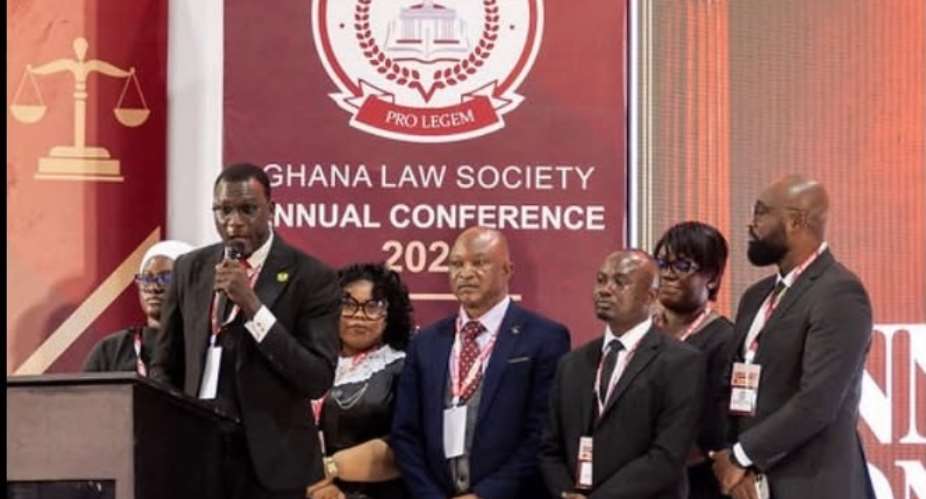
National President of the Ghana Law Society Students’ Association (GLSSA), Divine Adongo, has called for urgent investment in the two northern law schools to bring them up to the standard required for professional legal training and pave the way for their accreditation.
Speaking at the 2026 Ghana Law Society Bar Conference, Mr. Adongo specifically identified the University for Development Studies (UDS) School of Law and the University of Business and Integrated Development Studies (UBIDS) School of Law as institutions that require attention if the country’s recent legal education reforms are to deliver equitable access to legal education.
He argued that while the law requires law schools to have facilities including well-equipped libraries, adequate lecture halls and a sufficient complement of qualified lecturers, the relatively recent establishment of the two northern schools means they may not yet have the same level of infrastructure and resources as their southern counterparts.
“We must not apply the strict letter of the law alone. We must apply equity, for equity fills the gap that strict law leaves open,” Mr. Adongo said.
According to him, the principle of equity should guide decision-makers in assessing the readiness of the two institutions for accreditation rather than allowing existing resource gaps to permanently limit opportunities for students in northern Ghana.
He further called on the relevant authorities to consider accrediting at least one, and ideally both, of the northern law schools when accreditation decisions are made.
Mr. Adongo also proposed that, where necessary, emergency investments should be made in the short term to bring one or both institutions to an acceptable standard for accreditation.
“Even if it means making emergency investments in one or both schools of law in the short term to elevate them to an acceptable standard for accreditation, I believe it is worth it for the sake of equity,” he stated.
The GLSSA President said the continued need for students from the northern part of the country to travel south for professional legal training would undermine the spirit of the country’s legal education reforms.
“The spirit of legal reform will not have materialised if a law student in the north must still travel south merely to undergo professional training,” he said.
His call formed part of a broader appeal for greater inclusivity in Ghana’s legal education reforms. Mr. Adongo also called for formal representation of law students on the Council for Legal Education and Training and in the constitutional review process, arguing that reforms affecting students should be developed with their direct participation.
He said empowerment of law students must go beyond symbolic participation and include meaningful access to opportunities regardless of geographical location.
“Empowerment is not a favour to be granted to the law student. It is the very foundation on which a credible legal profession is built,” Mr. Adongo said in concluding his address.
The call comes against the backdrop of Ghana’s ongoing reforms in legal education, which Mr. Adongo said were intended to expand access to legal education and improve representation within the profession.

 Ethiopia's new rebel war redraws alliances across the Horn of Africa
 Netanyahu warns of 'very heavy price' if any country found to be behind FlyDubai...
 EU approves tougher migration rules in latest push to tighten borders
 EU ‘fully rejects’ US threat to ban diesel exports unless bloc releases more fue...
 AU urges Ethiopia, Eritrea and Egypt to exercise restraint amid rising diplomati...
 I consulted Akufo-Addo, Kufuor, NPP stalwarts before entering chairmanship race ...
 Strong partnerships key to advancing decentralisation – Mahama Ayariga
 AMA directs closure of shops, markets for October 3 National Cleanup Day
 ‘Fake’ – EOCO denies GH¢50m bail report on Baffour Awuah
 COMAC gives Finance Ministry 14-day ultimatum to suspend new fuel tax rule


