




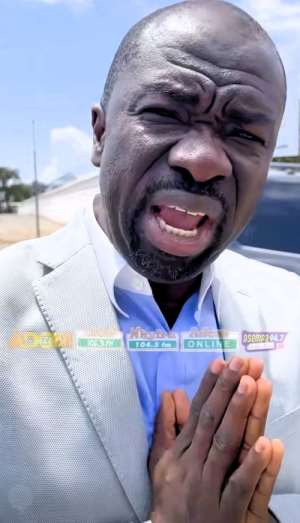
There is a long road between the first cedi invested by SIC Life Savings and Loans and the arrest warrant now hanging over Manhyia South MP Nana Agyei Baffour Awuah.
It did not begin with EOCO.
It began with money placed with Equity Savings and Loans.
In 2018, SIC Life Savings and Loans placed two investments with Equity Savings and Loans: GH¢2 million at 30 percent interest and another GH¢1.945 million at 29 percent.
The total principal was GH¢3.945 million.
When the investments matured, Equity did not pay.
SIC then turned to the courts.
In May 2020, SIC engaged the law firm Sarkodie Baffour Awuah & Partners to recover the money. The following month, June 2020, the firm commenced legal proceedings against Equity. Nana Agyei Baffour Awuah personally signed the writ.
The claim at that stage was GH¢6,495,834.10.
The matter subsequently went before the Commercial Court.
In July 2022, the court entered summary judgment in favour of SIC.
But winning the judgment was only one part of the problem.
SIC still had to get the money.
By December 2023, enforcement proceedings had reached the stage where a writ of fieri facias was issued against Equity’s assets. Lands at Oyibi and Ashongman were identified for enforcement.
Among the properties caught up in the process was a 31.93-acre parcel at Adamorobe, near KAS Valley Estate.
The court set a reserve price of GH¢25 million for the property.
That development appeared to give SIC a potentially substantial asset against which to enforce its judgment.
But the property would soon become the centre of a new dispute.
According to EOCO, Equity sold the same land to Eco Swiss Investment Limited for GH¢21.76 million even though the property was under attachment.
On July 17, 2024, Eco Swiss challenged the attachment.
The next day, July 18, terms of settlement were drawn up.
This is where the numbers become striking.
By then, the judgment debt had reportedly grown to GH¢14,850,776.14.
Yet the settlement provided for Eco Swiss to pay SIC GH¢5 million in full and final settlement.
The settlement also provided for Eco Swiss to pay the judgment creditor’s lawyer 15 percent of the outstanding judgment debt as legal fees — approximately GH¢2.23 million.
That arrangement is now one of the central issues in EOCO’s investigation.
EOCO’s concern is straightforward: why would SIC accept GH¢5 million when the judgment debt had risen to nearly GH¢14.85 million, particularly when the attached property had been assigned a GH¢25 million auction reserve price?
But that question needs context.
A judgment debt is not necessarily the same thing as cash that can immediately be recovered.
According to JoyNews reports, Baffour Awuah has said the recovery process had already been difficult and had taken years. According to his account, his firm struggled to identify assets belonging to Equity that could actually be attached and realised. He has also maintained that the eventual settlement was reached on his client’s instructions.
That brings us to the critical question: who authorised the settlement?
EOCO has raised questions about the authority of Amma Frimpomaa Dwumah, who signed the settlement on behalf of SIC.
EOCO says her formal appointment had ended in 2021. It also says there is no evidence that the SIC board or the Finance Ministry approved the arrangement.
Those claims will have to be tested against SIC’s corporate records, board resolutions, correspondence and the actual authority held by the signatory at the relevant time.
Then there is the money trail.
EOCO says Equity paid GH¢611,720.47 to the law firm.
It further alleges that, in November 2024, GH¢1 million was transferred from the law firm’s account to the personal account of Ms Dwumah, several months after the July 2024 settlement and, according to EOCO, after she had left SIC.
Those are serious allegations.
But a bank transfer is evidence of a transaction, not by itself evidence of a crime. The purpose, authorisation, documentation and accounting treatment of the payment are what investigators must establish.
And there is another issue that deserves close attention: the paperwork.
The terms of settlement are dated July 18, 2024.
Yet the document reportedly refers to a revised entry of judgment filed on July 24 and a notice to dispute the claim filed on August 2.
That chronology does not sit comfortably with a document dated July 18.
There may be an explanation. Perhaps the document was redrafted later while retaining an earlier date. Perhaps there was a clerical error. Perhaps the references were inserted during a later filing.
But if the settlement was actually executed or materially amended after August 2, another question follows: what authority did Ms Dwumah have at that point if, as EOCO alleges, her tenure had already ended?
That is not a question that should be answered by political speeches.
The documents should answer it.
And then came 2026.
In February, EOCO invited Baffour Awuah in connection with its investigation into transactions involving SIC Life Savings and Loans.
EOCO says he failed to honour two invitations.
Ghana News Agency reported, the MP has disputed that account. He has said that, after receiving the invitation, he referred the matter to Parliament and that a representative of his former law firm subsequently appeared before EOCO on March 4, March 18 and April 30 and provided information, including a written statement.
The dispute over attendance eventually moved from correspondence to confrontation.
On September 23, 2026, EOCO officers attempted to take Baffour Awuah into custody at the Accra High Court, where he had been representing a client.
The incident produced a confrontation at the court premises.
In Graphic Online publication, the Ghana Bar Association subsequently raised concerns about the manner in which the attempted arrest was carried out, while stressing that no individual is above the law and that enforcement agencies must respect due process and the professional independence of lawyers.
EOCO then went to court.
On September 30, several media outlets reported that the High Court granted the agency a warrant to arrest Baffour Awuah and authorised searches for and seizure of documents relevant to the investigation. The court directed that the arrest warrant be executed through the Speaker of Parliament.
The warrant followed EOCO’s argument that reasonable efforts to secure the MP’s voluntary attendance had been exhausted and that relevant documents could potentially be concealed, altered or destroyed.
The MP subsequently reported himself to EOCO on October 1, accompanied by his lawyer and parliamentary colleagues. He was questioned, after which EOCO proceeded to his office and residence to execute the search warrant.
So where does this leave the public?
It leaves us with a chain of events that must not be collapsed into a single allegation.
In 2018, SIC invested GH¢3.945 million with Equity.
In 2020, the investment dispute became a court case.
In 2022, SIC obtained judgment.
In 2023, enforcement reached the attachment of property.
In 2024, the attached Adamorobe land became entangled with Eco Swiss and a settlement was reached for GH¢5 million against a judgment debt reported at GH¢14.85 million.
Questions subsequently arose about the legal fee, the authority for the settlement, payments involving the lawyers and SIC’s former managing director, and the chronology of the settlement documents.
In 2026, EOCO began pursuing the matter as a criminal investigation.
And now a Member of Parliament is facing an arrest warrant and searches of his office and residence.
That chronology matters.
It also tells us what the case has not established.
The fact that SIC accepted GH¢5 million does not, by itself, establish that GH¢9.85 million was unlawfully lost.
The existence of a GH¢25 million reserve price does not establish that SIC would have realised GH¢25 million from the auction.
The payment of legal fees does not, by itself, establish an offence.
A payment to a former managing director does not, without more evidence, establish money laundering.
And an arrest warrant is not a conviction.
EOCO has a duty to investigate credible allegations of financial wrongdoing. The MP has a right to due process and the presumption of innocence. Those principles are not contradictory.
The real test now is the evidence.
Who authorised the settlement?
Why was GH¢5 million accepted?
What was the legal basis for the GH¢2.23 million fee?
Why did Eco Swiss pay the legal fee separately?
What was the purpose of the GH¢611,720.47 payment?
Why was GH¢1 million subsequently transferred to Ms Dwumah?
When exactly were the settlement terms negotiated, signed and filed?
And, perhaps most importantly, why do the dates appearing on the document appear to refer to events that occurred after its stated July 18 date?
Those questions should be answered with bank records, court filings, company resolutions, correspondence and the original versions of the documents.
Not speculation.
Not political loyalty.
Not public outrage.
The public deserves the complete chronology and the evidence behind every major allegation.
That is how a complicated financial dispute becomes a case capable of being understood — and, ultimately, judged on facts rather than noise.
#KWP #EarlyDetectionSaveLives #SIC #EOCO #October #BreastCancerAwarenessMonth
Michael Agbesi Kelly


 Ethiopia's new rebel war redraws alliances across the Horn of Africa
 Netanyahu warns of 'very heavy price' if any country found to be behind FlyDubai...
 EU approves tougher migration rules in latest push to tighten borders
 EU ‘fully rejects’ US threat to ban diesel exports unless bloc releases more fue...
 AU urges Ethiopia, Eritrea and Egypt to exercise restraint amid rising diplomati...
 I consulted Akufo-Addo, Kufuor, NPP stalwarts before entering chairmanship race ...
 Strong partnerships key to advancing decentralisation – Mahama Ayariga
 AMA directs closure of shops, markets for October 3 National Cleanup Day
 ‘Fake’ – EOCO denies GH¢50m bail report on Baffour Awuah
 COMAC gives Finance Ministry 14-day ultimatum to suspend new fuel tax rule


