




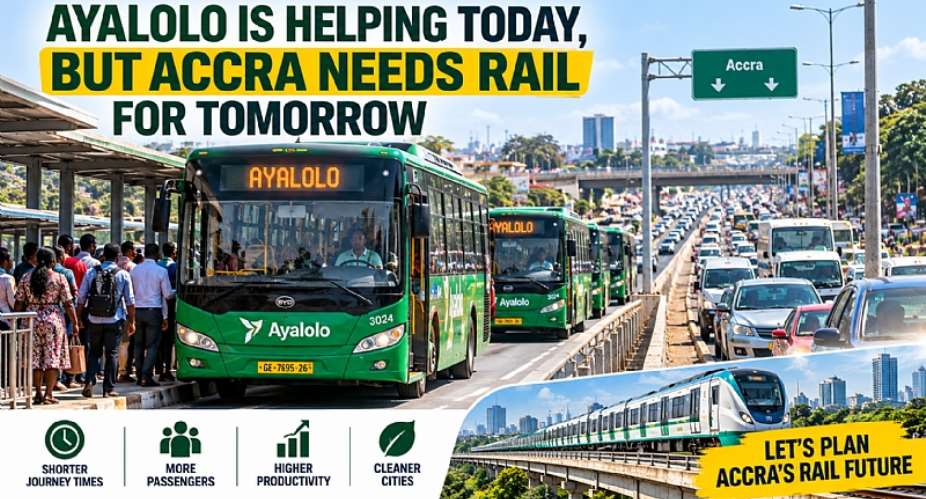
For the past few days, commuters travelling into Accra from Kasoa, Adenta and Amasaman have experienced something different. The government’s introduction of the Ayalolo Bus Rapid Transit contra-flow system on these major corridors is demonstrating what can happen when public transport is deliberately given priority.
The initiative, which commenced on 29 September 2026, allows designated Ayalolo buses to use controlled road space during peak periods, helping commuters bypass some of the congestion that has become a daily feature of life in Greater Accra.
The early results are encouraging. On the Adenta–Accra corridor alone, about 8,000 passengers were reportedly transported during the morning period on the first day. A journey that can take approximately two-and-a-half hours during severe congestion was reportedly completed in about 23 minutes under the arrangement. That achievement deserves recognition. But it should also force Ghana to confront a much bigger question: if thousands of people are travelling along these corridors every morning and evening, is it not time to seriously plan permanent high-capacity urban rail systems for Kasoa–Accra-Tema and Adenta–Accra?
I have previously argued for rail or metro development along these corridors. What is happening today only strengthens that position.
We should therefore stop treating congestion on these corridors purely as a road problem. It is increasingly a mass-transit problem. Buses are an essential part of the solution. Giving them priority is sensible because one bus can move considerably more people than individual private vehicles. However, buses still operate within the road environment. They remain exposed to intersections, accidents, enforcement challenges, competing vehicles and the physical limitations of existing roads.
Urban rail offers something different.
A properly planned metro, light-rail or suburban railway can move large passenger volumes along dedicated infrastructure while providing something Accra desperately needs: predictable journey times.
Imagine a worker living in Kasoa knowing that a train to central Accra will take approximately the same amount of time every morning, regardless of what is happening on the highway. Imagine residents of Adenta and Madina boarding a modern urban train and reaching central Accra without spending hours sitting in traffic. The benefits would extend far beyond convenience. They would improve the efficiency of the Ghanaian economy.
Every hour workers spend trapped in congestion is productive time lost. Businesses suffer when employees cannot predict their arrival times. Commercial vehicles complete fewer trips. Households spend more on fuel. Vehicles deteriorate faster. Air pollution increases, and families reorganise their daily lives around traffic.
Congestion is therefore not merely a transport problem; it is a productivity tax on Ghana’s economy.
This is why the current Ayalolo programme should become a laboratory for something bigger.
Government should use the passenger information being generated today, ridership levels, boarding locations, peak-hour demand, journey times and destination patterns, to undertake serious feasibility studies for high-capacity rail transit along the Kasoa–Accra-Tema and Adenta–Accra corridors.
Rail should become the high-capacity backbone of the metropolitan transport network, while Ayalolo buses, conventional buses, taxis and other services feed passengers into strategically located stations. Park-and-ride facilities could allow motorists from surrounding communities to leave their vehicles outside central Accra and continue their journeys by public transport.
Kasoa provides an especially important opportunity. The continuous urban expansion westward from Accra means that transport planning must anticipate tomorrow’s population rather than simply respond to today’s congestion. Waiting until every available corridor is occupied by buildings will make future railway construction considerably more expensive.
The same principle applies to Adenta and the rapidly developing northeastern side of Greater Accra.
Transport infrastructure should precede uncontrolled urban expansion, not chase it.
The current Ayalolo experience has already taught us an important lesson: when public transport becomes faster and more reliable, people will use it.
Ghana should build upon that lesson.
Support Ayalolo. Give buses priority where appropriate. Improve service frequency. Strengthen enforcement. Make public transport attractive.
But we should not mistake an effective short-term intervention for the final solution to Accra’s long-term mobility challenge.
The buses operating today are showing us where the passengers are.
The congestion is showing us where the demand is.
The growth of Kasoa, Adenta and surrounding communities is showing us where Greater Accra is heading.
The next step should be to determine where the rails should go.
Author: Joseph Fuseini: ([email protected])


 AMA directs closure of shops, markets for October 3 National Cleanup Day
 ‘We will resist it’ – NUGS kicks against proposed 26% UG accommodation hike
 ‘Fake’ – EOCO denies GH¢50m bail report on Baffour Awuah
 ‘The NPP I seek to lead will stand by every member’ – Boakye Agyarko
 ‘Keeping Baffour Awuah in custody serves no purpose’ – Boakye Agyarko tells EOCO
 GACL announces enhanced security screening at Accra International Airport
 Pursue drug kingpins, not political opponents — Afenyo-Markin tells EOCO
 Over 130 courts are without magistrates – JUSAG President
 We demand immediate, unconditional release of Baffour Awuah from EOCO custody – ...
 COMAC gives Finance Ministry 14-day ultimatum to suspend new fuel tax rule


