




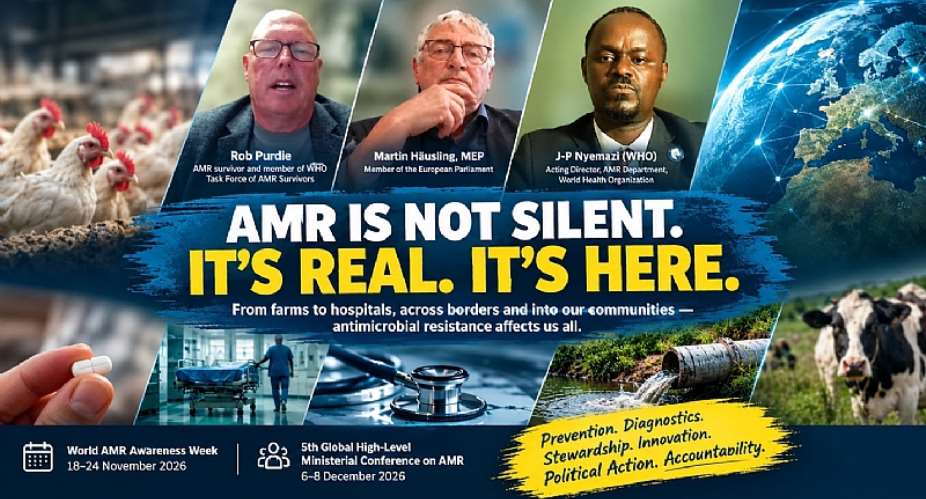
At the European Parliament this week, an exhibition titled "Antimicrobial Resistance (AMR): The Human Stories Behind a Silent Pandemic" confronts visitors with a stark reality. Antimicrobial resistance is not a distant scientific problem. It is already destroying families, emptying bank accounts, and killing at least one million people every year from drug-resistant bacteria alone — two bacterial AMR deaths every minute.
AMR or drug resistance happens when disease-causing microbes (like bacteria, virus, fungi or parasites) become resistant to medicines as a result of which, that medicine no longer work against them. Even simple to treat infections become difficult to treat - or incurable. Misuse of medicines in human health, animal health and livestock, and food and agriculture is causing AMR and polluting our environment too.
The exhibition, running from 28 September to 2 October 2026 and organised by the World Health Organization (WHO) together with German Member of the European Parliament Martin Häusling, brings personal testimonies from across Europe into the heart of European decision-making. Its message is deliberate: AMR can affect anyone. It is not the problem of a marginal group.
AMR survivor who refuses to stay silent
Rob Purdie, member of the WHO Task Force of AMR Survivors, stood before the press and dismantled the word 'silent.'
His ordeal began in January 2012 with a simple headache that became a crushing migraine. A first doctor diagnosed sinus infection and prescribed antibiotics. His condition did not improve. A second doctor did the same with a different antibiotic. Again, his condition did not improve. Only an ear, nose and throat specialist ordered an X-ray and declared: “You do not have a sinus infection.”
But the diagnosis was still not immediately clear. He was subsequently told he had cluster headaches — again, without diagnostics establishing the cause. Meanwhile, his symptoms intensified. The headache became so severe that he had to sit in a completely dark room. Even the tiny power light on a television had to be covered.
Then his vision began to deteriorate. That finally took him to a hospital emergency room. A resident doctor performed a lumbar puncture. On Valentine's Day 2012, Purdie received the diagnosis: a fungal infection that had progressed to meningitis. By then, the opportunity for earlier intervention had passed.
He was diagnosed to have the fungus - valley fever, or coccidioidomycosis.
Purdie believes that had diagnostics been used earlier, the infection might not have progressed to meningitis. That experience became one of the central lessons of his story: right and timely diagnosis is not a luxury in the fight against drug resistance. It is an essential part of the health response.
He was discharged from hospital in March 2012 and started on an antifungal drug approved in both the United States and the European Union for fungal infections, although not specifically for his infection.
He failed the first antifungal drug, then the second, then the third.
Because there are so few antifungal medicines available, doctors turned to what Purdie described as “salvage therapy”: adding another drug rather than abandoning the failing treatment. This additional drug was amphotericin B, a 1950s-era drug with severe side effects, which was directly injected into his brain through a port in his head. The drug combination controlled the fungal infection but the toxicity was unbearable.
One of the drugs caused photosensitivity that led to squamous cell carcinoma (cancer) in 2015. Five more skin cancers have been removed since. Purdie has been on a fourth antifungal since 2016 — four pills a day for the rest of his life. None of the available drugs can cure his infection; they only control it. The hospital bill alone reached a quarter of a million dollars. For five years he could not earn a living in a single-income household supporting a wife and two children. Mental-health consequences compounded the physical and financial ruin. Thirteen years later he still cannot retire and has limited savings.
“You lose a lot,” he said. “That is why it is so important for those of us who have survived and are able to speak, to remove the word ‘silent’ from the ‘silent pandemic.’"
One Health is not optional — it is essential
Dr Jean-Pierre Nyemazi, Acting Director of the AMR Department at WHO headquarters, placed Purdie’s story in its global context. AMR affects people, animals, plants, food systems, economies and the environment. Drug-resistant pathogens move across sectors and borders - from country to country, continent to continent, animals to humans and back again.
"This is why the One Health approach is not optional — it is essential. But One Health is not just a framework; it must translate into action," said Dr Nyemazi.
Dr Nyemazi stressed that parliamentarians hold a critical role in responding to AMR which is not only among top 10 global health threats but also threatening our food security, economies and our environment. We must translate national One Health commitments into legislation, financing and accountability.
From mass treatment of poultry to last-resort antibiotics in livestock
Member of the European Parliament Martin Häusling focused on the agricultural front too. In many countries antibiotics remain available without prescription, especially in animal husbandry. Broad-spectrum drugs are given without determining the precise need. In poultry production, thousands of birds share the same space. When one becomes sick, the entire flock receives antibiotics — even the healthy ones. Prophylactic mass treatment must end, he said.
He further shared that a nearby slaughterhouse illustrated the environmental pathway: wastewater carries drug resistant pathogens into the wider environment, exposing people through water they may never realise is contaminated. Last-resort antibiotics — the very drugs needed when all else fails — are still used far too freely in food-producing animals. In the United States, antibiotics continue to be used as growth promoters, a practice Häusling said must end urgently.
"The same principle applies as with human medicine: first determine what needs to be treated and which specific drug is required — not generalised use of medicine,” he said. “We must reduce overall use — both in humans and in animals.”
Tools exist. The cost of inaction is rising
In May 2026, WHO Member States approved an updated Global Action Plan on AMR that will guide the next decade through a genuine One Health lens. The previous plan leaned heavily toward human health. This one was developed jointly by the four Quadripartite organisations — WHO, FAO, UNEP and WOAH — and places prevention first: vaccination, infection prevention and control, water, sanitation and hygiene, and improved animal husbandry, said Dr Nyemazi of the WHO.
It adds a new objective on governance, sets clear measurable targets, and emphasises behavioural change in both prescribing and use. Dr Nyemazi pointed to the Political Declaration of the 2024 UN General Assembly High-Level Meeting on AMR which was endorsed by all 193 UN member States. One of the targets is to reduce bacterial AMR deaths by 10% by 2030 (compared to 2019 levels).
That target, he said, is realistic if countries implement infection prevention, vaccination and better access to quality antimicrobials. With stronger coordination, education and surveillance, more is possible.
Deadly gap between what-we-know-works and what-we-do
Dr Nyemazi said that the good news is that we know what works. "Preventing infections is number one priority. This can be done through better vaccination, infection prevention and control, water, sanitation and hygiene (WASH), and improved animal husbandry. All of these work and can prevent AMR. Strengthening surveillance, ensuring responsible use of antimicrobials, expanding access to quality medicines and diagnostics, and reducing environmental contamination can all make a difference. The tools exist and the evidence is there, but the cost of inaction is rising. The longer we delay action, the higher the cost becomes."
Access too remains unequal, he said. In Nepal and parts of sub-Saharan Africa, even obtaining a prescription can be difficult. Families may go straight to pharmacies. Strengthening primary healthcare, educating the public, enforcing regulations against over-the-counter sales of reserve antibiotics, and digitising dispensing systems so prescriptions can be audited are all required. There is no single solution.
Rob Purdie added that in high-income settings the problem is different but equally urgent. In the United States, as many as 50% of antibiotic prescriptions are unnecessary. Innovation — new antibiotics, new antifungals, phage therapy — is essential, but developing a novel antifungal has taken almost 30 years.
That is why Dr Nyemazi emphasised that without parallel investment in AMR stewardship and diagnostics, new drugs will never keep pace. Existing medicines must be protected as the foundation of modern medicine.
Everyone has a role — and the clock is running
Prevention is the gold standard and the cheapest approach. Delayed diagnosis and management, as Purdie’s story shows, multiply costs dramatically. Governments must lead on policy and service access. Civil society raises awareness and demands accountability. The private sector, especially where it delivers much of the care, must be at the table. Individuals can act through hand washing, vaccination and refusing unnecessary antibiotics — but only if the services exist.
The theme of this year’s World AMR Awareness Week (18–24 November) is “One Health, One Action, Prevent AMR Now.” The 5th Global High-Level Ministerial Conference on AMR follows in early December. The exhibition at the European Parliament is timed to ensure that Members of the European Parliament cannot look away.
Häusling pledged to keep the issue on the parliamentary agenda. Dr Nyemazi called for the media to keep it in the public square. Purdie and the Task Force of AMR Survivors insist that the stories of those still living with the consequences of AMR must be heard.
AMR crosses every line: socioeconomic, geographic, cultural and political. Addressing it will require an effort that does the same. It is not a war that can be won. It is a war that we cannot afford to lose, said Rob.
Shobha Shukla – CNS (Citizen News Service)
(Shobha Shukla is a feminist, health and development justice advocate, and an award-winning founding Managing Editor and Executive Director of CNS (Citizen News Service). She serves as Chairperson of Global AMR Media Alliance (GAMA), Host and Coordinator of SHE & Rights (Sexual Health with Equity & Rights), President of Asia Pacific Media Alliance for Health, Gender and Development Justice (APCAT Media), and founder leader of DJOP (Development Justice for Older Persons) initiative. She is the author of 2026 book "Justice Unbound: Feminist Voices on Gender Equality, Health Rights, and Inclusive Futures" and was also the Lead Discussant for SDG-3 at United Nations inter-governmental High Level Political Forum 2025. GAMA , led by her, received the AMR One Health Emerging Leaders and Outstanding Talents Award at UN High Level Ministerial Conference on AMR 2024. Follow her on X @shobha1shukla or read her writings here www.bit.ly/ShobhaShukla)


 Contractors begin construction of 120-bed trauma hospital at Bole – Kwakye Ofosu...
 Gov’t procurement must prioritise local farmers for school feeding – Dr. Ato For...
 Vacate by October 4 or face demolition – KMA warns Abrepo Junction occupants
 Star Oil and GOIL assure no fuel price increase for new window
 Diesel will not hit GH¢22 at pumps – NPA CEO assures
 Ghana records 3,876 cybersecurity incidents in seven months – Communications Min...
 “We never knew life was going to be hard like this in Ghana; we can’t even get j...
 $1.17bn GoldBod gave BoG is repayment, not new money’ – Dr. Gideon Boako
 Baffour Awuah didn’t help his case if he ignored EOCO’s invitation – Appiah Danq...
 Carlos Queiroz leaves Black Stars role after poor AFCON qualifying start


