




The first real-world comparison from my cocoa forecasting project shows why assumptions, policy rules and market conditions matter as much as the model itself.
The number is finally out - and it is lower than every 2026 scenario I published.
On September 25, 2026, Ghana announced a producer price of GHS 42,400 per metric tonne for the 2026/27 cocoa season, equivalent to GHS 2,650 per 64-kilogram bag. COCOBOD says the price represents 71.18% of the realized Gross Free-on-Board (FOB) value and took effect the same day.
For me, the announcement carried an additional layer of interest. Only weeks earlier, I had published a Data Science project asking what Ghanaian cocoa farmers might be paid between 2026 and 2035. Rather than produce one supposedly certain number, I built three economic scenarios - Low-Price / Stress, Baseline and High-Price - because future cocoa prices, exchange rates and production levels are not known in advance.
Now the first official price has arrived. That gives the project something every forecasting exercise eventually needs: a real-world observation against which its assumptions can be examined.
What COCOBOD announced - and what my model projected
For 2026, the model generated the following annual-average producer-price paths:
| 2026 comparison | Producer price (GHS/MT) | Above official (GHS/MT) | Above official |
| Official 2026/27 producer price | 42,400 | - | - |
| Low-Price / Stress scenario | 53,887 | 11,487 | 27.1% |
| Baseline scenario | 56,957 | 14,557 | 34.3% |
| High-Price scenario | 65,971 | 23,571 | 55.6% |
The immediate result is clear: the official producer price is below all three scenario forecasts. Even the Low-Price / Stress scenario is about GHS 11,487 per tonne, or 27.1%, above the newly announced price.
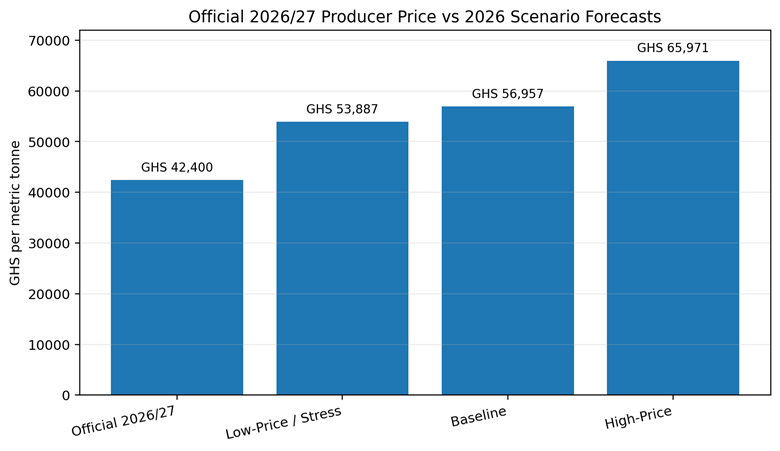
Figure 1. The official 2026/27 producer price is below all three 2026 scenario-conditioned forecasts from the original project.
But this is not quite a simple "forecast versus actual" scorecard
It would be tempting to place GHS 53,887 beside GHS 42,400 and conclude that the model simply missed the 2026 price by GHS 11,487. Numerically, the Low-Price / Stress scenario was indeed above the official price. Analytically, however, the comparison needs more care.
My forecasts were annual-average, scenario-conditioned model outputs. They asked what producer-price path the model would generate if international cocoa prices, the exchange rate and domestic production followed specified assumptions. COCOBOD's figure is an administratively determined producer price for a cocoa season, produced within a policy and institutional framework and based on realized Gross FOB values rather than a simple international spot-price calculation.
The two numbers are therefore related, but they are not identical concepts. That distinction was built into the original project, and the new announcement shows exactly why it matters.
The most interesting clue is where the gap appears
The Low-Price / Stress scenario assumed an international cocoa price of about US$4,700 per metric tonne in 2026 and an exchange rate of GHS 12.5 to the US dollar. Multiplying those two assumptions gives a simple reference value of roughly GHS 58,750 per tonne before any distinction between spot values and COCOBOD's realized Gross FOB is considered.
Now consider the official announcement from the other direction. If GHS 42,400 represents 71.18% of realized Gross FOB, the implied realized Gross FOB is about GHS 59,567 per tonne.
Those two reference values - about GHS 58,750 in my stress scenario and about GHS 59,567 implied by the official announcement - are surprisingly close. They differ by only about GHS 817 per tonne, or roughly 1.4%.
Yet the producer prices are far apart: GHS 53,887 in the model's stress scenario versus GHS 42,400 officially.
That suggests an important diagnostic point. The biggest difference may not have been the broad 2026 cocoa-value environment assumed in the stress scenario. It may have been how the model translated that environment into the producer price.
A simplified comparison helps show the issue:
| Measure | Low-Price / Stress scenario | Official 2026/27 | Interpretation |
| Cocoa-value reference (GHS/MT) | 58,750 | 59,567 | Very similar reference values |
| Producer price (GHS/MT) | 53,887 | 42,400 | Large gap remains |
| Producer-price share | 91.7% | 71.18% | Different translation from value to farm-gate price |
Important caveat: the model's international cocoa-value reference is not the same accounting concept as COCOBOD's realized Gross FOB. Forward sales, achieved contract prices and other commercial arrangements matter. The comparison is therefore diagnostic, not an accounting reconciliation.
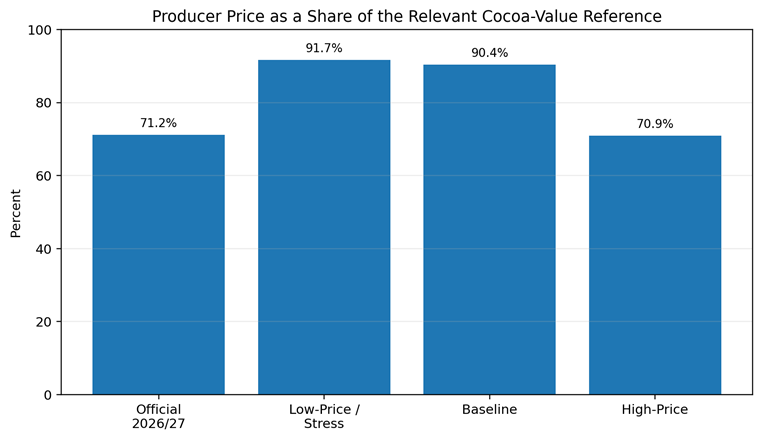
Figure 2. The model-implied producer-price shares vary by scenario. The official 2026/27 share is 71.18% of realized Gross FOB; scenario shares use the project's simpler international-price x exchange-rate reference and are not directly equivalent accounting measures.
The pricing regime has changed too
There is another reason the historical model should not be expected to reproduce the new price mechanically: the institutional framework has changed.
COCOBOD's September 25 announcement says the newly enacted Ghana Cocoa Board Act, 2026 (Act 1182) guarantees farmers a minimum of 70% of realized Gross FOB and introduces a new producer-pricing framework. The announced GHS 42,400 price corresponds to 71.18% of realized Gross FOB.
That matters because my historical analysis had found an implied producer share averaging roughly 59% over the long sample. I treated that historical relationship as an empirical pattern, not a fixed rule. The new law makes the distinction even more important: the institution governing how cocoa value is translated into the farm-gate price is itself evolving.
In February 2026, COCOBOD had already adjusted the producer price for the remainder of the 2025/26 season to GHS 41,392 per tonne, citing the fall in world cocoa prices and using a 90% share of an achieved Gross FOB of US$4,200 as part of the temporary response. The 2026/27 price is only about 2.4% above that immediately preceding level, even though the statutory framework now guarantees at least 70% of realized Gross FOB.
So, did the model get it wrong?
On a direct numerical comparison, all three 2026 scenario forecasts were higher than the official 2026/27 producer price. That should be stated plainly.
But the more useful question is why.
The new evidence suggests that the Low-Price / Stress scenario was not wildly detached from the broad cocoa-value environment implied by the official announcement. Instead, the model appears to have translated that environment into a substantially higher producer-price share than the 71.18% ultimately announced.
That is valuable information. It tells me that the next version of the forecasting framework should represent the producer-pricing mechanism more explicitly rather than allowing the model to infer that relationship mainly from historical patterns and lagged variables.
In other words, the comparison does not justify hiding the forecast or defending it at all costs. It tells us exactly where the model can be improved.
What I would change in the next forecasting cycle
The first improvement would be to model the producer-price share more explicitly. Instead of forecasting the farm-gate price only as a function of historical prices, exchange rates, production and international cocoa values, the framework could separately model the value available to the sector and the policy share passed to farmers.
Second, realized or achieved FOB information should be incorporated whenever it is available. International spot prices are useful market indicators, but Ghana's realized export value can differ because cocoa is sold through forward contracts and other arrangements.
Third, the new statutory pricing mechanism should enter the forecasting framework as a structural rule. A model trained mostly on earlier policy regimes should not be expected to discover a newly legislated floor from historical data alone.
Finally, the scenarios themselves should be updated continuously. Forecasts should not become museum pieces. As new prices, exchange rates, production estimates and policy information arrive, the assumptions should be revised and the model tested again.
This is what makes the exercise useful
Forecasting is sometimes presented as if success means publishing a number and later proving that the number was right. I think that is too narrow a view of applied Data Science.
A forecast is also a structured statement about assumptions. When reality differs from the forecast, the difference becomes evidence. It can reveal which assumptions were weak, which relationships changed and which parts of the model need redesign.
That is especially important in a sector like cocoa, where international markets, exchange rates, production shocks, financing arrangements and public policy interact.
The newly announced GHS 42,400 price is therefore more than a score against an old forecast. It is the first new observation in the next version of the project.
The first real-world test has arrived
The official 2026/27 producer price sits below every 2026 scenario in my original forecast. That result deserves to be acknowledged, not explained away.
But the deeper comparison is more revealing. The stress scenario's broad cocoa-value reference was surprisingly close to the value implied by COCOBOD's announcement, while the farm-gate share embedded in the model was much higher. That points directly to the producer-pricing mechanism as an area for improvement in the next model.
That is exactly how I want this forecasting project to evolve: publish the assumptions, observe what happens, investigate the gap and improve the framework.
A forecast earns its real value after reality arrives.
And sometimes, the gap between the model and the world teaches us more than a perfect prediction would have.
Project note
This article follows my earlier technical analysis, Forecasting Ghana's Cocoa Producer Prices to 2035: Can Machine Learning Outperform Traditional Forecasting Methods?, which compared seven forecasting approaches and produced scenario-conditioned annual producer-price paths through 2035.
Sources
- Ghana COCOBOD - Review of the Producer Price of Cocoa for the 2026/27 Cocoa Season (25 September 2026)
- Ghana COCOBOD - Press Release on Cocoa Sector Reforms for Financial Viability and Long-Term Sustainability (12 February 2026)
- Ghana COCOBOD - Government Maintains Producer Price for the 2025/26 Light Crop Season (12 June 2026)
About the author
Stephen Sarpong Lartey is a Data Scientist whose work focuses on the intersection of Data Science, economics, agriculture and public policy.


 From the Acropolis, Rubio calls on Europe to emerge from ‘slumber’
 Mahama proposes financing scheme to help Ghanaians complete unfinished houses
 'Free SHS not in crisis; it was suffering under you and we reviewed it' – Haruna...
 Mahama orders sanctions for officials who fail to enforce building safety rules
 2026 World Cup: Minority alleges how GTA charged $7,000–$14,000 for visa process...
 Mahama announces GHS1bn for revolving National Housing Fund
 PAC orders CWSA to recover GH¢2.5m public debt within 30 days
 Former NPP chairman Samuel Odoi-Sykes dies
 Stop taping, gluing damaged cedi notes for re-issuance – BoG tells Ghanaians
 NPP keeps pressing the self-destruction button by doing things anyhow – Akwatia ...


