




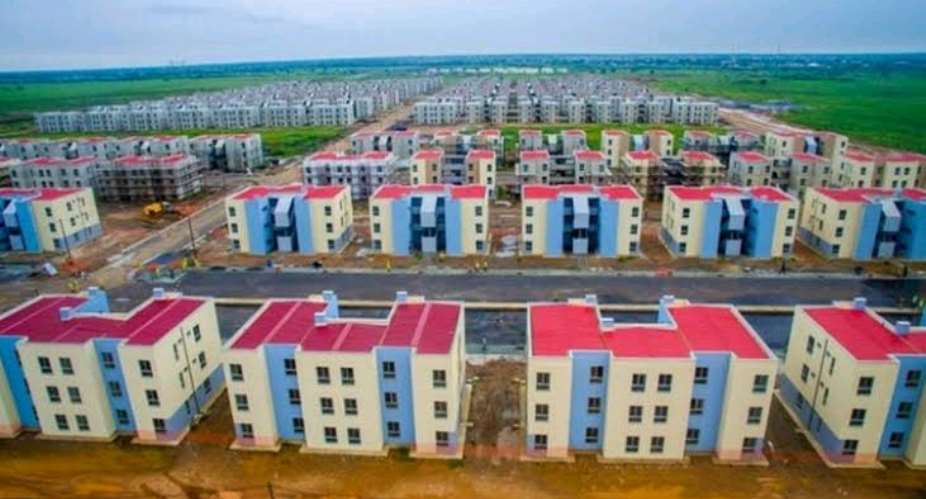
Every four or eight years, Ghana’s development agenda appears to be reset. A new administration assumes office and, too often, suspends, abandons, renames or rebrands projects initiated by its predecessor. Roads, hospitals, schools, water systems and other essential infrastructure are left unfinished, even though substantial amounts of taxpayers’ money have already been invested in them.
An unfinished hospital does not know whether it was initiated by the National Democratic Congress or the New Patriotic Party. The community waiting for healthcare services still needs the facility, regardless of which political party occupies the Jubilee House. In the same way, an abandoned road, school block or water project remains important to the people it was intended to serve.
The repeated cycle of beginning projects, abandoning them and later restarting similar ones cannot be described as development. It is political amnesia financed by the Ghanaian public. Beyond the visible waste, this practice delays essential services, increases project costs and weakens public confidence in the country’s political and administrative systems.
Ghana does not necessarily need to create another institution to address this problem. The National Development Planning Commission, established under Articles 86 and 87 of the 1992 Constitution, already has the mandate to coordinate and advise on national development planning. The Commission has acknowledged that the lack of continuity between successive governments undermines national progress and has advocated a consolidated long-term development framework incorporating major national priorities and infrastructure plans.
The challenge, therefore, is not the absence of institutions or development plans. It is the failure of successive governments to respect national priorities beyond their terms in office. Ghana needs a binding National Development Compact that protects carefully selected strategic projects from unnecessary political interference.
Such a compact would not prevent an elected government from implementing its manifesto or introducing new policies. Every administration must retain the authority to govern and respond to changing national circumstances. However, that authority should not include the casual abandonment of viable projects merely because they were initiated by a political opponent.
Parliament should build consensus around a limited number of strategic national projects that have been properly costed and independently evaluated. These projects should reflect Ghana’s long-term interests in areas such as transportation, healthcare, education, water, energy, agriculture and industrial development.
An incoming government should be permitted to review, modify or restructure the implementation of such projects where necessary. It should not, however, be allowed to abandon them without a transparent and evidence-based justification.
If a government concludes that a project is technically defective, economically unviable or no longer beneficial to the country, it must publicly disclose how much money has already been spent, the estimated cost of completion, the financial and social losses that abandonment would cause, and the technical reasons supporting cancellation. This information should be independently assessed and made available to Parliament and the public.
Abandoned projects represent far more than idle concrete structures and overgrown construction sites. They signify money wasted on land acquisition, feasibility studies, consultants, contractors, equipment, imported materials and loans. In some cases, Ghana continues to pay interest on borrowed funds for projects that are not delivering any public benefit.
The consequences also include lost employment opportunities, delayed economic activity and the denial of essential services to communities. A hospital left unfinished means patients must travel longer distances for treatment. An abandoned road increases transportation costs and restricts trade. An incomplete school deprives children of a safe and suitable learning environment. A neglected water project forces families to continue relying on unsafe or unreliable sources.
Ghana cannot continue complaining about public debt, unemployment and inadequate infrastructure while allowing productive national assets to deteriorate because of the political identity associated with them. The resources committed to these projects belong to the people, not to the political parties that initiated them.
Political leaders must stop measuring success by the number of projects carrying their names or the plaques they unveil. True leadership should be measured by the number of national problems permanently solved and the quality of life created for citizens.
Completing a valuable project inherited from a previous government should not be regarded as political weakness. It should be recognised as responsible leadership and respect for the taxpayer. Credit may belong to one administration for initiating a project and to another for completing it, but the ultimate benefit belongs to Ghana.
The country’s greatest development challenge may not simply be a lack of money. It is also a serious lack of continuity, accountability and institutional discipline. Without these principles, every election risks becoming the beginning of another expensive national reset.
Governments are temporary, but Ghana is permanent. Elections should change political leadership without destroying national progress. The guiding principle for every incoming administration must be simple: continue what works, correct what does not, and abandon only what has been objectively proven to be wasteful.


 Credit Godfred Dame for Ghana's US$393 million tax arbitration victory against T...
 How can EOCO be accused of wanting to kidnap Baffour Awuah in full glare of the ...
 'She is not party operative' – Kwakye Ofosu defends EOCO officer
 Baffour Awuah wanted over alleged financial loss, dissipation of public funds an...
 Brazil is the main source of cocaine in Ghana by sea concealed in sugar containe...
 'The cacophony of noises surrounding my comments were pure mischief' — Chief Jus...
 ‘Judges must not abandon their humanity because of their judicial office’ – Chie...
 GTEC flags over 100 tertiary institutions as unrecognised
 Political protection may be behind decline in visible cocaine trafficking in Gha...
 Ghana identified as source of explosives used in Sahel conflicts — Crime Index r...


