




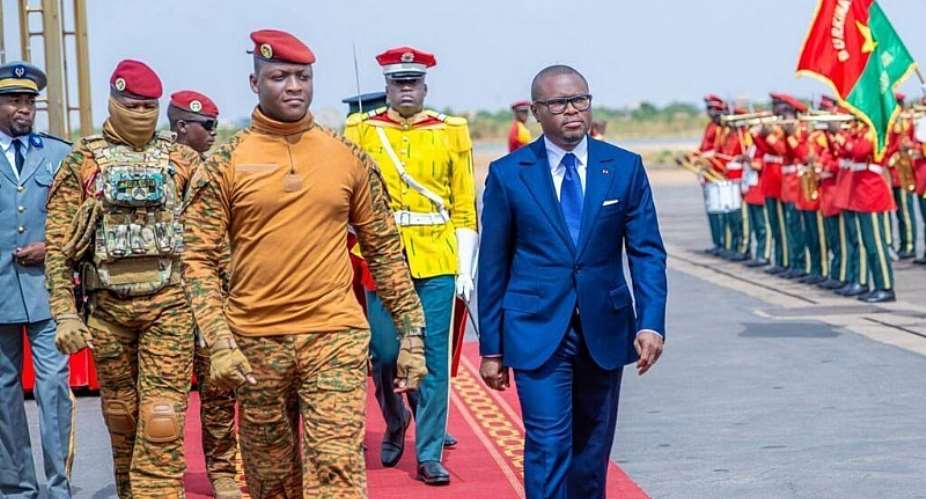
On 30 September 2022, Captain Ibrahim Traoré seized power in a coup in Ouagadougou, promising to restore security as Burkina Faso struggled with a jihadist insurgency that had left large parts of the country beyond state control.
"We'll keep the torch of Burkina's renaissance burning," Traoré has said, paying tribute to Sankara - who took over in 1983 – calling him the "nation's hero" and "compass".
Both men seized power as red beret-wearing young captains and promoted Pan-Africanism and national, economic and cultural autonomy and silenced dissent.
While Sankara had championed a "democratic" revolution, Traoré openly asserts that the country is not a democracy.
Journalists, magistrates and civil society members are regularly abducted and at times sent off to the front lines to boost the ranks of the anti-jihadist forces.
Inoussa Ouédraogo, who now lives in exile, was the publishing director of the weekly Bendré and presided over the Society of Private Press Publishers of Burkina Faso.
He says that while Traoré's new economic projects are seen as a positive development, they act as a distraction to the diminishing human rights.
RFI: When Captain Traoré declared, "democracy is not for us Burkinabé people," is he being provocative, or does he truly mean it?
Inoussa Ouédraogo: I do not know. Whether it is provocation or conviction, it doesn't matter. He came to power through force of arms. In a democracy, he would never have held power. Only a dictatorship allows him to remain the sole person holding the microphone and single-handedly deciding the future of 25 million people. He wants a country with no checks on his power – a place where one can vanish for the slightest reason. And in a democracy, he cannot achieve that.
RFI: For Captain Traoré, democracy goes hand in hand with revolution. He asserts that he is Captain Sankara's successor and is resuming his revolutionary work rooted in the principle of sovereignty. Do the two red-bereted officers share certain common points?
IO: In terms of form, yes: two 34-year-old captains who both came to power via a coup d'état. But in terms of substance, unfortunately, they seem to be polar opposites. Sankara's revolution was intended, first and foremost, to be democratic and grassroots. Sankara stood for humility, debate, and transparency. Ibrahim Traoré represents silence and total opacity. Sankara used to say, "Woe to those who gag the people." Today, everyone knows that they are gagging the Burkinabé people.
Burkina Faso's murdered leader Thomas Sankara reburied at site of his death
RFI: The first four years of Captain Traoré's regime have been marked by numerous repressive measures. However, the regime maintains that this is justified by the fight against the jihadist threat. What is your take on this?
IO: I believe it is simply a pretext to hold onto power for as long as possible. For these military figures, war has become a sort of business – akin to the coffee and cocoa trade. It is possible to fight terrorism without sacrificing the people's rights.
My thoughts go out to all the women and children whose loved ones have been abducted. Among the missing are journalists, doctors, lawyers, religious leaders, and even military personnel. I am thinking of a colleague who disappeared over two years ago. I am thinking of another person, who is ill and – according to the information we have – has requested medical treatment without success. I am thinking of Imam Mahmoud Diallo, a man nearly 80 years old; he vanished without a trace. We established an organisation called the Anti-Putschist Front, which has documented over 200 people abducted, held captive, and tortured by this regime; 82 of them appear in a photo dossier we compiled and are releasing on 30 September. It is truly regrettable. The fight against terrorism cannot justify all of this.
RFI: When Captain Traoré went to Ghana in early 2025 for President Mahama's inauguration ceremony, he was given a standing ovation by the thousands of people gathered for the occasion. How do you explain this popularity abroad?
IO: I was actually in Accra at that time. I was watching; I saw how Ghanaians reacted. But you know, Mobutu [Sese Seko, the first and only president of Zaïre from 1971 to 1997] was popular too – he was cheered. All dictators are, at some point. Popularity doesn't matter. In my view, what matters is improving the lives of one's people. Have the living conditions of the Burkinabé people changed? Isn't terrorism still causing them to suffer? Aren't thousands of people still displaced? Are people getting enough to eat?
Burkina junta chief says country must 'forget' democracy
RFI: Isn't Captain Traoré being applauded because he is viewed as a proponent of sovereignty? And doesn't that cause lend him a certain legitimacy?
IO: Anyone can claim to be a proponent of sovereignty. Anyone can call themselves a Pan-Africanist; anyone can fight against imperialism. But the struggle for sovereignty and the fight against terrorism cannot justify abducting people, imprisoning them, committing massive human rights violations, or rejecting democracy. Pan-Africanists have fought for Africans without needing to undermine their own people or subvert their constitutions. That is the point. No one opposes that. Regarding Ibrahim Traoré – it is simply his way of managing the lives of his fellow citizens that we oppose. No one is against the sovereignty of African people – quite the opposite. We all support the true liberation of Africa. But you do not liberate your people by gagging them. You cannot seek to liberate a people while silencing them. It is paradoxical; it is contradictory.
RFI: When Captain Traoré claims that jihadists have lost ground in Burkina Faso over the past four years, is that true or false?
IO: The reality on the ground tells a different story. My thoughts are with our security forces, who are killed every day and buried hastily – without military honours, often under the cover of night – so that the public remains unaware. Those who speak out against this are arrested and then dismissed from the service; they are forced into exile. The authorities themselves acknowledge that nearly 30 percent of our territory remains beyond their control.
Burkina Faso moves to reinstate death penalty as junta overhauls penal code
RFI: The regime is announcing major works and large-scale projects such as a gold refinery in Ouagadougou and a highway between Ouagadougou and Bobo-Dioulasso. Isn't that good news for your country?
IO: Yes, that is excellent news. We need development. We need roads. Even Mobutu had his own pharaonic projects to serve as a distraction.
RFI: Over the past four years, has the daily life of the Burkinabé people improved or not?
IO: I don't think so. Life is still hard. There is inflation. The price of fuel has gone up, the price of cement has gone up, as have the prices of rice, oil, and so on. Everything has gone up. Meanwhile, wages haven't risen. At the same time, money is being deducted on a daily basis. There are salary cuts for the so-called patriotic fund to support the war effort. Yes, fighting terrorism is a good thing, and it is good for the people to be able to contribute, but the people need to make a living.
This article is based on an interview done in French by RFI's Christophe Boisbouvier and slightly edited for clarity.

 Credit Godfred Dame for Ghana's US$393 million tax arbitration victory against T...
 How can EOCO be accused of wanting to kidnap Baffour Awuah in full glare of the ...
 'She is not party operative' – Kwakye Ofosu defends EOCO officer
 Baffour Awuah wanted over alleged financial loss, dissipation of public funds an...
 Brazil is the main source of cocaine in Ghana by sea concealed in sugar containe...
 'The cacophony of noises surrounding my comments were pure mischief' — Chief Jus...
 ‘Judges must not abandon their humanity because of their judicial office’ – Chie...
 GTEC flags over 100 tertiary institutions as unrecognised
 Political protection may be behind decline in visible cocaine trafficking in Gha...
 Ghana identified as source of explosives used in Sahel conflicts — Crime Index r...


