




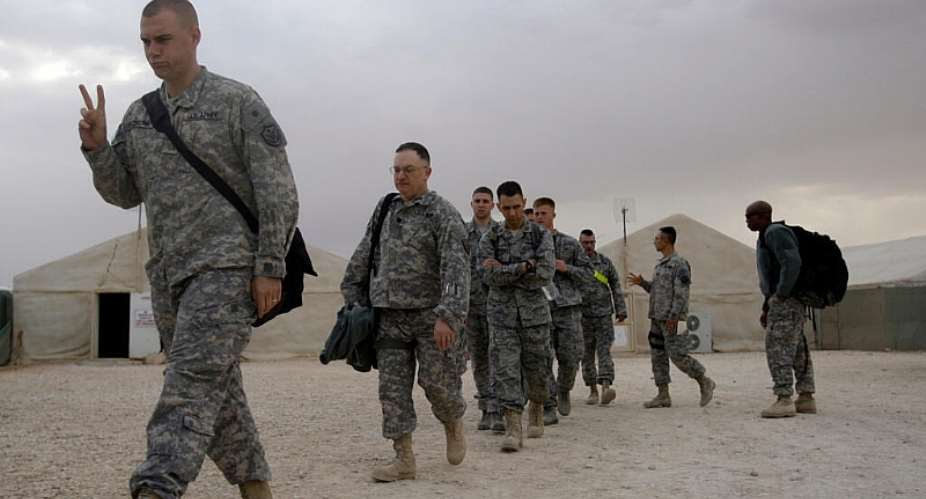
A US-led military coalition deployed to Iraq more than a decade ago to fight the Islamic State group formally ended its mission on Wednesday, marking a major shift in the country's security arrangements.
The coalition was created in 2014 after IS seized large parts of Iraq and neighbouring Syria, carrying out massacres and forcing thousands of women and children into slavery.
But the wider US military presence in Iraq stretches back to the 2003 invasion that toppled Saddam Hussein. The war was strongly opposed by France under president Jacques Chirac, whose government argued that UN weapons inspections should continue rather than resorting to military action.
US forces withdrew at the end of 2011 before returning three years later, at Baghdad's request, as IS swept across northern and western Iraq.
Iraqi and Kurdish forces, backed by coalition air power, training and intelligence, eventually drove IS from the territory it controlled. The group was declared territorially defeated in Iraq in 2017 and in Syria in 2019, although coalition forces remained to help combat its surviving cells.
Washington and Baghdad agreed in 2024 on a phased end to the mission, with coalition troops gradually withdrawing from bases across the country.
"Today, the United States and our Coalition partners formally concluded Operation Inherent Resolve in Iraq," the Pentagon said on Wednesday.
The US Defense Department added that Washington would continue to provide targeted training and intelligence support to Iraqi forces.
Pressure grows to bring French Islamic State suspects home from Iraqi prisons
Sovereignty and weapons
Iraq's government has presented the withdrawal as proof that its security forces are now capable of taking primary responsibility for national defence.
Prime Minister Ali al-Zaidi hailed the end of the coalition mission as the start of a new phase.
"A new phase has begun, defined by Iraq's sovereignty, the strength of its institutions, the readiness of its forces, unity of decision-making, and balanced partnerships with its friends," he said.
His government has declared 1 October Sovereignty Day.
But the withdrawal also brings a longstanding domestic issue into sharper focus – powerful armed factions operating outside the full control of the Iraqi state.
The US-led coalition was not alone in defeating IS. Kurdish Peshmerga forces played an important role, while Iraqi paramilitary groups – including factions closely aligned with Iran – also fought the jihadists.
Some have since retained substantial arsenals and political influence.
The government hopes the coalition's departure will remove one of the main arguments used by Iran-backed factions to justify holding on to their weapons.
Iraq's political and judicial leaders said this week that "the presence of weapons outside state authority must be addressed".
Zaidi, who took office this year, has pledged to reinforce the state's monopoly on arms.
Transfer of IS prisoners to Iraq puts renewed pressure on European governments
Pressure from Iran-aligned groups
His government initially set 30 September as a deadline for factions to disarm, but later dropped the date as negotiations continued over how to "regulate" weapons.
Several powerful groups have refused to disarm, while senior politicians are seeking a compromise.
Kataeb Hezbollah, one of Iraq's most powerful Iran-aligned factions, described the coalition's departure as "a start towards achieving full sovereignty".
But it also warned Zaidi's government that "a government that doesn't work for the good of its people will be brought down by all possible means".
Iran-backed factions have long demanded the departure of US troops and have repeatedly targeted bases hosting American and coalition forces with drones and missiles, prompting retaliatory US strikes.
Those attacks intensified during the wider Middle East conflict that followed US-Israeli strikes on Iran.
Meanwhile, IS cells remain active, raising concerns that the jihadist group could exploit any security gaps after the coalition's departure.
Iraqi forces – including the Peshmerga in Kurdistan – will now take the lead in keeping IS remnants suppressed, while Washington maintains a narrower counterterrorism partnership with Baghdad.
(with newsires)

 Baffour Awuah wanted over alleged financial loss, dissipation of public funds an...
 Brazil is the main source of cocaine in Ghana by sea concealed in sugar containe...
 'The cacophony of noises surrounding my comments were pure mischief' — Chief Jus...
 ‘Judges must not abandon their humanity because of their judicial office’ – Chie...
 BoG personnel costs more than double to GH¢3.29bn in three years as staff number...
 GTEC flags over 100 tertiary institutions as unrecognised
 Political protection may be behind decline in visible cocaine trafficking in Gha...
 Ghana identified as source of explosives used in Sahel conflicts — Crime Index r...
 EOCO could have written to Speaker Bagbin instead of seeking arrest warrant for ...
 Reduce unnecessary remands, utilise Community Service Act – Chief of Staff urges...


