




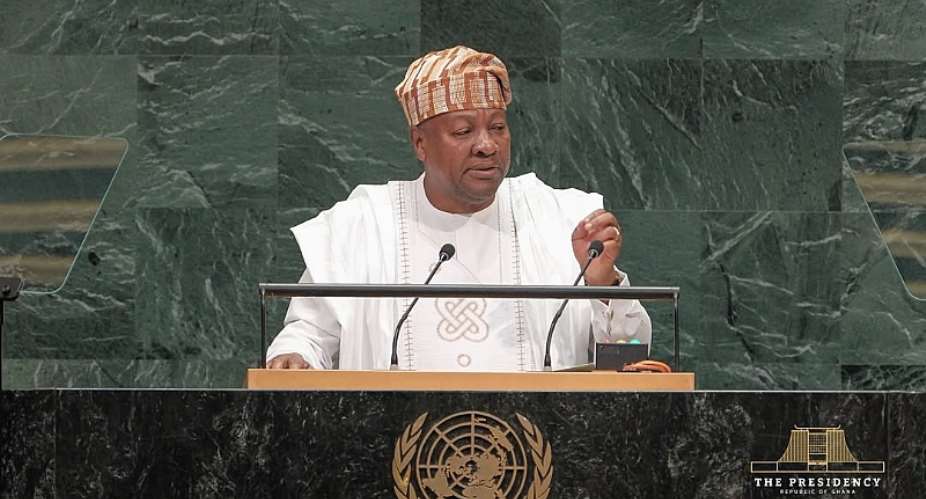
Ghanafuor, President John Dramani Mahama made us proud, paaapa, at the 81st United Nations General Assembly. He warned that Africa would not remain a passive arena for a new scramble for resources. He called for minerals to be processed at home, industries to be built on the continent, and more of the value from Africa’s natural wealth to remain in Africa. The principle was unmistakable: might does not make right.
Mahama’s address centred on critical minerals. Its deeper question reaches far beyond them. Does sovereignty mean controlling only what is dug from the soil, or also being able to see who owns the companies operating in a country, where their profits are declared, and whether the taxes due are paid? Ghana’s separate ambition to end raw mineral ore exports by 2030 is one answer in one sector. It cannot be the whole answer.
Value leaves a country in a ship’s hold. It can also leave in a spreadsheet.
It may travel as interest on an intra-group loan, a royalty, a management fee, a dividend or a profit booked in a company with little economic presence where the business actually operates. This question belongs wherever local activity creates value: in agriculture and manufacturing, energy and construction, telecoms and finance, transport, tourism and technology, as well as mining. The mechanisms differ. The test is the same: where are the people, assets, customers, infrastructure and commercial risks that made the profit possible, and who ultimately receives it?
A special purpose vehicle, or SPV, is not a synonym for wrongdoing. It can ring-fence a project’s risks, pool investment or make a complex transaction workable. Nor does an address in Mauritius or Luxembourg prove tax abuse. But a lawful structure can still be used abusively. When ownership chains conceal their beneficiaries, related-party charges bear little relation to real services or fair prices, or legal residence becomes detached from economic activity, the public has reason to ask what the structure is doing.
The target should not be every investor who uses an SPV. It should be secrecy, artificial profit shifting and failure to pay tax that is legally due. Do not outlaw the envelope because some people hide things in it. Require the envelope to show who sent it, who owns it and what it contains. Then give the authorities the means to check.
UNCTAD’s 2020 estimate put Africa’s annual illicit capital flight at US$88.6 billion. That figure covers a broad range of illicit financial flows; it cannot responsibly be attributed to SPVs or any one industry alone. Its meaning is still stark. Illicit outflows weaken the public capacity to invest in health, education, infrastructure and the productive base on which every sector depends. Double-taxation treaties should prevent the same income being taxed twice. They should not become a maze through which income escapes taxation altogether.
Patagonia offers a useful, carefully bounded example of how ownership can express a purpose. In 2022, Yvon Chouinard and his family transferred the company’s ownership to the Patagonia Purpose Trust and the Holdfast Collective. Patagonia said profits not reinvested in the business would be distributed to the Collective for environmental causes. “Earth is now our only shareholder” was the memorable formulation.
That structure does not solve tax avoidance, and it is no blueprint for every investor. Its lesson is that corporate ownership is designed, not ordained. A company can seek commercial success while recognising obligations to workers, communities, the environment and the societies whose people and public infrastructure help make that success possible.
If Ghana is serious about economic sovereignty, three principles should apply across the economy:
- Require verified, regularly updated disclosure of the natural persons who ultimately own or control companies seeking public concessions, licences, contracts or tax incentives. When public resources or money are involved, the public should be able to see who stands behind the decision and who may benefit from it.
- Strengthen country-by-country reporting for large multinational groups. The Ghana Revenue Authority should be able to compare where a group earns revenue, employs people, holds assets, reports profits and pays tax. It also needs the specialist capacity and information to examine related-party transactions and challenge abusive pricing.
- Make local value creation measurable and enforceable, but appropriate to each sector. A mining licence may require processing milestones; an agricultural or technology investment may call for local suppliers, skills, research or productive capacity. Each commitment needs public benchmarks, a realistic timetable and consequences for failure. “We will add value here” must become a testable undertaking, not a sentence repeated at every launch.
This is not a choice between welcoming all capital and rejecting all foreign investment. It is a choice between capital that builds productive capacity and structures that make ownership opaque while shifting the tax base out of sight. A fair system protects legitimate financing and insists that the law can follow the whole chain, from the first cedi invested to the last cedi of profit declared.
Ghanafuor, President Mahama made us proud abroad. The harder test is at home. Can we follow value from a farm, factory, mine, bank, port or digital platform through the corporate structure and into the public revenue owed to the people? Sovereignty is not secured by the address on a company’s registration papers. It is secured when a country can see, govern and fairly tax the value its economy creates. If capital crosses borders, accountability must cross them too.
A word to the wise…

 Credit Godfred Dame for Ghana's US$393 million tax arbitration victory against T...
 How can EOCO be accused of wanting to kidnap Baffour Awuah in full glare of the ...
 'She is not party operative' – Kwakye Ofosu defends EOCO officer
 Baffour Awuah wanted over alleged financial loss, dissipation of public funds an...
 Brazil is the main source of cocaine in Ghana by sea concealed in sugar containe...
 'The cacophony of noises surrounding my comments were pure mischief' — Chief Jus...
 ‘Judges must not abandon their humanity because of their judicial office’ – Chie...
 GTEC flags over 100 tertiary institutions as unrecognised
 Political protection may be behind decline in visible cocaine trafficking in Gha...
 Ghana identified as source of explosives used in Sahel conflicts — Crime Index r...


