




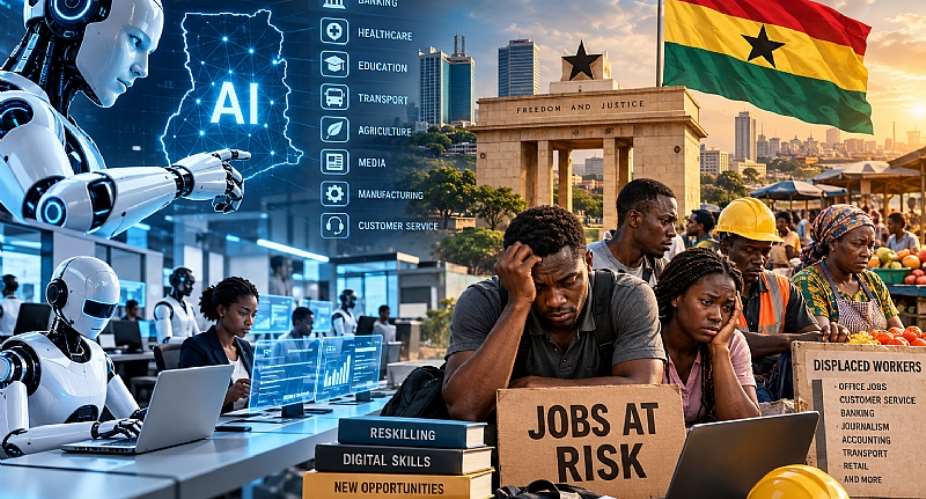
Artificial intelligence is often discussed in dramatic terms. Some technology leaders warn about machines becoming more intelligent than humans. Others imagine a future in which autonomous systems control critical infrastructure, military weapons or even major decisions affecting society. These concerns deserve attention, but for Ghana, the most immediate danger may be far less dramatic and much closer to home.
Artificial intelligence may not physically destroy us. It could, however, quietly destroy thousands of livelihoods if the country enters the coming automation decade without preparing its people.
Across the world, artificial intelligence is already changing how work is done. Tasks that once required several employees can increasingly be completed by software within minutes. Reports can be drafted automatically. Customer questions can be answered by chatbots. Computer programs can produce images, analyse documents, write software code, translate languages and process large amounts of financial information.
The important question for Ghana is therefore no longer whether artificial intelligence will change employment. It is whether our education system, labour market, businesses and public institutions are preparing quickly enough for that change.
For decades, Ghana has struggled with graduate unemployment and underemployment. Every year, universities, technical institutions and other tertiary institutions produce thousands of young people searching for limited employment opportunities. Artificial intelligence could make this competition even more difficult.
Consider a company that previously needed ten customer service officers to handle routine enquiries. With an advanced automated system, it may eventually need only three people to supervise the technology and respond to difficult cases.
A media organisation that previously employed several writers to produce routine reports may use artificial intelligence to prepare first drafts within seconds. Banks may automate customer support, document verification and transaction monitoring. Law firms may use software to review contracts. Accounting firms may automate basic bookkeeping. Schools may use intelligent tutoring platforms. Technology companies may use artificial intelligence to perform tasks previously assigned to junior programmers.
None of this means that every job will disappear. It means that the nature of many jobs will change.
Unfortunately, Ghana's educational system still places considerable emphasis on certificates, memorisation and examination performance. Students may spend years obtaining qualifications without developing the practical skills necessary to compete in an economy increasingly shaped by intelligent technologies.
This creates a serious danger.
If artificial intelligence can perform many routine intellectual tasks, possessing a university degree alone will no longer guarantee economic relevance. Employers will increasingly value people who can solve problems, think critically, communicate clearly, understand technology and work effectively alongside intelligent systems.
The worker of the future may not necessarily be replaced by artificial intelligence. He or she may be replaced by another worker who knows how to use artificial intelligence more effectively.
That distinction should concern every Ghanaian student, parent, teacher and policymaker.
We must also consider Ghana's informal economy. Discussions about artificial intelligence often focus on office workers, programmers and bankers, yet digital automation will eventually affect traders, drivers, farmers, artisans and small businesses as well.
Digital financial platforms are already changing commerce. Intelligent agricultural systems can help farmers predict weather conditions, detect crop diseases and manage production. Automated logistics platforms may transform transportation and delivery services. Online marketplaces will continue changing how people buy and sell goods.
These developments could create significant opportunities, but they could also widen inequality.
A farmer with access to digital tools may become more productive. Another farmer without internet access, digital skills or modern equipment may struggle to compete. A small business using artificial intelligence to analyse customers and automate marketing may grow rapidly, while another business operating entirely through traditional methods could lose customers.
The danger is therefore not simply job destruction. It is the possibility of creating two Ghanas.
One Ghana could consist of people with strong digital skills who use artificial intelligence to become more productive, competitive and prosperous. The other could consist of workers whose skills gradually become less valuable while technology moves forward without them.
That would deepen existing economic inequalities.
Another concern is technological dependence.
Most advanced artificial intelligence systems used by Ghanaians are developed outside the country. Ghana is largely a consumer of these technologies rather than a major producer of them.
This raises important economic questions.
If Ghanaian businesses increasingly depend on foreign artificial intelligence platforms, much of the economic value created by automation may leave the country. We could find ourselves paying international technology companies to automate jobs previously performed by Ghanaians.
That would be a painful contradiction. We would be celebrating digital transformation while simultaneously exporting income and reducing domestic employment.
Ghana must therefore think beyond simply teaching people how to use existing artificial intelligence tools. The country must develop its own technological capacity.
Universities should strengthen programmes in artificial intelligence, data science, robotics, cybersecurity, cloud computing and software engineering. More importantly, these programmes must move beyond theory.
Students should build real systems. They should work with Ghanaian datasets. They should develop solutions for agriculture, health, education, transport, mining, finance and public administration.
Technical and vocational education must also become part of the artificial intelligence conversation.
Electricians, technicians, mechanics and artisans should not be excluded from technological transformation. As machines become increasingly automated, Ghana will need people capable of installing, repairing and maintaining intelligent equipment.
The future economy will need both software engineers and highly skilled technicians.
Government also has an important responsibility.
Ghana needs a clear national strategy for managing the employment consequences of artificial intelligence. This should include continuous workforce training, support for technology start ups, digital infrastructure development and incentives for companies that invest in retraining workers rather than simply replacing them.
Public institutions themselves must prepare carefully.
Automation could improve government services by reducing paperwork, speeding up applications and improving access to public information. However, digital transformation should not become an excuse to introduce technology without considering workers whose responsibilities may disappear.
Retraining must become part of every major automation project.
The private sector must also recognise that automation comes with social responsibilities.
Replacing employees may reduce costs in the short term, but an economy cannot survive if technological productivity grows while large numbers of citizens lose the ability to earn income.
Companies should identify roles likely to change and begin training employees before those jobs become obsolete.
Workers themselves must also accept a difficult reality.
The era in which a person could learn one profession and rely on the same knowledge for thirty years is disappearing.
Continuous learning will become necessary.
A journalist may need to understand data analysis and artificial intelligence assisted research. An accountant may need to work with automated financial platforms. A teacher may need to integrate intelligent tutoring systems into the classroom. A doctor may increasingly interact with artificial intelligence supported diagnostic tools. A programmer may need to supervise software generated partly by machines.
Adaptability may become one of the most valuable professional skills of the next decade.
There is also an opportunity hidden within this disruption.
Artificial intelligence could help Ghana overcome some long standing development challenges.
Imagine farmers receiving accurate local agricultural advice through their mobile phones. Imagine students in rural communities receiving personalised learning support. Imagine hospitals using intelligent systems to assist doctors in analysing medical information. Imagine government agencies detecting financial irregularities more quickly. Imagine Ghanaian entrepreneurs building artificial intelligence solutions for African languages, markets and institutions.
These opportunities are real.
But they will not happen automatically.
Technology does not distribute its benefits equally simply because it exists. Countries that invest in skills, infrastructure, research and innovation usually capture more value from technological revolutions than countries that simply consume technology created elsewhere.
Ghana therefore faces a choice.
We can treat artificial intelligence as another imported technology and wait for its consequences to arrive. Or we can deliberately prepare our people to participate in the new economy it is creating.
Parents should encourage children to develop digital skills alongside traditional education. Universities should redesign programmes around practical competence. Businesses should retrain employees. Government should support innovation and digital inclusion. Young professionals should make continuous learning a personal responsibility.
The automation decade will not arrive with dramatic announcements.
It will happen gradually.
One company will automate its customer service desk. Another will reduce its administrative staff. A bank will introduce intelligent software. A newsroom will automate routine reporting. A school will introduce digital tutoring. A business will realise that three technology enabled employees can perform work previously done by ten people.
Then, suddenly, the labour market will look very different.
Artificial intelligence may not kill Ghanaians.
But if we fail to prepare, it could quietly destroy the livelihoods of people who believed their education and professions would protect them from economic disruption.
The greatest danger is therefore not the machine itself.
The greatest danger is entering the age of intelligent machines with an education system, workforce and national economy designed for yesterday.
Ghana still has time to prepare.
The question is whether we will use it.


 “Disband Black Stars, sack FA and let FIFA ban us for two years” – Sam George af...
 Young man blows GH₵280,000 bet wins on five iPhone 17 Pro Max, other items
 NPP executive elections: Justin Kodua dismisses claims of blocking constituency ...
 South Africa summons US ambassador for 'record' third time
 Israel-bound flight diverted to Saudi Arabia after brawl between pilots
 Dangote to launch $16bn refinery in Kenya
 GNFS rescues driver trapped in overturned tipper truck at Bolgatanga
 Ghana, Luxembourg to explore visa waiver agreement
 Tullow loses $393m tax arbitration case against Ghana – Finance Minister
 Bawumia outlines policy proposals to grow Ghana’s insurance industry


