




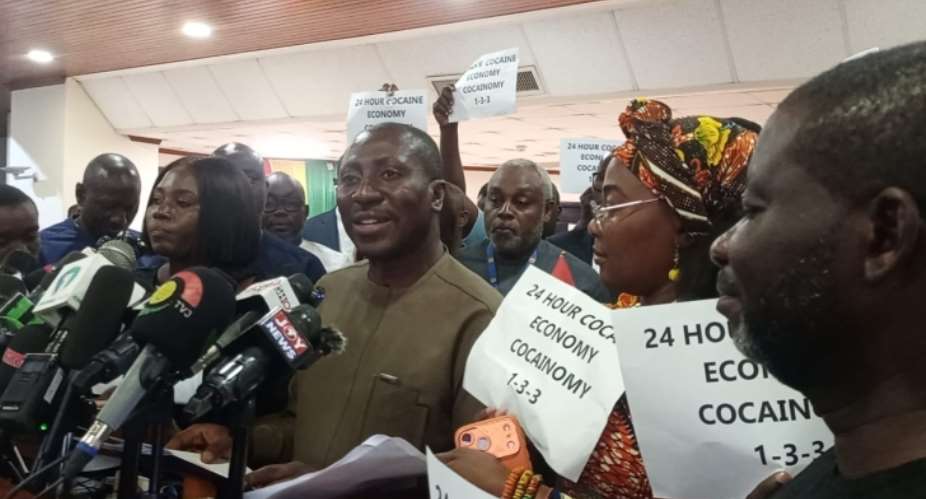
Minority Leader Alexander Afenyo-Markin has criticised Speaker Alban Sumana Kingsford Bagbin’s decision to dismiss a Private Member’s Motion seeking a parliamentary inquiry into a series of narcotics seizures linked to Ghana.
According to the Effutu MP, the ruling improperly restricted Parliament’s constitutional mandate to scrutinise the administration and effectiveness of public institutions connected to the incidents.
Speaking to the press after the Speaker’s ruling during Parliament’s emergency sitting on Tuesday, September 29, 2026, Mr Afenyo-Markin described the development as “a sad day for democracy and parliamentary oversight”.
He also accused the Majority Caucus of relying on its numerical strength, with the support of the Speaker, to limit Parliament’s ability to exercise its oversight responsibilities.
“Mr Speaker tells us that there are certain matters before the court but he does not explain to us how these matters oust the constitutional jurisdiction of Parliament to enquire into the conduct, administration and effectiveness of public institutions involved in the matter.
“The Majority are resisting scrutiny and they quickly welcomed the Speaker's decision and moved to adjourn the sitting,” he said.
Parliament’s oversight mandate
Mr Afenyo-Markin maintained that the motion submitted by the Minority was not intended to interfere with criminal proceedings or determine the guilt or innocence of anyone facing prosecution.
Rather, he said, the proposed inquiry was aimed at determining whether public institutions responsible for preventing and combating narcotics trafficking had effectively performed their duties.
He cited Articles 93(2) and 103 of the 1992 Constitution as the basis for Parliament’s legislative and oversight functions, pointing specifically to Article 103(3), which empowers parliamentary committees to investigate and inquire into the activities and administration of ministries, departments and agencies.
He also referred to Article 103(6), which gives parliamentary committees powers, rights and privileges similar to those of the High Court for purposes including compelling witnesses to appear, examining them and requiring documents to be produced.
“These provisions we submit are important because the motion we filed before the House does not seek to try any accused person.
“It does not ask Parliament to determine criminal liability, pronounce upon the guilt or innocence of any person, assess the credibility of prosecution witnesses or decide upon evidence that is properly before a court. The import of our motion is institutional oversight,” he said.
What the inquiry would have examined
The Minority Leader said the proposed committee would have investigated the operations of institutions responsible for narcotics control, customs administration, port and airport security, intelligence gathering, maritime surveillance and border protection.
He said the inquiry was particularly necessary in light of a series of major narcotics incidents recorded since January 2025.
Mr Afenyo-Markin acknowledged that Parliament and the courts have different constitutional responsibilities, arguing that the existence of criminal cases should not automatically prevent Parliament from examining the performance of public institutions.
“We submit that as far as we know, the courts are concerned with the criminal liability of particular accused persons but Parliament is concerned with the performance, administration and accountability of public institutions,” he said.
“These are separate constitutional functions even where they arise from some of the same underlying factors,” he said.
He further challenged the interpretation of the subjudice principle applied in rejecting the motion.
According to him, the relevant consideration should not simply be whether a matter is before a court, but whether the proposed parliamentary investigation could prejudice the outcome of those proceedings.
“The proper question is not simply whether there is a case in court; the proper question is whether the particular parliamentary enquiry would prejudice a determination of that case,” he said.
The Minority Leader argued that Parliament could have established safeguards to ensure that the proposed committee did not investigate the guilt or otherwise of accused persons, comment on evidence before the courts or disclose information capable of prejudicing ongoing proceedings.
He added that the committee could also have conducted its proceedings in camera where issues involving national security or ongoing investigations arose.
Mr Afenyo-Markin said such measures would have enabled Parliament to carry out its oversight mandate while respecting the authority and independence of the courts.
He said the inquiry could instead have concentrated on “container scanning procedures, customs control, port access systems, cargo inspection, intelligence sharing, institutional coordination, freight forwarding regulation, export controls, warehouse security, maritime supervision” and the ability of state institutions to identify financiers and organisers of large-scale narcotics networks.
“None of those institutional systems is an accused person before a court. The scanning regime at our port is not on trial. The effectiveness of customs risk profiling is not on trial,” he said.
“The inter-agency intelligence sharing is not on trial. The adequacy of narcotics institutional capacity is not on trial. The integrity of our export control system is not on trial.”

 Speaker Bagbin adjourns Parliament indefinitely after rejecting narcotics probe ...
 Food Buffer Stock seeks stronger liquidity buffer despite record GH¢91.7 million...
 Ex NAFCO Boss trial: Court adjourns trial to hear application for return of seiz...
 Bagbin backs Mahama’s call for national dialogue on social media insults
 Speaker Bagbin got it wrong by rejecting our narcotics inquiry motion - Afenyo M...
 National conversation should not become an exercise in suppressing dissent — Bag...
 ‘Don’t reward only bitter tongues, it encourages others to copy’ – Bagbin tells ...
 We have cut cost of capital by more than half since Mahama took office – Ato For...
 Customs intercepts three firearms, 610 rounds of ammunition at Tema Port


