




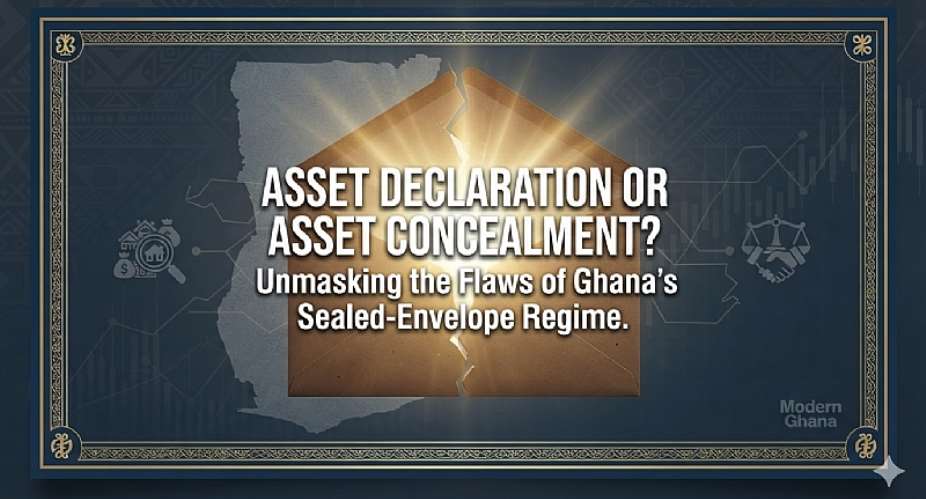
Every election cycle, Ghanaians walk to the ballot box with a singular, burning hope: that the leaders they choose will protect the public purse. Yet, history has shown a recurring, heartbreaking cycle. Public officers enter government with modest means, only to exit with overnight mansions, vast tracts of land, and staggering bank accounts that mock the daily struggles of ordinary citizens. The recent investigation by the Economic and Organised Crime Office (EOCO) into high-profile political figures forces us to confront a foundational flaw in our democracy. Why is it that our primary mechanism to fight corruption—the Asset Declaration regime—feels more like a state-sanctioned protocol for hiding ill-gotten wealth rather than exposing it? To dismantle this culture of impunity, we must unmask the legal loopholes, evaluate real-world case studies, draw lessons from global transparency models, and empower citizens to force structural legislative change.
The Dented Framework: Toothless Penalties and Shrouded Envelopes
Under Article 286 of the 1992 Constitution and the Public Office Holders (Declaration of Assets and Disqualification) Act, 1998 (Act 550), specified appointees must declare their assets before taking office, every four years, and upon leaving. However, the existing system is structurally designed to fail.
First, failing to file does not carry strong criminal penalties or automatically trigger a prosecution. Instead, enforcement often depends on administrative reprimands or a formal written complaint filed by citizens to the Commission on Human Rights and Administrative Justice (CHRAJ). Second, the system operates on a complete lack of verification. Appointees hand their declarations to the Auditor-General in a sealed envelope. State authorities are legally forbidden from opening or verifying the truth of those contents unless the official is already facing a formal corruption lawsuit or an active investigation. This makes the entire regime a passive repository rather than an active shield against public theft.
Case Studies in Contrast: The Locked Envelopes of Dennis Miracles Aboagye vs. Executive Transparency Under President John Dramani Mahama
The deep flaws in the verification system, combined with how different administrations handle the political will for transparency, are clearly illustrated by two major modern case studies:
1. Dennis Miracles Aboagye
- The Allegations: The former Executive Secretary of the Inter-Ministerial Coordinating Committee on Decentralisation (IMCCoD) was arrested and investigated by EOCO over alleged financial and procurement-related irregularities involving roughly GH¢55 million.
- The Seized Assets: While unverified political claims circulated on radio alleging that the number of seized properties had escalated to 17, official court records confirm that the Accra High Court upheld a preservation order freezing five bank accounts and four landed properties. These assets comprise a seven-bedroom residential property at Larteh, a two-bedroom house at Spintex, an apartment complex at Adjiringanor, and 15 acres of land.
- The Systemic Breakdown: Because Aboagye's asset declaration envelope remained legally locked and unverified prior to the crisis, state investigators had to manually track down his properties via lifestyle audits and inter-agency mapping after a petition was filed. His defense team has since argued a temporal alibi, claiming these assets were funded prior to his public appointment—a claim that could have been instantly settled on day one if Ghana maintained an open, verified public asset registry.
2. President John Dramani Mahama and His Team
- Leading with Openness: In a direct attempt to break the culture of secrecy, President John Dramani Mahama broke tradition by publicly submitting his completed asset declaration forms to the Auditor-General. He explicitly stated that the current process is "shrouded in secrecy" and used his public filing to demand transparency across the political landscape.
- The Executive Crackdown: Moving beyond personal symbolism, President Mahama issued a strict directive ordering all government appointees to declare their assets by March 31, 2025. When an independent investigation by The Fourth Estate revealed that 55 officials defaulted on this deadline, the presidency instituted a rigid consequence structure.
- The Consequence Structure: Under a landmark Code of Conduct launched to restore trust, defaulting appointees automatically forfeited three months of their salary to the Ghana Medical Trust Fund (Mahama Cares). Furthermore, Mahama issued a final ultimatum: any appointee who failed to declare their assets by May 7, 2025, faced automatic dismissal. Data from the Audit Service subsequently confirmed near-total compliance, demonstrating that executive political will can enforce accountability even within a flawed legal framework.
The Battle for Reform: The Conduct of Public Officers Bill
To move past temporary executive directives and establish permanent transparency, Civil Society Organisations (CSOs) like the Ghana Anti-Corruption Coalition (GACC) have relentlessly championed the passage of the Conduct of Public Officers (CoPO) Bill.
First introduced nearly two decades ago, the legislation has faced persistent bureaucratic delays and political resistance at the cabinet level. A revised version, the Conduct of Public Officers Bill, 2026, was laid in the Ninth Parliament. CSOs are actively campaigning to ensure the final bill remains uncompromised. While the draft introduces concrete punishments—including steep fines and prison sentences ranging from six months to two years for failing to submit forms—activists warn against clauses that punish the breach of declaration confidentiality more harshly than the actual concealment of wealth. The ongoing legislative battle centers on ensuring that public accountability strictly overrides absolute privacy.
Global Blueprints: How the World Enforces Asset Transparency
Ghana does not need to reinvent the wheel. Lawmakers and citizens can look to established international frameworks across Africa, Europe, Asia, and the Americas to see how asset verification effectively deters illicit wealth accumulation:
- Kenya: Enforced by the Public Officer Ethics Act, Kenya mandates that all public officers, their spouses, and dependent children declare their income and assets every two years. Crucially, the law provides a mechanism for civil society and citizens to request access to these records to verify outside wealth.
- Ukraine: Following widespread anti-corruption movements, Ukraine established "e-Declaration," a 100% digital, open-access online portal. Every public servant must upload their financial assets publicly, allowing journalists and citizens to instantly cross-reference political lifestyles with declared earnings.
- Canada: Regulated under the Conflict of Interest Act, public officials submit detailed financial data to an independent Ethics Commissioner. A comprehensive public summary detailing the official's commercial assets, outside liabilities, and corporate ties is published directly online.
- United States: Governed by the Ethics in Government Act, the U.S. utilizes searchable digital registries like the EthicsEDGAR portal. Any member of the public can easily download and inspect the precise financial disclosure reports, investment portfolios, and capital gains of the President, Cabinet Secretaries, and Members of Congress.
- Singapore: Driven by the Corrupt Practices Investigation Bureau (CPIB), Singapore pairs strict asset monitoring with an aggressive "unexplained wealth" legal doctrine. If a public official holds assets that their lawful state salary cannot justify, the burden of proof shifts entirely to the official to legally justify the acquisition, failing which results in immediate asset seizure and imprisonment.
- Russia: Under Federal Anti-Corruption Law No. 273-FZ, public officials are subjected to rigorous expenditure tracking. If the cost of a single transaction—such as the purchase of a luxury vehicle or real estate—exceeds the combined income of the official and their spouse over the preceding three years, the transaction triggers an automatic asset-forfeiture court case.
- South Korea: Governed by the Public Service Ethics Act, the property registries of high-ranking state officials are published directly in the official government gazette. Backed by the Anti-Corruption and Civil Rights Commission (ACRC), the law allows groups of ordinary citizens to petition for mandatory financial audits into any public official suspected of concealing wealth.
Citizen Action: How Ghanaians Can Pressure Local MPs
Passage of the CoPO Bill will not happen through passive observation; it requires targeted, constituency-led civic pressure on Members of Parliament (MPs) who hold the voting power:
- Leverage Local Traditional and Religious Structures: MPs are highly sensitive to their local influence bases. Appointees and constituents should collaborate with market queens, youth groups, traditional councils, and clergy to ensure that the CoPO Bill and open asset disclosure are mandatory agenda items at every town hall meeting, constituency clinic, and local festival.
- Enforce Primary and General Election Commitments: Youth coalitions can launch localized petition drives demanding that their sitting MPs publicly pledge their alignment with the asset-verification amendments of the CoPO Bill. Constituents must explicitly state that any lawmaker who skips parliamentary debates on the bill or attempts to dilute its anti-corruption clauses will face aggressive opposition during party primaries and general elections.
- Amplify Whistleblowing and Digital Exposure: Citizens must actively support investigative media and anti-corruption watchdogs by sharing verifiable data regarding sudden, unexplained luxury developments in their districts. Public shaming remains a potent tool; when civil society exposes widespread non-compliance, lawmakers historically scramble to file their papers to protect their political survival.
Recommendations and Suggestions for Ghana
To transition the asset declaration regime from a secret archive into an active deterrent against corruption, the state must implement the following structural updates:
- Pass the CoPO Bill with an Open Registry Amendment: Parliament must expedite the passage of the Conduct of Public Officers Bill. Crucially, it must include amendments that transition asset filings into an encrypted, publicly searchable digital database accessible via Right to Information (RTI) requests.
- Expand Mandates to Cover Close Family Members: Corrupt officials routinely obscure illicit wealth by registering assets in the names of family members. The law must be revised to mandate separate, verifiable asset filings for spouses and dependent children, matching global anti-corruption standards.
- Establish Automated Digital Verification: The Auditor-General must be empowered to automatically cross-reference submitted asset registries against tax records from the Ghana Revenue Authority (GRA), vehicle ownership data from the DVLA, and corporate registrations at the Registrar General's Department.
- Grant CHRAJ Independent Self-Initiation Powers: Legal bottlenecks that prevent CHRAJ from investigating asset anomalies without an external, formal complaint must be dismantled. The state must grant CHRAJ the autonomous legal mandate to launch independent financial audits on any public officer displaying signs of unexplained wealth.
- Publish an Institutional Asset Compliance Table: In alignment with international open-governance principles, the state should publish an annual compliance ledger. Publicly naming and shaming ministries, departments, and state agencies that fail to achieve 100% asset filing compliance will enforce structural accountability from the top down.
True accountability cannot exist in the dark. As long as the assets of public officers remain securely locked away in brown paper envelopes, our asset declaration system will remain an exercise in public deception. The contrast between a modern EOCO investigation manually clawing back frozen properties, and proactive transparency initiatives like President Mahama's public disclosure, proves that openness protects the state far better than secrecy.
Politicians must remember that public service is a trust, not a commercial business venture. If you are clean, you have nothing to hide. It is time for the citizens of Ghana to demand that Parliament passes a fierce, uncompromised Conduct of Public Officers Bill. Let us turn the keys, open the envelopes, and shine the light of transparency on the wealth of those who lead us. Ghana deserves nothing less.
✍️ Submitted by:
Retired Senior Citizen
For and on behalf of all Senior Citizens of the Republic of Ghana 🇬🇭
Teshie-Nungua
[email protected]


 September 29: Cedi finishes day selling at GHS12.20 on forex market, GHS11.67 on...
 ‘We’ll explore another constitutional option for narcotics probe’ – Minority on ...
 Speaker Bagbin adjourns Parliament indefinitely after rejecting narcotics probe ...
 Food Buffer Stock seeks stronger liquidity buffer despite record GH¢91.7 million...
 Ex NAFCO Boss trial: Court adjourns trial to hear application for return of seiz...
 Bagbin backs Mahama’s call for national dialogue on social media insults
 National conversation should not become an exercise in suppressing dissent — Bag...
 ‘Don’t reward only bitter tongues, it encourages others to copy’ – Bagbin tells ...
 We have cut cost of capital by more than half since Mahama took office – Ato For...


