




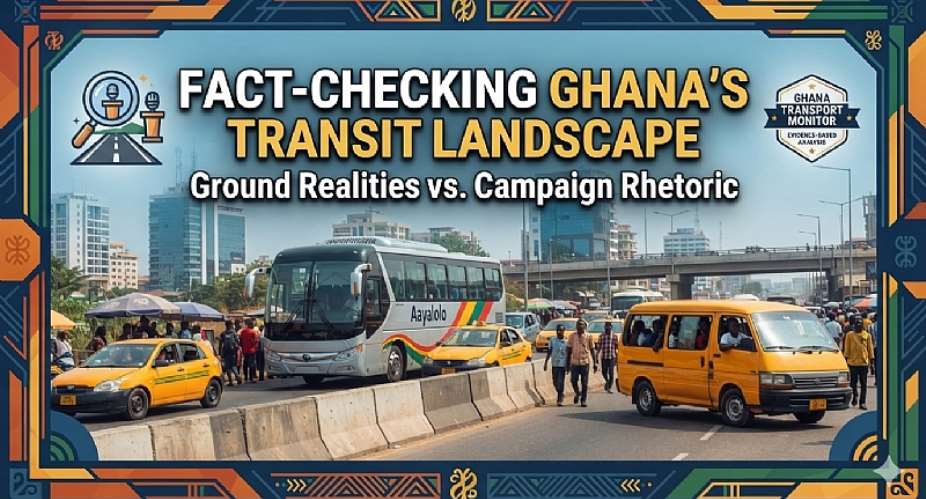
Beyond the Tunnels of Rhetoric – The True Cost of Ghana's Transit Future
Every election cycle presents Ghanaians with a familiar flurry of grand infrastructural promises. Recently, a viral flyer alleging a New Patriotic Party (NPP) proposal to construct an "underground train from Kumasi to Accra" ignited intense public debate, heavily evoking memories of the unfulfilled Accra Sky Train project. In a democratic landscape where capital-intensive infrastructure demands ultimate transparency, citizens deserve clarity over campaign graphics.
Ghana stands at a critical transport crossroads: public transport unions have just implemented a sharp 8% fare adjustment, and sovereign debt realities loom large. It is vital to look past the political theater, ground ourselves in the actual physical tracks built since 2017, expose the fabrications, and unpack how Ghana can sustainably fund the movement of its people and goods.
The Reality of the "Underground Train" and the Sky Train Legacy
Before examining current transit data, it is crucial to separate verified policy positions from digital misinformation and analyze the structural precedents:
- The Flawed "Underground" Flyer: Regional media monitoring and digital tracking indicate that the widely circulated graphic promising an "underground bullet train" from Kumasi to Accra is entirely fake. The flyer mimics breaking news layouts to project an exaggerated policy promise. The official government agenda remains anchored on expanding standard, ground-level intercity rail, not multi-billion-dollar subterranean tunneling.
- The Accra Sky Train Fallout: The public skepticism surrounding these rumors is rooted in the legacy of the Accra Sky Train project. Originally initiated via a Memorandum of Understanding in 2018 and a concession agreement in 2019 with a South African consortium, the project was officially shelved by 2021. The Ministry of Railway Development cited exorbitant costs and structural challenges, noting the state could not fund a network built on massive aerial columns.
- The $2 Million Liability: A subsequent Auditor-General’s report revealed that the Ghana Infrastructure Investment Fund (GIIF) disbursed a $2 million equity stake to a special purpose vehicle in Mauritius before feasibility studies were concluded. This transaction resulted in ongoing high-profile criminal trials targeting former officials for willfully causing financial loss to the state.
Track Record: What Has Actually Been Built Since 2017?
Despite the collapse of the Sky Train initiative, the shift toward traditional standard-gauge physical rail networks has yielded tangible results under the Ghana Railway Development Authority (GRDA):
- The Flagship Tema–Mpakadan Line (97.7 km): Fully completed and operational, this standard-gauge line serves as Phase 1 of the broader Ghana–Burkina Faso Interconnectivity Project. Funded through a $447 million credit facility from the India Exim Bank, the route features a massive 300-meter rail bridge spanning the Volta River, linking Tema Port directly to inland lake transport networks.
- The 7 Completed Stations & Regions: The line strategically features seven modern stations designed as microeconomic transit hubs across the Greater Accra, Eastern, and Volta regions:
- Tema Port Station (Greater Accra Region) – The industrial freight and passenger origin point.
- Tema Industrial Area Station (Greater Accra Region) – Serving the manufacturing enclave.
- Ashaiman Station (Greater Accra Region) – High-density commuter hub.
- Afienya Station (Greater Accra Region) – Key residential and suburban linkage.
- Doryumu-Jokpanya-Kodiabe Station (Greater Accra Region) – Serving the Shai Osudoku district.
- Kpone / Juapong Station (Eastern / Volta Region boundary) – Linking agricultural trade lines.
- Mpakadan Terminal / Adome (Volta Region) – The primary inland port transfer hub on the edge of the Volta Lake.
- Western Railway Line Expansion (80 km): A newly laid 80-kilometer track stretching from Takoradi to Huni Valley (via Nsuta and Tarkwa) was successfully completed. This narrow-gauge upgrade directly targets economic viability by linking mining enclaves to the Takoradi Port to facilitate manganese and bauxite export.
Macroeconomic Breakdown: The 8% Fare Shock and Accra Food Prices
While long-term rail lines develop, road transport remains the immediate economic lifeline for millions of Ghanaians. Following negotiations between the Ministry of Transport, the Ghana Private Road Transport Union (GPRTU), and the Ghana Road Transport Coordinating Council (GRTCC), an official 8% upward adjustment on commercial transport fares has taken effect.
In Ghana, transport fares are never just transport fares; they are a direct driver of food inflation. The recent 8% transit hike has caused an immediate, disproportionate compounding effect on the cost of food inside major Accra markets like Agbogbloshie, Makola, and Madina:
- The Trilateral Transport Cost Accumulation: Food commodities sold in Accra are heavily reliant on multi-stage haulage. A single tuber of yam or bag of maize incurs an 8% increase when transported from farm-gate to regional aggregation hubs, another 8% increase on long-distance wholesale haulage trucks moving down the Eastern or Central corridors, and a final 8% cost surge on retail trotros or market taxis distributing goods within Accra.
- Wholesale to Retail Price Compounding: Because transport unions adjusted long-distance premium hauls to GH¢324.00, bulk wholesalers have passed these direct transactional overruns onto market queens. For instance, the retail price of stable staples—such as a bag of local rice, cassava, or onions—has surged by 12% to 15% at the market stall level, far outpacing the nominal 8% fare boundary as traders absorb the combined transport hikes of their entire supply chains.
- The Commuter Budget Squeeze: With intra-city trotro rates moving to GH¢5.50 for short hops and up to GH¢36.80 for extended urban runs, the lower-income demographic faces a dual financial squeeze. Over 80% of urban Accra residents rely on public transport; they are now forced to navigate higher daily commuting expenses while simultaneously facing reduced purchasing power for basic household food items.
Deconstructing the Funding Models: How Do We Pay for It?
Given Ghana's rigid fiscal constraints, funding mega-projects without compounding the national debt requires a complete departure from traditional government financing. Currently, the transport sector is relying on three distinct funding streams:
- Freight-Driven Commercial PPPs: The cornerstone of the revised Ghana Railway Master Plan is a transition to a "freight-first" model. Because passenger fares alone cannot recoup the capital expenditure of heavy rail, the state leverages private investment by guaranteeing return on investment (ROI) backed by off-take logistics agreements with major mining firms.
- Bilateral Development and Concessional Capital: Major regional links rely on long-term, low-interest credit lines from international export-import banks (such as India Exim Bank). While this keeps interest rates low, these timelines remain highly vulnerable to broader national debt restructuring terms.
- Targeted Domestic Subsidy Interventions: For immediate road transport relief, the government utilizes domestic treasury splits. This includes injecting dedicated pools—such as recent allocations of approximately GH¢200 million to GH¢400 million—to procure high-capacity buses for the Metro Mass Transit (MMT) and STC networks, alongside short-term fuel price stabilization mechanisms to absorb global oil shocks.
Conclusion & Policy Recommendations for Ghana's Transit Future
Ghana does not need subterranean bullet trains or unfeasible aerial sky trains to revolutionize its economy. The completed Tema–Mpakadan line proves that realistic, well-executed standard-gauge ground infrastructure yields genuine economic connectivity. To ensure sustainable, reliable, and affordable transit for all citizens, the following policy interventions are recommended:
- Enforce Rigid BOT Procurement Frameworks: All upcoming phases of the Ghana–Burkina Faso rail network must strictly adhere to transparent Build-Operate-Transfer (BOT) models. Government must entirely eliminate upfront sovereign equity disbursements before comprehensive feasibility reports are legally finalized to prevent a recurrence of the Sky Train loss.
- Prioritize the Central Railway Spine Over Prestige Projects: State planning must concentrate exclusively on completing the ground-level rail link connecting the Port of Tema and Accra to Kumasi and Tamale. Prioritizing bulk cargo freight (cocoa, bauxite, cement) will generate the necessary commercial revenue to naturally subsidize passenger transit over time.
- Establish a Dedicated Mass Transit Fuel Levy Fund: To prevent friction between transport unions and commuters, a fraction of domestic energy levies should be formally ring-fenced into a Mass Transit Stabilization Fund. This fund should exclusively subsidize fuel margins for high-capacity state buses (MMT/STC) during international oil spikes, keeping commuter fare hikes rare and manageable.
- Accelerate Multi-Modal Logistics Integration: The Ministry of Transport must expedite the construction of the Volta Lake barge infrastructure at Mpakadan and Buipe. Integrating rail directly with inland water transport creates the cheapest possible shipping pipeline to the north, lowering food commodity costs and mitigating inflation across the country.
✍️ Submitted by:
Retired Senior Citizen
For and on behalf of all Senior Citizens of the Republic of Ghana 🇬🇭
Teshie-Nungua
[email protected]


 September 29: Cedi finishes day selling at GHS12.20 on forex market, GHS11.67 on...
 ‘We’ll explore another constitutional option for narcotics probe’ – Minority on ...
 Speaker Bagbin adjourns Parliament indefinitely after rejecting narcotics probe ...
 Food Buffer Stock seeks stronger liquidity buffer despite record GH¢91.7 million...
 Ex NAFCO Boss trial: Court adjourns trial to hear application for return of seiz...
 Bagbin backs Mahama’s call for national dialogue on social media insults
 National conversation should not become an exercise in suppressing dissent — Bag...
 ‘Don’t reward only bitter tongues, it encourages others to copy’ – Bagbin tells ...
 We have cut cost of capital by more than half since Mahama took office – Ato For...


