




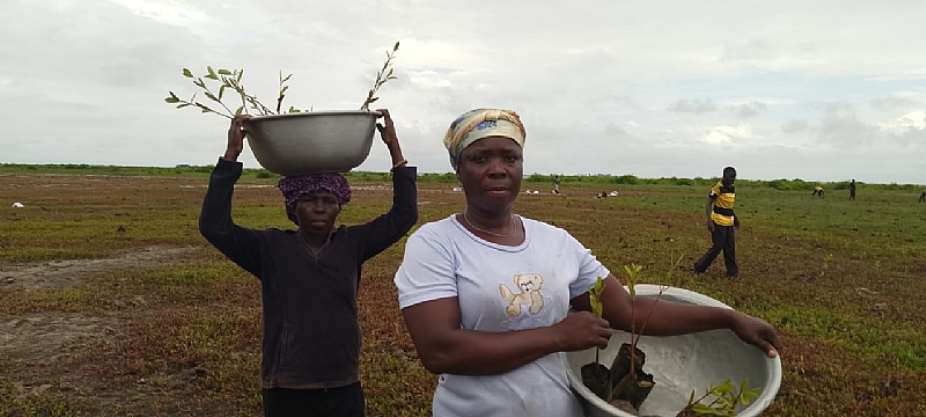
Rural women manage the water, forests and farmland that climate projects depend on, yet they are often left out of planning. Guidance on Nature-based Solutions says that is a mistake.
Ask who fetches the water, gathers shellfish from the mangroves, harvests fruits and nuts from the trees, or notices when a medicinal plant starts to vanish. In rural communities across Africa, the answer is often the same: women.
That is the starting point of a growing push for gender-responsive nature-based Solutions (NbS), which holds that projects to protect, manage and restore ecosystems work better when women help lead them. The International Union for Conservation of Nature (IUCN) defines NbS as actions that protect, sustainably manage and restore natural and modified ecosystems to tackle societal challenges, with benefits for both people and biodiversity.
Why it matters
Many African countries are on the front lines of climate change, facing droughts, floods and shifting rainfall. In Sub-Saharan Africa, a large share of the population depends on agriculture and natural resources for a living. Women play a crucial role in these sectors, but they often have poorer access to resources, information and decision-making.
Gender-responsive NbS aims to close that gap. It seeks to ensure that women, men, youth and marginalised groups all take part in designing, delivering and evaluating projects, and all share in the benefits.
Women's knowledge changes the design.
The guidance argues that women's involvement improves projects at every stage:
- Identifying the problem: Because women are often the main managers of natural resources, they can spot issues others miss, such as water quality concerns or a decline in plants a family relies on for food or medicine.
- Design: Where projects involve heavy work such as planting trees or building terraces, women should help plan so that tasks, tools and schedules suit everyone.
- Implementation: Balanced leadership and labour ensure fair access to jobs and income. That may mean training women in areas usually dominated by men, such as technical forestry or water-conservation engineering.
- Monitoring and evaluation: Women can report how a project affects daily life and help measure progress on equality and empowerment.
- Judging success: Counting trees planted or hectares restored is not enough. Success should also be measured by women's income, time saved on unpaid care work, and women's role in decision-making.
What it looks like on the ground
In mangrove restoration, women who gather shellfish and men who fish nearby see the ecosystem differently. Consulting both leads to better goals and better monitoring.
In reforestation, women may favour species that yield fruit, nuts or medicinal herbs, while men may prioritise timber. Involving both encourages a wider mix of species, which supports biodiversity.
In agroforestry, women often harvest fruits and nuts, so targeted training in sustainable harvesting and marketing can make their work as profitable as men's.
In water management, where women are often responsible for collection, involving them in design helps ensure access points are convenient and water quality suits household needs.
Lessons from other countries
- Nepal: An IUCN-funded community reforestation project gave women decision-making roles and training in nursery management and afforestation. It improved forest cover and gave women more control over resources.
- Jordan: A UN Women-funded project set up water user associations in which women were encouraged to join as members and leaders, so water distribution reflected the needs of all household members.
- Uganda: The Women Empowerment in Sustainable Land Management (WESLAM) project in Bugiri and Mayuge districts, funded by the Swedish Postcode Lottery, supports women in beekeeping and mushroom cultivation. These alternative incomes reduce dependence on activities that drive deforestation, while collaborative forest management gives farmers sustainable access to forest reserves.
The barriers
Women face serious obstacles to taking part. The guidance lists:
- Poorer access than men to land, water, finance and technology
- Social norms that limit women's voice in household and community decisions
- Fewer opportunities for education and training
- Heavy childcare and household duties, and financial dependence that leaves little time for projects with no quick returns
- Involvement that stops at providing labour, with little say in planning or leadership
- Limited access to markets, including transport, price information and freedom of movement
- Weak support and mentorship networks
- A lack of gender-disaggregated data, which hides women's specific needs
- Compounded disadvantages for women who are disabled, displaced or from minority groups
The payoff
When women participate, the benefits reach the whole community: income from sustainable farming and agroforestry, better food and nutrition, stronger conservation of soil, water and biodiversity, and greater resilience to climate change. Women also preserve traditional knowledge and pass skills to the next generation.
The stakes are large. According to the United Nations, giving rural women equal access to resources, education and markets could raise agricultural output enough to lift hunger for up to 150 million people.
Nature-based solutions are only as strong as the people who carry them out. As the guidance makes clear, projects that count women only as labourers miss the knowledge and leadership that could make them last.


 September 29: Cedi finishes day selling at GHS12.20 on forex market, GHS11.67 on...
 ‘We’ll explore another constitutional option for narcotics probe’ – Minority on ...
 Speaker Bagbin adjourns Parliament indefinitely after rejecting narcotics probe ...
 Food Buffer Stock seeks stronger liquidity buffer despite record GH¢91.7 million...
 Ex NAFCO Boss trial: Court adjourns trial to hear application for return of seiz...
 Bagbin backs Mahama’s call for national dialogue on social media insults
 National conversation should not become an exercise in suppressing dissent — Bag...
 ‘Don’t reward only bitter tongues, it encourages others to copy’ – Bagbin tells ...
 We have cut cost of capital by more than half since Mahama took office – Ato For...


