




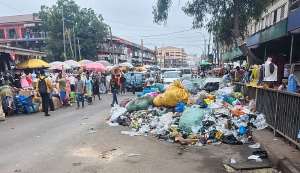
At 9:00 AM on a bustling morning in the heart of the Accra Central District, the city is usually alive with energy. Traders set up their displays, commuters weave through traffic, and shopkeepers unlock their doors, ready for the day’s commerce. Yet, right on the main thoroughfare, another sight greets passersby: towering mounds of unsorted, overflowing garbage heaped directly onto the asphalt. As citizens step around piles of decaying refuse and decaying plastic sacks to conduct their daily business, a pressing question arises: why are local authorities allowing the capital’s commercial core to deteriorate into an open-air dump?
Traders and businesses in the Central Business District of Accra contribute dutifully to public coffers through local taxes, market tolls, and operating fees. In return, the primary expectation is basic urban service delivery—chief among which is a clean, safe, and navigable environment. When garbage sits unattended during peak morning business hours, it represents a breakdown in basic municipal duty. Sanitation is not a luxury or a secondary priority; it is a fundamental public service funded directly by the taxpayers who must now breathe in the stench of uncollected waste as they earn their living.
The current situation points to two crucial failures: inadequate waste collection schedules and non-existent enforcement of sanitation bylaws. Collecting trash once a day or whenever contractor trucks happen to arrive is no longer sufficient for a high-density commercial hub. Beyond clearing the streets, the Assembly must strictly enforce existing environmental and sanitation laws. Nighttime dumping has become an unchecked routine for unscrupulous individuals who exploit empty streets after dark, knowing no task force or night patrol will hold them accountable.
This governance gap becomes even more glaring against the backdrop of national development ambitions. Policy discussions frequently champion a 24-hour economy to drive growth, productivity, and employment. However, a 24-hour economy cannot function on an 8-hour municipal clock. If private citizens and businesses are expected to operate around the clock, local authorities must also work around the clock. Ensuring clean streets, monitoring high-risk dumping spots, and prosecuting offenders cannot pause when the sun goes down.
The Mayor of Accra and the Accra Metropolitan Assembly must step up and serve the public with the urgency this crisis demands. Addressing this issue requires an immediate shift to round-the-clock municipal oversight:
First, waste management operations must transition to nightly schedules so that main commercial avenues are completely cleared before morning trade begins.
Second, the Assembly must deploy dedicated sanitation task forces during off-peak and overnight hours to catch and prosecute illegal dumpers under municipal bylaws.
Third, public infrastructure must be upgraded with heavy-duty, enclosed waste receptacles in high-density market zones to prevent street-level piling.
Accra’s status as a gateway city and economic engine cannot survive alongside roadside garbage heaps. The taxpayers of the Central Business District have done their part by contributing to municipal revenue; it is now time for the local assembly to honor its obligation, enforce the law, and deliver a clean capital city fit for day and night.
The author is an Information Officer, a regular contributor to News Commentary, a current affairs programme by the Ghana Broadcasting Corporation and a columnist with Modern Ghana, an esteemed online news portal.


 Credit Godfred Dame for Ghana's US$393 million tax arbitration victory against T...
 How can EOCO be accused of wanting to kidnap Baffour Awuah in full glare of the ...
 'She is not party operative' – Kwakye Ofosu defends EOCO officer
 Baffour Awuah wanted over alleged financial loss, dissipation of public funds an...
 Brazil is the main source of cocaine in Ghana by sea concealed in sugar containe...
 'The cacophony of noises surrounding my comments were pure mischief' — Chief Jus...
 ‘Judges must not abandon their humanity because of their judicial office’ – Chie...
 GTEC flags over 100 tertiary institutions as unrecognised
 Political protection may be behind decline in visible cocaine trafficking in Gha...
 Ghana identified as source of explosives used in Sahel conflicts — Crime Index r...



Comments
The Accra Metro Assembly is simply not working.