




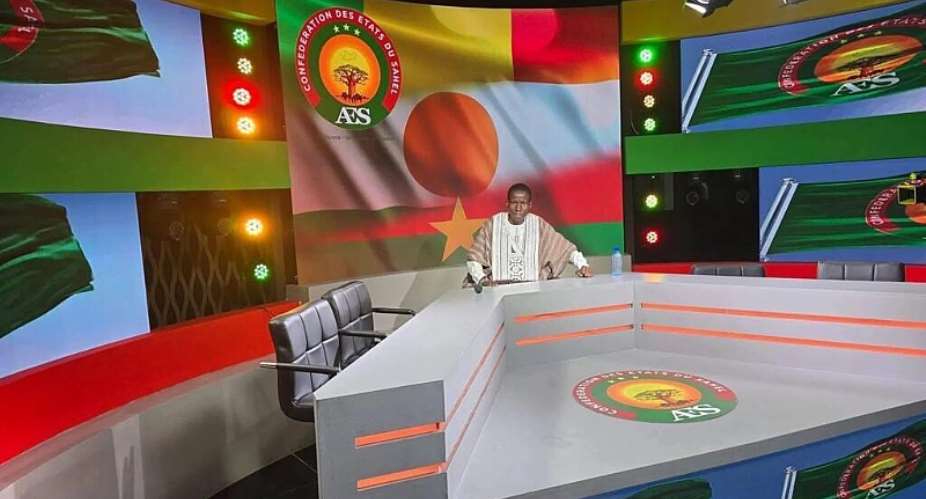
Broadcasting from Bamako and available through Canal+, the channel is part of a wider media network being developed by the Alliance of Sahel States – or AES – as its members deepen ties with Russia and distance themselves from France and other Western partners.
“We had to strike back... to ensure that these platforms could spread our own narrative,” Malian Foreign Minister Abdoulaye Diop said this month.
Tafouk TV, whose name means “Sun” in Tamasheq, the language spoken by many Tuareg communities across the Sahel, began official programming on 16 September.
Its presentation draws heavily on regional imagery. The opening theme is inspired by the music of traditional Dozo hunters, while the logo of its Communication Intervention Brigade programme features a shield incorporating a camera, microphone and pen.
“When plotters attempt to destabilise the state, the battle plays out not just in the barracks, but also on our screens, in newspaper columns and on social media,” said presenter Abdoul Niang, Tafouk TV's news director and a cyberactivist close to Mali's military authorities.
One programme featured pan-African influencer Franklin Nyamsi, a supporter of the Sahel juntas, analysing French media coverage of a thwarted mutiny in Niger in August.
Burkina Faso added to human rights watchlist over crackdown on civil society
Battle over the narrative
Burkina Faso, Mali and Niger have progressively broken with Western governments, particularly former colonial power France, while strengthening diplomatic and security ties with Russia.
Military leaders in the three countries justified their takeovers partly by citing the failure of civilian governments to contain years of jihadist violence. Armed groups nevertheless remain active across large parts of the region, with civilians and security forces continuing to be killed.
The juntas have also faced criticism over restrictions on political opposition and the media.
Foreign correspondents have been expelled and several major Western broadcasters suspended or banned after reporting military losses or accounts that contradicted official claims of battlefield successes.
How a disinformation network is destabilising the Alliance of Sahel States
Tafouk TV broadcasts three daily news bulletins focused on the three members of the Alliance of Sahel States, or AES.
Burkina Faso, Mali and Niger created the alliance before withdrawing from the Economic Community of West African States, Ecowas, and have since sought to build common political, security and diplomatic structures.
Niger's state television said the launch meant Sahel populations were “no longer passive consumers of false and manipulated stories coming from fake news factories”.
Tafouk TV plans programmes on fact-checking, geopolitics and frontline developments in French, English and regional languages including Bambara and Hausa.
Russia has openly supported the project. Moscow's ambassador to Mali, Igor Gromyko, praised its planned role in fighting “disinformation and cognitive warfare” in June.
A month later, Tafouk TV signed a cooperation agreement in Niamey with the parent company of Russian state-funded broadcaster RT, covering content exchanges, expertise and joint coverage of events in Russia and the Sahel.
Burkina Faso, Mali and Niger jointly announce withdrawal from the ICC
Building an AES media network
The television channel follows the launch in December of Daande Liptako radio, broadcasting from Ouagadougou on a frequency previously used by Radio France Internationale.
RFI is now banned in all three AES states.
The alliance is also planning a joint official news agency based in Niamey, further extending a media network designed to give the three governments greater control over how their policies and security campaigns are presented.
But the project has also prompted calls for greater media pluralism.
A former Nigerien MP warned that the new service “must not become a propaganda tool”.
“We also need genuine, open debates where any and all opinions can be expressed,” the former lawmaker said.
(with newswires)


 We have cut cost of capital by more than half since Mahama took office – Ato For...
 Dr Bertha Ayi on how parents hurt children by raising them only on English
 Customs intercepts three firearms, 610 rounds of ammunition at Tema Port
 NDC to open nominations for 2026 regional executive elections on October 6
 Africa will be mostly self-sufficient in fuel by 2030: Dangote to AFP
 PRETAG threatens to intensify strike over unpaid teacher entitlements
 Lands Minister exits GoldBod Board as Minister's Chief Director takes over
 Court refuses bail for six accused in 3.9-tonne cocaine shipment case
 Philippines to open first-ever embassy in Ghana
 1992 Constitution review: Prof. Atsu Ayee and Dr Osae-Kwapong explain why Consti...


