




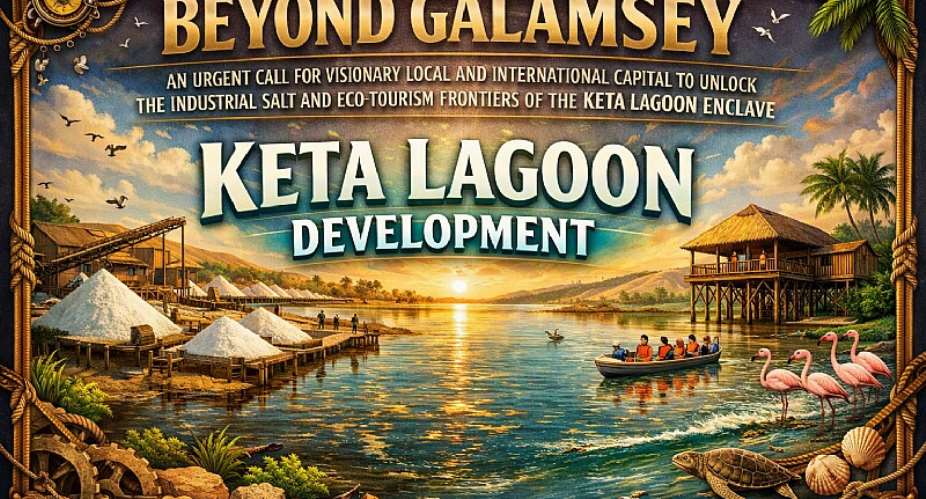
The stern declaration by the Agbogbomefia of Asogli, Togbe Afede XIV, at the Volta Economic Forum sent a clear, thunderous, and non-negotiable message across the nation: “We will not allow galamsey in the Volta Region.” This proactive stance by the regional leadership is not merely an environmental shield; it is a profound, foundational economic strategy. While other parts of our beautiful nation battle the devastating scars of illegal mining—poisoned river bodies, destroyed forest reserves, and ruined communities—the Volta Region is drawing a sacred line in the sand.
True sovereign wealth does not lie in the short-sighted, toxic extraction of gold that leaves our posterity penniless, sick, and landless. Instead, Ghana’s greatest economic frontiers reside in sustainable, green, and circular industries. Foremost among these sleeping giants is the Keta Lagoon enclave—a sprawling, pristine geophysical masterpiece that holds the keys to completely transforming Ghana's macro-economy. For both domestic financiers and international venture capitalists, the Keta Lagoon is an export goldmine hiding in plain sight. It is time to shift our focus from mere political momentum to concrete, high-yield investment execution.
Global Export Powerhouse: The Industrial Salt & Chemical Value Chain
The physical layout and unique micro-climate of the Keta Lagoon basin present some of the most favorable solar evaporation conditions in all of West African coastal areas. With an annual demand exceeding 3 million metric tons of salt within the ECOWAS sub-region alone, Keta’s industrial potential remains critically under-exploited. Turning this potential into an economic engine requires state-of-the-art logistical execution:
- Targeting High-Margin ECOWAS Export Hubs: The primary strategic focus for large-scale investors is capturing the immense, underserved industrial salt markets across West Africa. Nearby manufacturing giants—particularly in Nigeria, Côte d'Ivoire, and Togo—rely heavily on expensive, overseas imported salt for oil refining, textiles, caustic soda production, and food processing. Keta's geographical proximity offers an unbeatable logistical advantage, slashing transit times and cross-border shipping costs across the sub-region.
- Geo-Membrane Crystallization for International Standards: To transition from basic domestic salt winning to premium industrial-grade "White Gold" fit for global export, the blueprint mandates the deployment of high-density geo-membrane pond liners. This completely prevents mud contamination, accelerates crystallization, and ensures the finished product meets strict international chemical, pharmaceutical, and food-safety purity standards.
- Eco-Friendly Brine Management Systems: Modern investments must focus on engineered evaporation pipelines and automated water management channels. Drawing sea brine efficiently into controlled networks ensures a high-purity yield without disrupting local groundwater or altering the delicate hydrology of the lagoon ecosystem.
- Renewable-Powered Mechanization: Operations should integrate solar-powered pumping networks, automated washing lines, and wind-driven drying technology. This green energy footprint significantly reduces operational overhead while qualifying the project for international green bonds, carbon credits, and climate-focused Foreign Direct Investment (FDI).
- Inclusive Cooperatives & Local Protection: To eliminate community friction and past historical tensions with large-scale concessions, the logistics model must carve out designated zones managed via Public-Private Partnerships (PPPs) with youth and women-led local cooperatives. By formalizing traditional salt winners into the supply chain as contracted growers, investors secure absolute local protection, social license, and uninterrupted operations.
Cultivating Global Desires: Premium Eco-Tourism & Regenerative Experiences
The Keta Lagoon Complex is a globally recognized Ramsar site, sheltering hundreds of rare and migratory bird species. In an era where international travelers actively seek low-carbon, authentic, and restorative experiences, Keta is perfectly positioned to become Africa’s premier eco-luxury hub. The logistical blueprint includes:
- Exporting the "Keta Experience" to International Markets: This blueprint is explicitly designed to position the Volta Region directly on the global map for luxury green travel. By targeting affluent ecotourists, academic researchers, and leisure travelers from the diaspora, Europe, and the Americas, investors can tap into a multi-billion-dollar global industry that imports hard foreign currency directly into the local economy.
- Solar-Powered Stilt Villages & Capsule Resorts: Developing low-impact, premium boutique hospitality infrastructure built on elevated wooden pilings over non-sensitive water margins. Utilizing modular, sustainable designs equipped with off-grid solar energy storage systems and eco-friendly biodigester waste management preserves the water body while offering an unparalleled luxury aesthetic.
- Blue Carbon Mangrove Sanctuaries: Investors can spearhead community-led mangrove nursery and replanting programs. Logistically structured as carbon offset projects, these sanctuaries allow corporate investors to monetize blue carbon credits on the global market while building scenic boardwalks for world-class birdwatching, research, and scientific tourism.
- Green Water Transit Infrastructure: Introducing commercial fleets of solar-powered electric boats and low-noise electric water tricycles. This unlocks seamless, eco-friendly transit corridors connecting tourist hubs across Keta, Anyako, and Afiadenyigba without fossil-fuel spillage or disruptive engine noise polluting the aquatic ecosystem.
- Integrated Heritage & Cultural Circuits: Coupling the breathtaking natural landscape with the deep, rich history of Anlo land. Structuring professional, guided excursions to historical landmarks like Fort Prinzenstein, paired with local culinary and arts festivals, creates a continuous hospitality economy that drives 24-hour domestic and international tourism.
Actionable Strategic Recommendations for Investors
- Form Strategic Local Joint Ventures: International investors should actively seek partnerships with local traditional authorities, regional development organizations, and existing innovative youth hubs to guarantee institutional legitimacy, smooth land securing, and deep social license.
- Utilize Green and Circular Integration: Design industrial models where salt-processing by-products or lagoon aquaculture wastes are funneled into high-protein animal feeds or organic composts for nearby hybrid coconut and oil palm plantations, ensuring a zero-waste, highly profitable circular loop.
- Leverage AfCFTA and ECOWAS Trade Protocols: Position your Keta operations to exploit the immediate geographical proximity to the West African market, taking full advantage of reduced transport costs, harmonized tariffs, and shorter maritime or land supply routes under the African Continental Free Trade Area.
- Prioritize Rigorous Environmental Compliance: Work closely with the Environmental Protection Agency (EPA), the Forestry Commission, and local assemblies to ensure all setups align strictly with the lagoon's conservation status, securing long-term operational peace and global sustainability certifications.
The Upstream Petroleum Integration — Keta’s Salt as the Lifeline of West Africa’s Oil Drilling Export Market
While salt is widely recognized as a domestic commodity, its highest financial value lies hidden in the global oil and gas upstream sector. For local and international investors, the Keta Lagoon enclave represents a multi-billion dollar industrial raw-material hub capable of fueling the entire West African petroleum industry.
1. The Critical Physics of Oil Drilling and "White Gold"
In petroleum exploration, industrial-grade rock salt is a non-negotiable component of drilling fluids and completion muds:
- Density Control & Blowout Prevention: Coarse rock salt increases the specific gravity and density of drilling muds. This creates vital hydrostatic pressure to counteract downhole pressure, stabilizing the wellbore wall and preventing catastrophic oil well blowouts.
- Shale Inhibition: When drilling through active shale formations, fresh water causes the clay to swell and collapse the wellbore. High-salinity brine formulated from pure industrial salt prevents water absorption, preserving structural integrity.
- Well Completion Fluids: Saturated, clear brines are used as wash and packer fluids to prevent formation damage when transitioning an oil well from drilling to active production.
2. The Multi-Billion Dollar West African Demand Matrix: Facts and Figures
The current geopolitical supply chain for industrial salt in Africa presents a stark, highly profitable economic anomaly that investors can exploit immediately:
- The Overlooked 3 Million Ton Market Gap: The total regional demand for industrial and food-grade salt within the ECOWAS sub-region stands at a staggering 3,000,000 metric tons annually. Yet, Ghana currently produces less than 400,000 metric tons per year across all operational sites, operating at a fraction of its true physical potential.
- The Brazilian Supply-Chain Anomaly: Neighboring Nigeria, Africa's major petroleum producer, spends over $1.5 billion annually importing raw industrial resources from distant nations. A significant part of this trade involves shipping raw industrial crude salt from Brazil across entire oceans, instead of sourcing it from the Ghanaian coastline just a few hundred kilometers away.
- Ghana's Deepwater Demand Expansion: Ghana’s domestic upstream sector—boasting hundreds of millions of barrels of recoverable crude oil reserves—is experiencing an expansion in deepwater offshore drilling operations. The domestic oil and gas industry requires over a million tons of salt annually as drilling inputs, a massive market gap that is currently satisfied through foreign imports.
- The Keta Scale Advantage: The Keta Lagoon basin possesses an inherent capacity to scale up industrial salt operations exponentially. Engineered infrastructure rollouts can comfortably support an initial output of 600,000 metric tons annually, scaling past 1.2 million metric tons within secondary investment phases. This volume is capable of transforming the Volta Region into the primary upstream chemical supplier for the entire West African maritime trade corridor.
3. Strategic Value-Addition and Logistics for Upstream Buyers
To successfully capture international oil-drilling supply contracts, Keta's processing models must shift from raw solar extraction to technical manufacturing:
- Chlor-Alkali Downstream Hubs: Strategic capital must target the setup of refining plants capable of processing salt into advanced chemical derivatives like caustic soda, chlorine, and hydrochloric acid—the baseline fluids required for oilfield cleaning, stimulation, and regional water treatment facilities.
- Bulk Marine Export Infrastructure: By leveraging the coastal geography of Keta, investors can engineer specialized bulk-loading marine terminals or link operations to regional deepwater ports. This allows for the cost-effective, bulk maritime export of industrial brines and solid rock salt directly to offshore drilling platforms across the Niger Delta, Angola, and the wider ECOWAS energy sector.
Special Call for Prospective Partners
The development of the Keta Lagoon enclave represents a unique, generational wealth-creation opportunity. To facilitate seamless execution, interested local financiers, international venture capital funds, and eco-development consortia are invited to engage directly for strategic data sharing, site mapping, and regulatory navigation guidance.
For tailored project briefs, institutional insights, or to discuss partnership frameworks on Public-Private Partnership (PPP) models, please contact the author and strategic coordinator, Atitso Akpalu (Consultant & Columnist), directly at [email protected] or via the Office of the Strategic Coordinator at Dawn Vision Technologies Ltd. Together, we can move this framework from a blueprint into an unshakeable, profitable reality.
Togbe Afede XIV’s warning must be taken as an urgent, golden invitation to build, innovate, and protect. The choice before Ghana is stark: we can either allow lawless elements to plunder our rivers and soil for immediate greed, or we can step forward with sophisticated, sustainable investments that guarantee intergenerational wealth. The Keta Lagoon basin stands ready. With its vast natural salt reserves, unmatched ecological beauty, and an energetic, disciplined youth population hungry for green jobs, all that is missing is the bold execution of visionary capital. The opportunity is clear, the local leadership is fully supportive, and the time to build a resilient, prosperous Volta Region is right now. Let us turn this coastal treasure into the shining economic anchor of West Africa.
✍️ Submitted by:
Retired Senior Citizen
For and on behalf of all Senior Citizens of the Republic of Ghana 🇬🇭
Teshie-Nungua
[email protected]


 We have cut cost of capital by more than half since Mahama took office – Ato For...
 Dr Bertha Ayi on how parents hurt children by raising them only on English
 Customs intercepts three firearms, 610 rounds of ammunition at Tema Port
 NDC to open nominations for 2026 regional executive elections on October 6
 Africa will be mostly self-sufficient in fuel by 2030: Dangote to AFP
 PRETAG threatens to intensify strike over unpaid teacher entitlements
 Lands Minister exits GoldBod Board as Minister's Chief Director takes over
 Court refuses bail for six accused in 3.9-tonne cocaine shipment case
 Philippines to open first-ever embassy in Ghana
 1992 Constitution review: Prof. Atsu Ayee and Dr Osae-Kwapong explain why Consti...


