




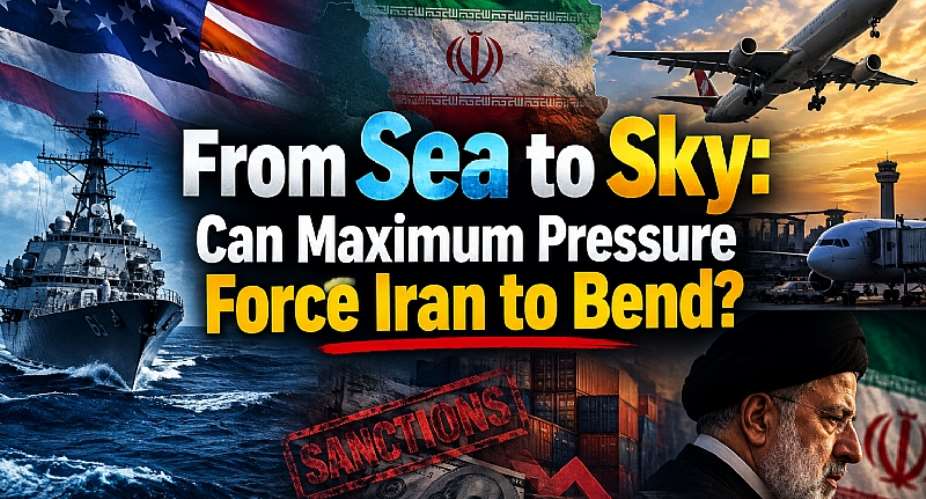
The larger the scale, the greater the difficulty of maintaining precision. Physics may not be a textbook for geopolitics, but its logic can sometimes offer an interesting metaphor: when pressure expands without producing the intended result, the question is whether the pressure itself has become the strategy. The United States has moved from maritime pressure towards aviation isolation against Iran. But if the strategy remains the same, how can Washington expect a different strategic result?
In early September, the US Treasury imposed sweeping sanctions targeting Iran’s aviation sector. Treasury Secretary Scott Bessent warned that foreign companies providing fuel, landing services or ticketing to Iranian carriers could face exclusion from the US dollar system. Washington set September 23 as the enforcement deadline.
The immediate impact has been significant but not absolute. Iranian international connectivity has been reduced, with several regional routes suspended or restricted. Yet Iranian airlines have continued to operate some international flights, including services involving China and other destinations. This raises the central question: Is aviation isolation capable of producing political capitulation, or will it simply create another layer of economic and humanitarian pressure?
HOW DOES THE US ADD THE SAME MOVE ON THE PUSHED LIMIT?
Washington's argument is that sustained economic pressure can restrict Iran's ability to finance military and strategic activities. Tehran, however, has challenged the legitimacy of unilateral sanctions and has sought international diplomatic channels. The dispute therefore extends beyond aircraft and airports; it has become another test of whether economic coercion can substitute for negotiated diplomacy.
Iran's response has also demonstrated that isolation is not necessarily synonymous with complete disconnection. China has openly opposed unilateral US sanctions, while Iranian flights have continued to reach Chinese destinations. Russia and China remain important diplomatic counterweights, even though Beijing has not committed to military support for Tehran.
The question therefore becomes: Can Washington close Iran's international doors when major powers continue to keep some of those doors open?
HOW WILL IRAQ AND OTHER COUNTRIES REACT TO THE AVIATION BLOCKADE?
The regional response has been mixed. Iraq initially suspended Iranian flights to Baghdad under pressure generated by the threat of secondary sanctions. Yet Baghdad simultaneously sought alternative arrangements involving Najaf, reflecting the importance of religious travel and its delicate relationship with both Washington and Tehran. On September 28, the United States moved towards a limited waiver for Iraqi Airways flights between Iran and Najaf.
Other countries have also faced difficult choices. Some regional and neighbouring states restricted Iranian carriers, while China continued to reject the American approach. The result is therefore not a uniform blockade but a fragmented aviation environment.
If even neighbouring states must balance Washington's sanctions against their own economic, religious and strategic interests, can aviation pressure produce the comprehensive isolation Washington seeks?
HOW ARE THE GCC AND ISRAEL DEALING BEHIND CLOSED DOORS?
The Gulf states face an equally complicated equation. MBS's Vision 2030 is fundamentally associated with economic diversification, investment and regional connectivity. Such ambitions require a diplomatic environment in which Saudi Arabia and other Gulf states can maintain working relationships across competing geopolitical camps.
Israel, meanwhile, views Iran through a fundamentally different security lens. Yet the wider regional calculation is more complicated than a simple Iran-versus-Israel equation. Gulf governments must consider the consequences of prolonged conflict, disruption to energy markets, regional security and the possibility that escalation may eventually reach their own territory.
This also raises questions about the Mecca Pact and its regional security implications. If a mutual-defence arrangement is designed around external threats, how should it address a conflict involving a regional actor when Israel itself is directly involved in the wider confrontation but relies heavily on US strategic support?
The unanswered questions surrounding the Abraham Accords, Gulf-Israel relations and Iran's regional role demonstrate that public diplomacy and private strategic calculations do not always move at the same speed.
PAKISTAN'S DIPLOMATIC STRAIN UNDER TEST?
For Pakistan, the aviation sanctions create another diplomatic balancing test. Pakistan's regional mediation role and its relationships with Saudi Arabia, Iran, China and the United States require careful management. The fact that exemptions or alternative arrangements can emerge demonstrates that sanctions are not always absolute; diplomacy can create limited spaces within pressure regimes.
But Pakistan faces a deeper question: How can Islamabad preserve strategic relationships without becoming directly absorbed into a conflict whose consequences are already approaching its regional neighbourhood?
The choice is not simply between supporting one side and opposing another. Pakistan must calculate economic interests, regional security, its relationship with Saudi Arabia, ties with Iran, relations with China and its broader engagement with Washington.
A blockade may restrict aircraft, ships and financial channels, but diplomacy remains the only mechanism capable of converting pressure into an exit strategy. The ultimate question is therefore not merely whether Iran can survive the blockade, but whether maximum pressure can produce a sustainable peace without creating a wider regional crisis.


 Credit Godfred Dame for Ghana's US$393 million tax arbitration victory against T...
 How can EOCO be accused of wanting to kidnap Baffour Awuah in full glare of the ...
 'She is not party operative' – Kwakye Ofosu defends EOCO officer
 Baffour Awuah wanted over alleged financial loss, dissipation of public funds an...
 Brazil is the main source of cocaine in Ghana by sea concealed in sugar containe...
 'The cacophony of noises surrounding my comments were pure mischief' — Chief Jus...
 ‘Judges must not abandon their humanity because of their judicial office’ – Chie...
 GTEC flags over 100 tertiary institutions as unrecognised
 Political protection may be behind decline in visible cocaine trafficking in Gha...
 Ghana identified as source of explosives used in Sahel conflicts — Crime Index r...


