




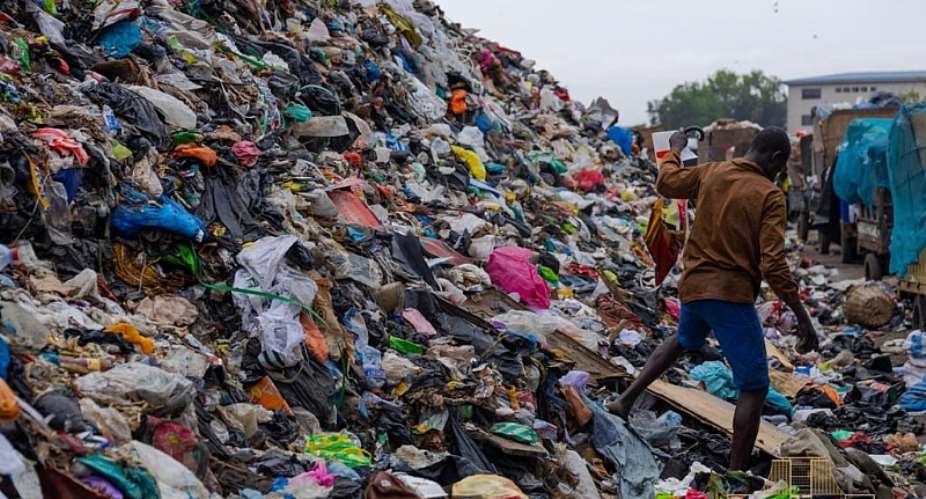
Ghana loses more than GH¢6.2 billion every year through healthcare costs and lost productivity linked to poor waste management and sanitation, according to a new policy brief by the Institute of Statistical, Social and Economic Research (ISSER) of the University of Ghana.
The researchers are urging government to urgently scale up investment in sanitation, warning that preventable diseases linked to poor waste management cost the country 31.9 million work and school days each year.
MMDAs Spend Only GH¢180.2 Million on Sanitation
The losses far exceed what Metropolitan, Municipal and District Assemblies (MMDAs) currently spend on the problem.
According to ISSER's February 2026 policy brief, all MMDAs together spent about GH¢180.2 million on waste management and sanitation. This compares with more than GH¢6.2 billion lost annually to the health and productivity effects of inadequate waste management.
The researchers describe this as an unsustainable imbalance, with Ghana spending far more on dealing with the consequences of poor sanitation than on preventing them.
GH¢5.58 Billion in Medical Costs, 107,222 Premature Deaths
The study estimates that poor waste management costs the country about GH¢5.58 billion in direct medical expenses and a further GH¢650 million in lost productivity every year.
The burden is driven by preventable diseases such as malaria, cholera and typhoid. ISSER estimates that these sanitation-related illnesses account for 31.9 million lost work and school days annually and contribute to an estimated 107,222 premature deaths every year.
The Economics of Inaction
The findings challenge the view that sanitation is simply a social or environmental obligation. ISSER argues that waste management and sanitation should be treated as a strategic economic investment, because the cost of failing to act is far greater than the resources needed to fix the problem.
According to the researchers, rapid urbanisation, population growth and changing consumption patterns are producing unprecedented volumes of solid and liquid waste, overwhelming the capacity of many MMDAs.
They warn that the consequences go beyond dirty streets and overflowing dumpsites, affecting public health, productivity and economic development.
ISSER Calls for Increased Government Investment
The report calls for a significant increase in public investment in sanitation, drainage and environmental health.
ISSER recommends that government prioritise interventions with the highest health returns, including safe faecal sludge management and the elimination of open refuse dumps that help spread disease.
The researchers also want capital investment directed towards high-risk urban and peri-urban communities, particularly densely populated slums, flood-prone neighbourhoods and underserved areas. They say such targeted interventions could reduce disease and deaths while easing the heavy sanitation burden carried by vulnerable communities.
Huge Financing Gap in Waste Management
The report highlights a wide financing gap. It estimates Ghana's current average investment in waste management at just GH¢38.78 per tonne of waste.
By comparison, ISSER uses GH¢1,028 per tonne as the average investment benchmark for lower-middle-income countries in its best-case scenario.
The researchers argue that Ghana can no longer treat sanitation spending as a discretionary cost. Instead, they say it should be built into national economic planning as an investment capable of generating substantial returns.
The report recommends that the health and economic benefits of improved sanitation be factored into government budgeting and medium-term expenditure frameworks.
A Choice for Government
The findings present government with a strong economic case for urgent action, as the country is effectively paying billions of cedis each year for failing to invest adequately in sanitation.
Government must choose between continuing to spend little on prevention while absorbing huge costs from disease, healthcare and lost productivity, or significantly increasing investment in the infrastructure and systems needed to prevent those losses.
ISSER's recommendation is clear: Ghana must scale up investment in sanitation and drainage, prioritise high-risk communities and bring waste management spending closer to international standards.

 We have cut cost of capital by more than half since Mahama took office – Ato For...
 Dr Bertha Ayi on how parents hurt children by raising them only on English
 Customs intercepts three firearms, 610 rounds of ammunition at Tema Port
 NDC to open nominations for 2026 regional executive elections on October 6
 Africa will be mostly self-sufficient in fuel by 2030: Dangote to AFP
 PRETAG threatens to intensify strike over unpaid teacher entitlements
 Lands Minister exits GoldBod Board as Minister's Chief Director takes over
 Court refuses bail for six accused in 3.9-tonne cocaine shipment case
 Philippines to open first-ever embassy in Ghana
 1992 Constitution review: Prof. Atsu Ayee and Dr Osae-Kwapong explain why Consti...


