




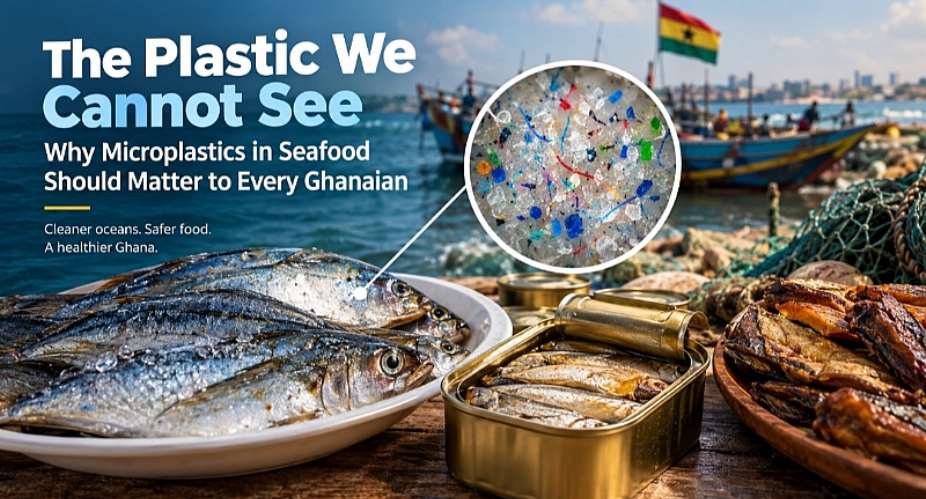
When most Ghanaians go to the market and want to try some seafood, they look out for fish with a clear eye, meat that is firm, and a pleasant smell. They might even check the label on canned fish for their preferred brand. What Ghanaian buyers do not consider is that the plastic waste that they leave unattended at the roadside, in the drain, or at the beach is creeping its way into the fish they are about to eat.
Tiny plastics less than 5 millimetres in size have invaded oceans, lakes, rivers, lagoons, estuaries, even the air we breathe and the foods we eat. Researchers have confirmed the presence of microplastics in fish and seafood across the world. Their investigations in Ghana’s coast and inland waters have revealed that plastics are invading the very fish that Ghanaians love to eat.
Fish and seafood are a staple food in the Ghanaian diet. They permeate every aspect of our dining table, from simple soups and stews to the grilled delights, and the smoked and canned delicacies. Fish has been our main animal protein in Ghana and is available in the many markets across the country including the famous Makola and Kejetia. It provides nourishment to the people and is part of the Ghanaian culture. The fact that this mainstay is at risk from invisible plastic pollutants is a matter of great concern.
Plastics are invasive and are getting into the environment from many sources. Discarded plastic bags, bottles, and wrappers thrown anywhere, including the beach, are gradually destroyed by wind, wave action, and abrasion and become smaller fragments that are eventually too small to see. Fibres shed from clothing during laundry, tyre wear from vehicles, and broken plastics from nets, packaging, and other items also add to the mountain of plastics in drains and rivers that eventually empty into the sea.
Most people would not believe that such minuscule plastics could be in the fish they eat. However, these tiny plastics pass through the food chain as the fish and other aquatic animals mistake them for food. Planktons, crustaceans, oysters, clams, and bivalves are the first to ingest them and excrete them, accumulating the particles. Larger carnivorous fish then eat them and also humans, so that microplastics eventually end up in the belly of the unsuspecting Ghanaian.
Studies in Ghana have shown that several commercial fish species purchased at the local market in the Gulf of Guinea have been contaminated with plastics. Research reports indicate that over 66% of the fish sampled in the Gulf of Guinea had microplastics in their tissues, and most of these were fibres. Other studies in the estuaries and coastal waters of Ghana have also confirmed this observation.
However, controversy surrounds whether microplastics could be in the canned fish that many Ghanaians consume.
Ghanaian consumers believe that once the fish has been canned in a factory under sterile conditions, there is no way microplastics could get into the fish. Even though processing the fish in factories ensures that there is no bacteria in the fish, it does not guarantee that the fish is free from plastics. In fact, the processing, storage, and transport of the final product are prone to introducing microplastics. Plastics in the processing plants, clothing of the workers, and airborne particles in the manufacturing environment can either contaminate the fish during processing or packaging. Therefore, any consumer who believes that they are free from microplastics just because the fish has been processed should rethink that belief. It is not that the plastic waste in the environment is not harmful; it is that the plastic waste has permeated every aspect of the environment, including the processing plants.
The most pressing issue about microplastics in fish is the fact that scientists do not fully understand their impact on human health.
There is evidence that when ingested, the microplastics cause inflammation and toxicity to the membranes of the intestines and accumulate in the organs of the body. Microplastics are also made up of various polymers, and during the manufacturing process, they are contaminated with heavy metals and airborne particles. When these plastics are eaten, the toxins stick to the plastics and are transferred to the membranes of the stomach and intestines. However, the extent to which these health complications develop depends on the amount of microplastics in a person’s system. The question of whether the amount of plastics that Ghanaians consume is enough to cause these health problems is still under research. Therefore, the fact that the answer to whether microplastics are harmful is yet to be discovered should be reason enough for concern.
The main issue for concern regarding microplastics in the Ghanaian environment goes beyond the impact on the consumer.
The Ghanaian fishing industry relies on the oceans, rivers, and lakes for the fish that feed the nation. If we continue to pollute these waters, they will become barren, and the industry will suffer greatly. The health hazards of the pollutants may also affect the marketability of Ghanaian fish and seafood.
The answer to this whole predicament lies in stopping the plastics from getting into the environment. In Ghana, the overuse of single-use plastics in packaging, shopping, and trash bags is contributing to the plastic waste that clogs the rivers and the oceans. The Ghanaian must rethink their dependence on single-use plastics and invest in long-term reusable plastics. Effective waste management is key to controlling the amount of plastic that ends up in the ocean. Improving the standards of the fishing industry and the food processing and manufacturing industries will also help reduce the amount of microplastics in the environment and the rate at which they are invading the ecosystem.
Research on the extent of this environmental pollution disaster is of great interest to microplastic investigators. Ghanaian researchers have investigated the presence of microplastics in the oceans, but they need to explore into the depths of the canned fish industry. More research would help establish whether the popular brands of canned fish that Ghanaians consume are contaminated with microplastics. It will also help determine the extent of contamination, the types of polymer plastics, their health implications, and provide data for monitoring these contaminants.
Microplastics are an invisible plastic menace that Ghana must confront. The plastic bottle that we throw away carelessly has a life of its own and will eventually end up in our food chain. For most Ghanaians, seafood is a staple and a delicacy, and their love for it should be a motivation to ensure they protect that which feeds and nourishes them.

 'EOCO attempted arrest of Baffour Awuah was unprofessional' — James Agalga
 'Building a congregation of 20,000 will kill you' – Duncan-Williams tells young ...
 September 29: Cedi finishes day selling at GHS12.20 on forex market, GHS11.67 on...
 ‘We’ll explore another constitutional option for narcotics probe’ – Minority on ...
 Speaker Bagbin adjourns Parliament indefinitely after rejecting narcotics probe ...
 Food Buffer Stock seeks stronger liquidity buffer despite record GH¢91.7 million...
 Ex NAFCO Boss trial: Court adjourns trial to hear application for return of seiz...
 Bagbin backs Mahama’s call for national dialogue on social media insults


