




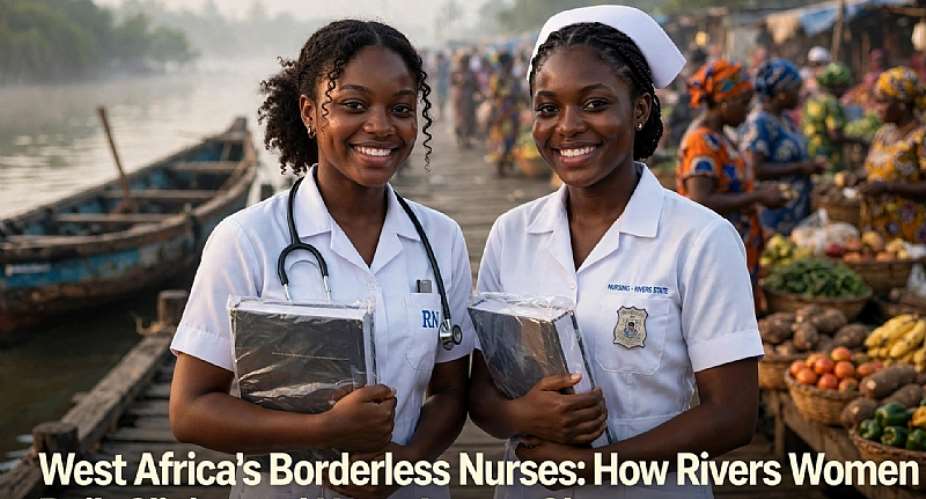
Port Harcourt nurses in faded uniforms, once buying ogbono at Mile One after night duty, now run small maternities in Ghana's Central Region. Not UK japa, but strategic ECOWAS move: 90 days visa-free, three hours flight. As Ghana loses 6,000 nurses to the UK, according to PSI, its private clinics recruit Nigerians from Rivers, Bayelsa, Imo at Lagos and Port Harcourt fairs. Wages are modest, but light, water, gloves and leadership courses are constant. Remittances buy freezers in waterfront homes. Some return with Ghana's Thursday birth classes where husbands learn danger signs. Integration is a white uniform boarding a boat, ODIMEGWU ONWUMERE writes
Port Harcourt does not sleep. By 4:30 a.m., Mile One market is already shouting. Fish traders arrange ice, call prices in Ijaw, in Igbo, in Pidgin.
Until recently, among them were women in faded white uniforms, just off night duty, buying ogbono before their children woke for school.
Last month, those uniforms disappeared from the market.
One of them reappeared in a peri-urban community in Ghana's Central Region.
While national debate focuses on nurses leaving for the United Kingdom and the United States, a quieter corridor has opened. Individual nurses are moving from Nigeria, including Rivers State, to Ghana.
The trail is public. On professional networking platforms, a familiar pattern repeats: training at a school of nursing in Rivers State, followed by a volunteer clinical role in Ghana or postgraduate study at a public university in Kumasi.
A retired nursing educator in Port Harcourt who trained dozens of nurses between 2018 and 2023 keeps a private group chat for her former students. More than ten are now in Ghana. She declined to be named, citing retirement from public service. Consent is on file.
She showed a photograph. A former student, in her early thirties, from a riverine community in Rivers State, now manages a small private maternity on the outskirts of a Ghanaian town. Two beds. A small pharmacy. A veranda where pregnant women wait on a wooden bench.
On the phone, the nurse said, "For here light dey, water dey, gloves dey. And I dey do my leadership course for university. I for no get that chance for home."
The movement is not primarily about higher wages. Salaries in Ghana's private health sector remain modest and comparable to what private clinics in Port Harcourt offer. For these nurses, the move is strategic: academic advancement, private corporate employment, and regional professional networking within West Africa.
The logistics make it possible. Three hours by air. Ninety days visa-free under the ECOWAS free movement protocol. A similar nursing curriculum. English on both sides.
Institutional linkages reinforce it. Information from the Africa Centre of Excellence in Public Health and Toxicological Research at the University of Port Harcourt indicates the Centre runs joint health research engagements with a school of nursing at a public university in Ghana, driving exchange of specialist nurses. A 2023 seminar flyer documenting the collaboration is on file.
The wider context is documented. According to Comrade Haruna Mamman, President of the Nigerian Association of Nurses and Midwives, speaking to Tribune Online, the exodus of health workers poses a threat to national health security and is driven by poor conditions and limited professional development.
According to a Public Services International report covered by Tribune Online, Ghana lost over 6,000 nurses to the US, UK, Canada and Australia in 2024 alone. According to Saturday PUNCH, citing the State of Health of the Nation Report 2025, 20,966 health workers including 7,487 nurses and midwives relocated from Nigeria in one year.
The result is a chain. As Ghanaian nurses leave for the United Kingdom and the United States, gaps open in private clinics in Ghana's Central and Western Regions. Nigerian nurses, including from Rivers, Bayelsa and Imo, fill some of those gaps, recruited at academic fairs in Lagos and Port Harcourt.
According to SBM Intelligence, remittances from Nigerians abroad often exceed foreign direct investment. In a waterfront community in Port Harcourt, a small-scale trader displayed a new freezer. She said her daughter in Ghana sends money every two months for school fees and business support. Consent is on file, name withheld.
According to nursing experts at a university of medical sciences in the Western part of the country, emigration can have mixed effects, including research collaboration, remittances and memoranda of understanding between institutions.
Some return.
In 2024, two returnees, both in their late thirties and from Rivers State, who had spent several years working in a private health facility in Ghana, opened a small joint clinic in a residential area of Port Harcourt. Two beds, one delivery couch, one microscope, a hand-painted signboard.
What they brought back was a system. In Ghana, they learned how midwives run free birth preparedness classes every Thursday with husbands invited. Now in Port Harcourt, they do the same. Market women come with their husbands, practice breathing, learn danger signs, save small amounts weekly for emergency transport. A community health volunteer in their catchment said late referrals have reduced.
An anonymized attendance sheet sighted for the first half of 2024 shows over a hundred women attended the Thursday sessions. Patient names were redacted, tally kept on file.
The ECOWAS Protocol on free movement and the West African Health Organisation's harmonized curricula were designed for this: a nurse trained in Port Harcourt can work in Accra without retraining. Integration is not only a meeting in Abuja. It is a white uniform boarding a boat.
Last month, the 6 a.m. boat from Bonny to Port Harcourt left the jetty. Inside were two young women, textbooks wrapped in nylon to protect them from sea spray. They were traveling to write a postgraduate entrance examination for a public university in Ghana. Their mothers, fish traders, waved from the jetty.
"Go and build,* they said. "Come back and build here too."
•Onwumere writes from Rivers State


 We have cut cost of capital by more than half since Mahama took office – Ato For...
 Dr Bertha Ayi on how parents hurt children by raising them only on English
 Customs intercepts three firearms, 610 rounds of ammunition at Tema Port
 NDC to open nominations for 2026 regional executive elections on October 6
 Africa will be mostly self-sufficient in fuel by 2030: Dangote to AFP
 PRETAG threatens to intensify strike over unpaid teacher entitlements
 Lands Minister exits GoldBod Board as Minister's Chief Director takes over
 Court refuses bail for six accused in 3.9-tonne cocaine shipment case
 Philippines to open first-ever embassy in Ghana
 1992 Constitution review: Prof. Atsu Ayee and Dr Osae-Kwapong explain why Consti...


