




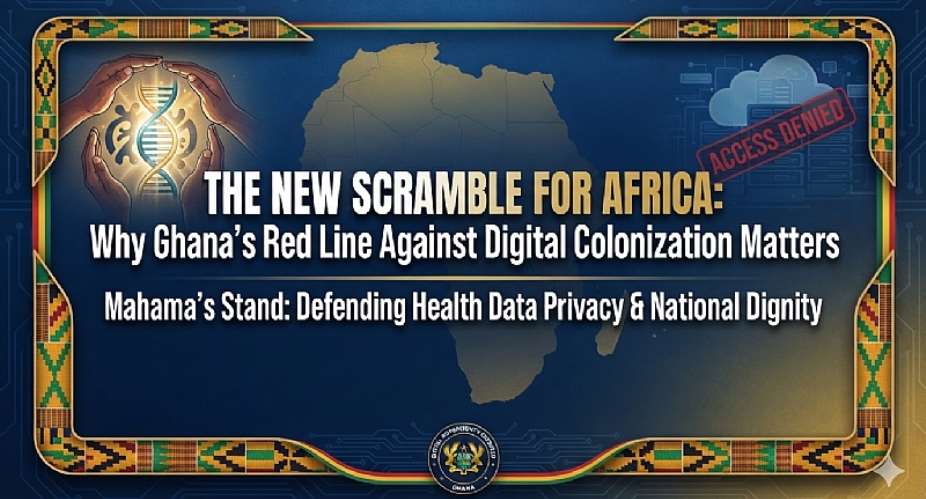
The Sovereignty of the Server
For decades, global health aid was packaged as an act of pure humanitarian benevolence. Today, under Washington’s revamped "America First Global Health Strategy," foreign aid has subtly transformed into something far more dangerous: a data-extractive transaction. The recent revelation by President John Dramani Mahama that Ghana summarily threw out a $109 million US bilateral health compact because it demanded access to our national pathogen profiles and citizen medical records is a massive wake-up call. This was not a routine funding dispute; it was a firm resistance against digital colonization. In the 21st century, data is the new oil, and genetic data is the new gold. By refusing to exchange the fundamental privacy of millions of Ghanaians for a five-year financial check, Cabinet drew a line in the sand, proving that health security can never be decoupled from national sovereignty.
The Rhetorical Question: A Standard Washington Would Never Accept
To understand the sheer asymmetry of what was being demanded of Accra, we must flip the script and view this through the lens of domestic American policy:
- The Ultimate Double Standard: We must directly pose a fundamental question to US President Donald Trump: Would you ever authorize the United States government to release the raw, individual medical records and biological pathogen profiles of American citizens to another sovereign power?
- Geopolitical Realities: Would Washington ever hand over the biometric or health data of the American public to China, Russia, North Korea, India, or Singapore in exchange for an infrastructure project or trade concession?
- The Obvious Answer: The answer is an absolute, unequivocal no. In the United States, medical data is protected by ironclad federal laws like HIPAA, and any foreign attempt to systematically harvest the health metrics of American citizens would be treated as an act of espionage or a severe national security breach.
- Rejecting Subservience: Why, then, should an African nation be expected to treat its own citizens' data with less respect? Aid that requires a sovereign nation to surrender data metrics it would never dream of asking its own populace to give up is not a partnership—it is a digital capitulation.
A Global Pattern: Who Else is Under the "America First" Microscope?
Ghana is not alone in asking these tough questions. Washington's data-harvesting demands are part of a coordinated global strategy, but the pushback is intensifying across the continent:
- The African Resisters: While over 20 African nations have signed variations of these health compacts, a powerful bloc is standing firm with Ghana. Zimbabwe halted negotiations after refusing to engage in long-term data and sample sharing without guaranteed access to the resulting medicines. Zambia rejected its draft framework, completely stalling talks due to data privacy violations, and Namibia has actively moved to reject the deal as its funding is phased out.
- The Legal Battlegrounds: In Kenya, civil society and authorities mounted significant resistance, successfully throwing the agreement into a delayed legal limbo in court over the exact same data-sharing concerns.
- The Asymmetry: The Trump administration's aggressive drive targeting developing nations reveals an uncomfortable geopolitical truth: these intrusive, 25-year data access demands are only ever presented to nations reliant on foreign aid. They are noticeably absent from bilateral agreements with wealthier counterparts in Europe or Asia, exposing the transactional, predatory nature of modern global health diplomacy.
Unpacking Health Cyber-Colonization: What Was At Stake
The US Embassy has downplayed these concerns, claiming the requested metrics were merely "aggregate data" meant to evaluate aid efficacy. However, digital experts and Ghana’s Data Protection Commission recognized the structural traps buried in the text:
- The Fallacy of Anonymization: In the era of advanced AI and cross-referencing algorithms, "anonymized data" is a myth. By matching generic pathogen tracking with localized clinic records, external entities can reverse-engineer and re-identify specific communities or individuals.
- Biopiracy and Patent Monopolies: Giving up national pathogen profiles means relinquishing rights to local genetic properties. Foreign pharmaceutical conglomerates can weaponize this data to develop vaccines or therapies, patent them, and then sell them back to Africa at exorbitant prices.
- Erosion of National Regulators: Forcing Ghana to exempt imported medical products from Food and Drugs Authority (FDA) inspection while simultaneously harvesting domestic data is a total subversion of national security. It forces a country to act as a blind consumer while remaining completely transparent to foreign observers.
The Blueprint for Digital Non-Alignment
Ghana’s bold rejection of the compact aligns perfectly with the "Accra Reset"—the pan-African initiative championed by President Mahama to reduce the continent's dependency on foreign funding and assert complete health sovereignty. The collective resistance of Ghana, Kenya, Zambia, and Zimbabwe proves that the continent is waking up to the data trap. True independence in the modern era is no longer just about flags and anthems; it is about server control, cloud security, and data privacy. Ghana has set a powerful precedent for Africa. We have proven that our bodies, our medical files, and our national pathogen signatures are not commodities to be traded for short-term fiscal relief. National dignity cannot be bought, and our digital borders are officially closed to predatory exploitation.
✍️ Submitted by:
Retired Senior Citizen
For and on behalf of all Senior Citizens of the Republic of Ghana 🇬🇭
Teshie-Nungua
[email protected]


 We have cut cost of capital by more than half since Mahama took office – Ato For...
 Dr Bertha Ayi on how parents hurt children by raising them only on English
 Customs intercepts three firearms, 610 rounds of ammunition at Tema Port
 NDC to open nominations for 2026 regional executive elections on October 6
 Africa will be mostly self-sufficient in fuel by 2030: Dangote to AFP
 PRETAG threatens to intensify strike over unpaid teacher entitlements
 Lands Minister exits GoldBod Board as Minister's Chief Director takes over
 Court refuses bail for six accused in 3.9-tonne cocaine shipment case
 Philippines to open first-ever embassy in Ghana
 1992 Constitution review: Prof. Atsu Ayee and Dr Osae-Kwapong explain why Consti...


