




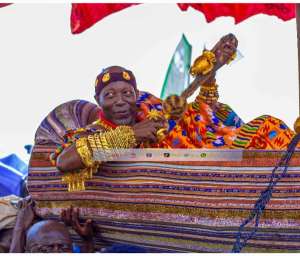
The Gyasehene of Okuapeman and Chief of Amanokrom, Oyeeman Okofrobour Osim Kwatia II, has launched an ambitious development covenant to build teachers' quarters and a modern classroom block as Amanokrom marks 200 years of the Akuapem Odwira Festival.
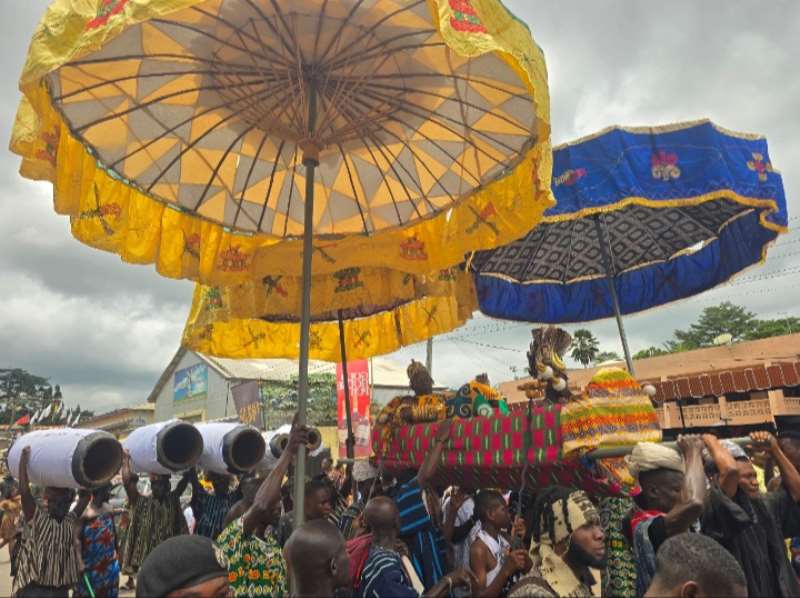
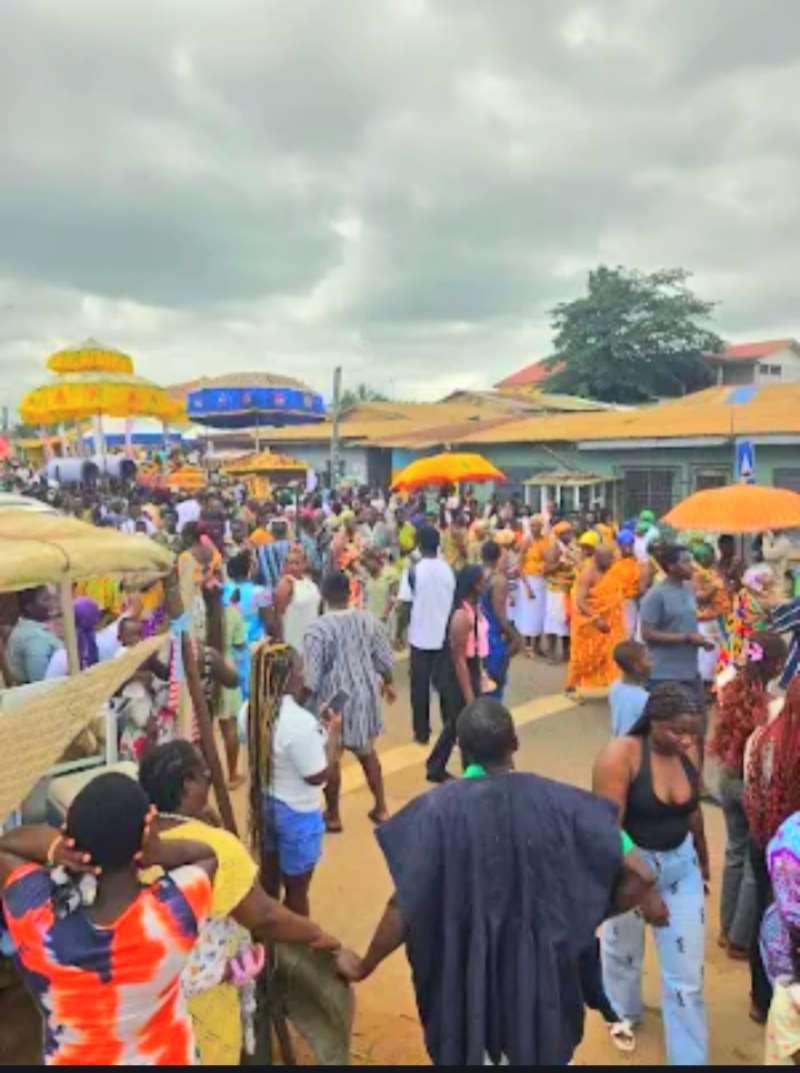
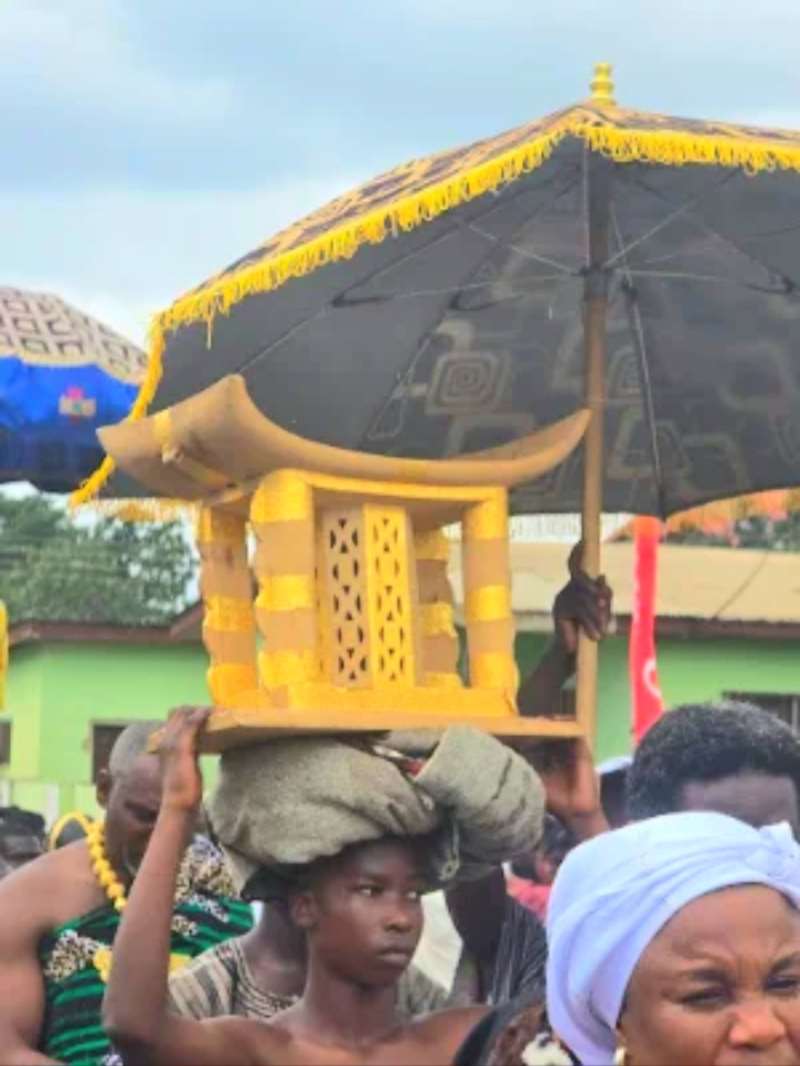
He made the call at the historic bicentennial Grand Durbar held at Amanokrom in the Eastern Region, on the theme "200 Years of Odwira: Honoring Our Heritage, Securing Our Future."
Addressing HRM Okuapehene Oseadeeyo Kwasi Akuffo III, Nananom, government officials, clergy and sons and daughters of Okuapeman at home and abroad, the chief said the 200-year milestone is more than time passing.
"Two hundred years is not merely the passage of time. It is a testimony that a people who remember, renew and unite can endure," he declared.
Defining the essence of the festival, Oyeeman said, "Odwira is more than a festival on our calendar. It is a sacred return to ourselves."
According to him, when the drums speak during Odwira, they summon the people to remember, not merely to dance, and the procession declares that Okuapeman still knows its name, story and duty.
Quoting the Akan proverb "Se wope se wuhu baabi a woreko a, hwe baabi a wofiri," he stressed that a people who forget their source may travel quickly but cannot travel wisely.
He traced Okuapeman's history to unity, sacrifice and freedom, citing the Akatamanso victory as a triumph of common purpose over fear, grounded in the wisdom "Dua koro gye mframa a, ebu."
"Our ancestors marched not only with weapons, but with the hopes of children they would never meet. We are those children," he told the gathering.
Explaining the role of the Gyaase Division, he said Amanokrom served as a spiritual centre of preparation, while Lower Dodowa preserved the founding alliance linked to Konton Mensah, and Adawso strengthened strategic pathways.
In Amanokrom, he said, the names of Nana Amanor Awuah and Konton Mensah still teach that strength without character is dangerous, but courage guided by service can build a nation.
Recalling the forebears' battle cry, "Wope ko! Wope ko! Wope ko! Yko ye me adedade!" he said it was not a celebration of violence but a declaration that duty could not be abandoned when injustice threatened.
Under his Bicentennial Mandate, he declared that the battlefield has changed: "No invading army stands at the gates of Okuapeman today. Yet ignorance can still imprison a child. Poverty can still silence talent."
"Our ancestors fought oppression; we must fight exclusion. They prepared warriors; we must prepare teachers, learners, artisans, farmers and entrepreneurs," he charged.
"The greatest shrine we can build today is an educated child. The strongest fortress we can build is a healthy and united community," he added.
Moving from promise to purpose, the chief unveiled three practical priorities for the coming year to convert memory into progress and heritage into hope.
First, a Teachers' Quarters to honour those who shape the future. "This is not simply a residential structure. It is an investment in the men and women to whom we entrust the minds of our children," he said.
Second, a four-unit classroom block as the new battlefield of knowledge. "Where our forebears once gathered warriors for preparation, we must now gather children for learning," he noted.
He insisted: "Let no child of Amanokrom believe that greatness belongs elsewhere. Education is the new battlefield, knowledge is the new weapon; and character is the new shield."
Third, another ultra-modern community washroom to complement the newly commissioned facility, describing it as dignity through sanitation and a visible expression of Odwira itself.
"Clean, safe and dignified sanitation is not a minor matter. It protects public health and strengthens the dignity of women, children, the elderly and persons with disabilities," he stated.
He summarised: "The teacher's quarters supports those who teach; the classroom block creates the space in which children learn; and the washrooms protect the health and dignity required for learning and life to flourish."
In a passionate call to partnership, he declared that the Palace alone cannot deliver the projects: "Nsa baako nkura adesoa – one hand cannot lift a heavy load."
He called on the Akuapem North Municipal Assembly for technical support, corporate bodies and development partners to invest, professionals to offer expertise, and sons and daughters at home and in the diaspora to give and open doors.
Assuring accountability, he stressed, "What we build must endure. What we receive must be accounted for. What we begin must be completed."
On preserving the soul of Amanokrom, he urged documentation of the histories of Nana Amanor Awuah, Konton Mensah and Senyani Abena, protection of sacred rivers like Oboansa and Adenkyemsu Kofi, and reconciliation, warning that no classroom can transform a bitter people.
Charging the youth, he said, "You are not merely beneficiaries of an ancient history; you are authors of its next chapter. Your Akatamanso may be a classroom, a workshop, a farm or a digital platform."
He closed with a royal benediction, praying for peace in every home and that "our teacher's quarters rise as a home of service, our classroom block as a house of knowledge, and our washrooms as a symbol of dignity," adding "Onyame nhyira Amanokrom, Gyaseman, Okuapeman and Ghana."
About Akuapem Odwira Festival
The Akuapem Odwira Festival has several related purposes, among which are purification, thanksgiving, eating of the new yam, service to ancestors, purification of the King and his People for a happy and prosperous new year, mourning of the dead of the immediate past year, re-affirming political loyalties and allegiances, re-establishing the military order and social ties and proclaiming the unity of the State Organizations.
Basically, therefore, the festival celebration is to affirm the spiritual values that inspire the people's way of life, values that can operate in the relationship between man and the unseen, or between man and his environment and whilst influence the scope, form, content and intensity of the religious behavior.
The festival also strengthens the social bonds which binds members of the Akuapem Community not only within Akuapem but throughout the whole of Ghana and particularly the Kin group within it.
Like all traditional festivals, the Akuapem Odwira Festival is a combination of ritual, ceremonial, artistic and recreational activities which take place in difference locations according to a defined schedule.
The festival also provides opportunities for the collective renewal of the arts as a form of community experience or as an expression of group consciousness with great deal of stress being laid on music and dancing on many events of the festival.
Significantly, the festival was inspired by issues that were partly religious and partly political. It therefore dramatizes Akuapem Sacred Myths, Legends and specific historical episodes such as those which took place during the great Akatamanso war of 1826.
Odwira is a time for organized expression of public sentiment is done in a social context through the medium of songs, but as a collective action.
In this way, the festival provides the unique opportunity for the expression of group solidarity through songs and other activities to remind members of the Akuapem Community of their great past or their relationship with the departed members of the community.
The first ever Odwira Festival in Akuapem was celebrated one hundred and seventy nine years ago on 16th October, 1826 soon after the Akatamanso war from 1826 to the present.
Therefore, the Akuapems and the Adaebutuw have been celebrated one hundred and seventy nine times respectively with varying degrees of spiritual intensity.
The following are some important dates of the Akuapem Odwira and Adaebutuw festivals since 1826.
(Friday) Fida Fofie
In 1826 the Great Akatamanso War against the Ashantis started.
11th August, 1826 (Monday)
Ashanti Army completely routed after being defeated in the Akatamanso War.
16th August, 1826
Spiritual consultations on the Odosu Shrine at Mpeniase Akropong
23rd August, 1826
The decision to make the Odwira Festival an annual Akuapem Festival Celebration was taken at Mpeniase at the time of the Okuapeman purification ceremony.
6th September 1826
Akuapem celebrated the first Adaebutuw festival after the Akatamanso War.
Akropong.
Brief History of Akuapem Amanokrom
The town Amanokrom was founded in 1742 by Nana Amanor Awua, their third ruler. It is one of the 17 principal towns that constitute the original Akuapem State.
The town is also one of the Akan Twi-speaking enclaves, and it forms the Adonten No. 3 (Main Army Number Three) of the Akuapem State. Amanokromhene is a descendants of Akyem Abuakwa Asona clan and they founded their town ten years after the formation of the Akuapem State.
The Akuapem State was founded in 1733 after the signing of the Abotakyi Accord following the Akyem and their allies' defeat of the Akwamu Kingdom in the 1730 after the Battle of Nsakye. The name Amanokrom means "Amanor's Town" and their appellation is "Asuketewa A Eso Aguare" A rivulet that makes bathing possible"
Origin and Migration
Their oral tradition asserts that their ancestors were members of the Akyem Abuakwa Asona clan group, their apical ancestor was Nana Ahenkora Kese, the Asona Chief of Adanse Kokobiante, who shared common ancestry with Nana Kuntunkununku I, the first King of the Asona group (Akyem Abuakwa) when they were settling in Adanse Kokobiante. In the great migration of the Asona clan southwards, Ahenkora Kese's group was led by Nana Agyapong Tenten.
He moved with the people to first settle at Adanse Ofoase and later proceeded to join his relative, Nana Ofori Panin. The groups moved together to settle at Pamen on the Eastern side of what became the Akyem Abuakwa State.
It was in their settlement at Pamen that the hilly Guans sent a message to Akyem chiefs to help them to break the shackles of the autocratic and dangerous chains of the Akwamu. The Akwamu was then a powerful state which has conquered many Akan and non-Akan states and placed them under their powers and made them vassal states.
They lay siege on main roads and capture non-Akwamu citizens and sell them into slavery. Many Guan citizens were captured in this dastardly act. Reindorf (1887) recorded that the Akwamu princes forced Guan women to go naked and use the middle of the breast as targets in their gun marksmanship or shooting training. This led to several deaths of Guan women.
LIST OF PAST CHIEFS OF AMANOKROM
1 Nana Ahenkora Kese 1550-1600 At Adanse Ofoase
2 Nana Kwasi Wareko Ampem 1600-1642 At Adanse Ofoase
3 Nana Agyepong Tenten 1642-1700 At Ofoase and Pamem
4 Nana Kwatia Akompi I 1700-1736 Pamem, Amamprobi
5 Nana Osim Kwatia I 1736-1740 Amamprobi / Akropong
6 Nana Amanor Awua 1740-1760 Akropong, Odomenae and Amanokrom
7 Nana Fo Kwagyan 1760-1770 Amanokrom
8 Nana Adagkwa Asare Yiadom 1770-1784 Amanokrom
9 Nana Odame Tenten 1784-1796 Amanokrom
10 Nana Ofei Dankwa I 1796-1816 Amanokrom
11 Nana Epo Wosereka 1816-1825 Amanokrom
12 Nana Ohene Ntow (Koso) 1825-1835 Amanokrom
13 Nana Grogoo Bapo 1835-1844 Amanokrom
14 Nana Asamoah Amanor 1844-1850 Amanokrom
15 Nana Osabu Gyawu 1850-1855 Amanokrom
16 Nana Mensah Kuma 1855-1862 Amanokrom
17 Nana Kwasi Darko 1862-1911 Amanokrom
18 Nana Kwasi Asamoh 1911-1914 Amanokrom
19 Nana Kwadwo Darko (Kwadwo Pa)
1914-1919 Amanokrom
20 Nana Ofei Darko 1919-1925 Amanokrom
21 Nana Ampem Darko 1925-1942 Amanokrom
22 Nana Kwatia Akompi II 1943-1955 Amanokrom
23 Nana Ofei Dankwa II 1956-1974 Amanokrom
24 Oyeeman Wereko Ampem II 1975-2005 Amanokrom
25 Oyeeman Osim Kwatia II 2007- to date Amanokrom



 Bawumia calls for paradigm shift in Ghana’s healthcare policies after meeting GM...
 POWA calls for end to gendered attacks on Lordina Mahama and Samira Bawumia
 This is the best time to develop Volta Region — James Gunu
 “I’m not only contesting for the position, but for the work that defines it” – A...
 DRIP road works stall in Bekwai over fuel shortage as MP intervenes with GH¢30,0...
 “If you can hire people to insult, malign others for your gain, then you must be...
 Iran says it expects US response Tuesday on plan to reopen Strait of Hormuz
 'If God will judge people we call holy, what about us?' — Evangelist asks after ...
 Nigerian evangelist shares list of top Nigerian pastors he saw in hell weeping f...
 How suspected phone thief swallowed five SIM cards during arrest on Kasoa-Bawjia...


