




Before 2017, the message to Ghanaian BECE graduates was simple: "Bring your only trunk — your green light to SHS will be on." In many homes in Ghana, it was undeniably true that the cost of trunk, chop box, mattress, fees and prospectus were gatekeeper costs that decided who entered and who stayed home when Senior High Secondary Schools open for admissions.
From Campaign Masterpiece to Constitutional Implementation
Free SHS was not just a policy; it was a masterpiece campaign message that brought President Nana Addo Dankwa Akufo-Addo and the NPP to power in 2016. The campaign message itself, however, was not detailed enough for the populace. So when people heard "Free," many thought the programme would start in 2017 with SHS 1, 2 and 3 all at once. Government, however, implemented it progressively beginning with first-year students as stipulated by Article 25(1)(b) of the 1992 Constitution.
This progressive vision is why the previous NDC government under President John Dramani Mahama was constructing E-blocks across the country in order to ensure full access to graduates as the number was obviously going to augment astronomically. Unfortunately, that complementary infrastructure vision suffered a vehement political opposition then, and when the NPP came to power, many of those E-blocks were neglected. This attitude of halting projects embarked on by successive government must stop. After all, no president uses his own hard earned money to carry out those projects. To manage the enrollment surge however, the government introduced the double-track system, which, though created access, came with its own host of problems such as prolonged stays at home, learning gaps, and as widely reported, a rise in teenage pregnancies during long vacations.
Continuity and Investment: Protecting the Policy
Governance we all say is a continuum, yet policy about national development plan since 2017 has virtually left unattended to. In fact, policy must outlive party. Credit must be given to the current NDC government under President John Dramani Mahama for protecting Free SHS as a national policy and investing heavily to sustain it.
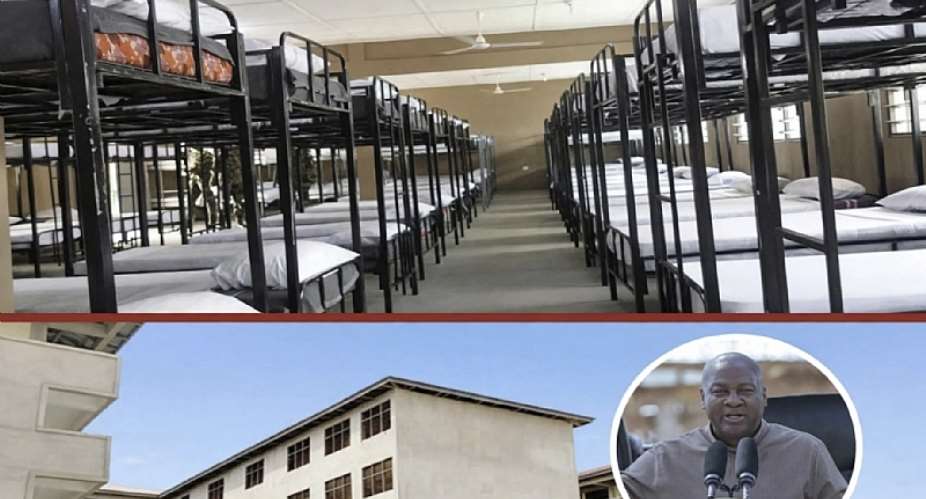
Two interventions stand out: Resourcing and expansion of SHS infrastructure to facilitate a return to single-track, including completion of 30 abandoned E-Blocks as shown above, and inclusion of private SHSs through an MoU with the Conference of Heads of Private Second-Cycle Schools (CHOPSS). If the NPP gave us 'partial access', this continuity gives us sustainability.
The New Threat: After Access, Governance
Suffice it to assert that access without governance betrays the rationale. It is therefore prudent and appropriate to install certain governance practices to ensure smooth operation of the Free SHS intentions:
1. Re-commodification: Some heads collect unapproved monies. As the Centre for Policy Scrutiny (2026) observed, "The 'Free' is not always free."
2. Sanitation: Not to delve into the issues of how nutritious the food served are, or how hygienic or safe the entire SHS schools environments are, the issue of fumigation is what has caught my attention. The image above tells the story: bunk beds packed less than one meter apart, low ceilings, one or two ceiling fans for 50 to 60 students, poor ventilation, and high room temperature. Is this conducive? Your guess is good as mine. Metal bunks packed without spacing and concrete or cement walls trapping heat make learning the next day obviously difficult. Many SHSs fumigate only when bedbug infestation becomes a crisis, not preemptively. A child cannot learn if he cannot sleep well and have enough rest in order to get rejuvenated the next day.
3. District Leadership Vacuum: Supervision remains ceremonial on speech days, not surprise welfare audits.
Way Forward: Four (4) Prescriptions
1. Honour Free Means Free: Mount Zero-Fee Transparency Boards at every SHS gate backed with symbolic or sign pictures or images plus the possible sanctions that may be meted out to culprits.
2. Institutionalize Preventive Fumigation: Don't wait for bedbugs to attack before you fumigate. Set a compulsory fumigation timetable every term, every vacation, for all SHS dormitories nationwide. After each exercise, the school must publish the report and post the certificate on the notice board for parents and students to see. No secrecy, no ad-hoc levies on students.
3. Unannounced Welfare Audits: GES and Free SHS Secretariat must conduct surprise checks not announced visits. Each term, inspectors should check four things: bed capacity vs. enrollment, ventilation and windows, room temperature and heat, and sanitation/toilets. Results should be scored and published. This will stop overcrowding and the heat that breeds bedbugs.
4. Ethical Leadership Formation: Headship Must Require Certification
By ethical leadership formation, we mean moving SHS headship from appointment by seniority to appointment by proven ethical and managerial competence. Currently, many heads are excellent classroom teachers promoted for long service, but with little formal training in financial governance, procurement ethics, and welfare leadership before managing budgets of millions and boarding houses of over 1,500 adolescents.
This gap can be closed. As a holder of a Professional Postgraduate Diploma in Management and Consultancy from the Chartered Institute of Administrators and Management Consultants - Ghana (CIAMC-GH) since 2012, I can attest that such professional formation works. The CIAMC-GH programme has equipped me with tools in administrative ethics, consultancy, compliance, and institutional management that classroom experience alone could not provide.
I therefore propose a Mandatory Pre-Headship Certificate in Ethical Educational Leadership, modelled on programmes like CIAMC-GH's, to be run by GES in partnership with Universities and Chartered Institutes, covering:
- Public Financial Management & Zero-Fee Compliance
- Boarding House Welfare, Preventive Health & Fumigation Management
- Child Rights, Safeguarding & Inclusive Leadership
- Transparency, Community Engagement & Conflict of Interest
And like professional bodies, heads must renew their licenses annually through CPD points and clean audit reports not WASSCE reports only. It is a truism that a certificate does not automatically make a person ethical, but it creates a standard, a common language, and an accountability framework. When a head knows that unauthorized fees or poor sanitation records will cost their license, governance improves.
We cannot entrust Free SHS, a multi-billion cedi national investment to good intentions alone. We must institutionalize ethics as a professional requirement for headship.
Conclusively, free SHS told the Ghanaian child: you only need your trunk to enter. Now we must ensure that inside the dormitory, the child can sleep without bedbugs, learn without paying, and be led by ethically certified leadership. Completing the 30 abandoned E-Blocks is not just about buildings. It is about restoring dignity to the dormitory.

 Serbian President Aleksandar Vucic resigns
 Swiss reject plan to toughen neutrality
 Inside the business of gony bags, Madagascar's ubiquitous plastic sacks
 Caucus Warns: ‘If We Lose Our Teachers, We Lose Our Nation’ as Education Crisis ...
 Boeing Projects 18‑Month Timeline for Ghana’s National Airline Revival Under New...
 Legal Expert Questions EOCO’s Conduct, Says MP Had Right to Resist Unlawful Arre...
 Gunmen kill 27 in two shootings in South Africa
 'We shall hold govt feet to the fire of accountability' — Anyidoho on €225m coca...
 ‘Russian sleeper cell’: Can Germany’s far-right AfD be barred from sensitive int...
 Pope Leo XIV visits Lourdes after giant Paris mass to meet clergy abuse victims


