




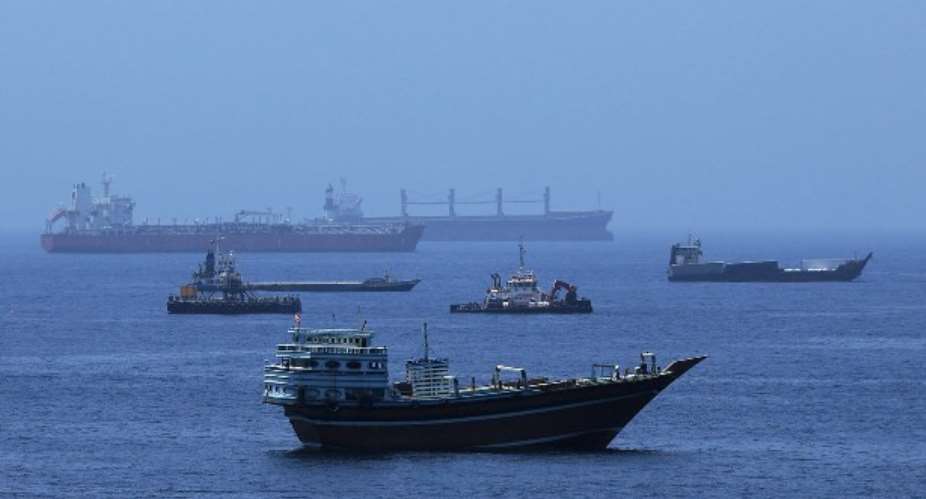
The Strait of Hormuz, a checkepoint barely 21 kilometres wide at its narrowest, remains the single most consequential waterway in the global economy and 2026 has proven, once again, that no region feels its tremors more painfully than ordinary citizens in the West African sub-region, even though not a single barrel of their own crude passes through it.
A Checkepoint That Still Rules the World
An average of 20 million barrels of crude and oil products moved through the Strait of Hormuz in 2025 alone, carrying roughly 20 percent of the world's total oil trade and about a fifth of global liquefied natural gas supply.
When the US-Israel war with Iran erupted in late February 2026 and Tehran moved to restrict shipping through the strait, the result was described by the International Energy Agency as the largest supply disruption in the history of the global oil market. Combined with the later shutdown of the East-West Crude Oil Pipeline in September, the crisis ultimately disrupted 39 percent of global trade and 31 percent of global shipments.
Global oil supply collapsed by 10.1 million barrels per day in March alone, and Brent crude the international benchmark surged from roughly $69 a barrel in February to more than $114–120 a barrel at its peak, a rise of over 55 percent in a matter of weeks. For a fleeting moment, analysts at the World Bank and on Wall Street openly discussed the prospect of $200-a-barrel oil.
Africa Sits Outside Hormuz Yet Still Bleeds
The bitter irony at the heart of this crisis is that West Africa's major oil producers Nigeria, Angola, and others export entirely through Atlantic routes and have no direct exposure to the Strait of Hormuz.
In theory, that should have insulated them. In practice, because oil, refined fuel, shipping, and insurance are priced globally, no producer is shielded from a shock of this scale, and countries that import more fuel than they refine were left exposed to the same price spikes as the rest of the world without the crude revenues to offset them.
Nigeria: The Cruelest Contradiction
Nigeria, Africa's largest oil producer, offers the clearest illustration of this paradox. Despite pumping roughly 1.4 to 1.6 million barrels of crude a day, the country still imports the bulk of its refined petroleum, leaving ordinary Nigerians exposed to the very price shocks their nation's oil wealth should have cushioned.
Petrol prices surged from ₦870 (about $0.65) to ₦1,300 (about $0.97) per litre in March 2026 alone, later climbing toward ₦1,500 a litre as the crisis deepened.
The Dangote Refinery's 650,000-barrel-per-day capacity hailed as a turning point that made Nigeria a net petrol exporter by March 2026 was itself constrained by supply bottlenecks, receiving only 29.21 million barrels of crude against a requirement of 108.74 million barrels between October 2025 and mid-March 2026.
The human cost has been severe.
Nigeria's inflation, which had climbed to nearly 35 percent in late 2024 before easing to around 15 percent in early 2026, was driven substantially by fuel prices, a weakening naira, and disrupted food supply chains a burden falling on a population where more than 140 million people are already classified as multidimensionally poor. Analysts have warned that even if global prices ease, ordinary Nigerians are unlikely to feel relief quickly, since local pricing structures tend to adjust upward faster than they adjust down.
Ghana: A Cushion, But Not an Escape
Ghana fared somewhat better, partly due to a fortunate offset: while the oil shock was projected to raise the country's energy import bill by roughly $2.4 billion in 2026, a surge in global gold prices was expected to bring in as much as $6.5 billion in additional gold revenue, helping stabilize the cedi and protect the country's $14.5 billion in foreign reserves.
Yet that macroeconomic cushion did little for households at the pump. Petrol inflation jumped 3.1 percent in a single month in March 2026 a sharp reversal from a slight deflation the month before while diesel rose 1.4 percent, and transport fares and water prices climbed in tandem.
The deeper structural problem is one that predates the Hormuz crisis: Ghana imports nearly 70 percent of its refined fuel, meaning every fluctuation in the cedi's exchange rate compounds every fluctuation in global crude prices.
By May 2026, with petrol at GH₵13.25 a litre, a Ghanaian worker earning the national daily minimum wage of GH₵21.77 had to spend 61 percent of an entire day's wage to buy a single litre of fuel one of the harshest fuel-affordability burdens in the sub-region, worse even than in subsidy-cushioned Nigeria at the time.
A Global Pattern, A Regional Wound
West Africa's experience mirrors a pattern seen across the developing world. A Kiel Institute policy analysis found that energy-dependent developing countries in South Asia, sub-Saharan Africa, and the Middle East were the most exposed to welfare losses from the closure, with cascading effects moving from energy costs into higher fertilizer and food prices a mechanism the IMF separately warned could push low-income countries toward food insecurity even as international assistance for such crises has been declining.
Countries in the region responded with a patchwork of short-term relief: Eswatini raised regulated fuel prices outright, Namibia slashed fuel levies by half for three months, and South Africa temporarily cut its general fuel levy to soften the blow stopgap measures that treat symptoms rather than the underlying vulnerability.
The Structural Lesson
What the 2026 Hormuz crisis exposed, more than any single price spike, is the fragility of a region that produces oil but cannot refine enough of it, and that measures its economic security in months of import cover rather than in barrels beneath its own soil.
Until West African nations close that refining gap as Nigeria's Dangote Refinery and Angola's expanding capacity have only begun to do a war fought over a waterway thousands of miles away, in which the region has no ships, no cargo, and no stake, will continue to decide how much its own citizens pay to fuel a motorcycle, run a generator, or get to work in the morning.
Mustapha Bature Sallama
Medical/ Science Communicator,
Private Investigator, Criminal Investigation and Intelligence Analysis,
International Conflict Management and Peacebuilding. (USIP)
[email protected]
+233555275880
Sources
World Bank Blogs "Strait of Hormuz disruption sends oil prices surging," May 8, 2026. https://blogs.worldbank.org/en/opendata/strait-of-hormuz-disruption-sends-oil-prices-surging
International Energy Agency "Strait of Hormuz - About." https://www.iea.org/about/oil-security-and-emergency-response/strait-of-hormuz
IMF Blog "How the War in the Middle East Is Affecting Energy, Trade, and Finance," March 30, 2026. https://www.imf.org/en/blogs/articles/2026/03/30/how-the-war-in-the-middle-east-is-affecting-energy-trade-and-finance
Bloomberg "Iran War: How High Could Oil Prices Get with Strait of Hormuz Closure?" March 30, 2026. https://www.bloomberg.com/graphics/2026-iran-war-hormuz-closure-oil-shock/
Axios "Oil, gas prices spike as Iran war thrusts Strait of Hormuz into crisis." https://www.axios.com/2026/03/09/oil-prices-iran-war-strait-hormuz
Wikipedia "2026 Iran War Fuel Crisis." https://en.wikipedia.org/wiki/2026_Iran_war_fuel_crisis
Wikipedia "2026 Philippine Energy Crisis." https://en.wikipedia.org/wiki/2026_Philippine_energy_crisis
Kiel Institute for the World Economy "The Cost of Closing the Strait of Hormuz," Kiel Policy Brief, March 2026. https://www.kielinstitut.de/fileadmin/Dateiverwaltung/IfW-Publications/fis-import/03f6ac6f-5c1e-4374-a169-9070d4732d8c-KPB_206.pdf
Businessfront "Nigeria faces its biggest fuel prices shock yet. When will it end?" May 30, 2026. https://businessfront.com/energy/insights/nigeria-faces-fuel-prices-shock/
RT Africa "Beyond Hormuz: This oil giant is plagued by a curse," May 8, 2026. https://www.rt.com/africa/639584-hormuz-global-energy-crisis-nigeria/
The Guardian (Nigeria) "Can Nigeria subsidise its way out of energy crisis?" https://guardian.ng/opinion/can-nigeria-subsidise-its-way-out-of-energy-crisis/
AllAfrica "Nigeria: Double Tragedy - Nigerians Ration Power, Hustle for Fuel As Petrol Price Hit N1,500," March 29, 2026. https://allafrica.com/stories/202603300730.html
NewsGhana "Oil Shock Hits Ghana's Fuel and Transport Costs as Hormuz Crisis Bites," April 7, 2026. https://newsghana.com.gh/oil-shock-hits-ghanas-fuel-and-transport-costs-as-hormuz-crisis-bites/
ModernGhana "Beyond The Politics: Understanding Ghana's Fuel Price Reality In 2026," May 10, 2026. https://www.modernghana.com/news/1491787/beyond-the-politics-understanding-ghanas-fuel.amp
People Daily "African nations hike fuel prices amid Middle East oil crisis," April 1, 2026. https://peopledaily.digital/business/african-nations-hike-fuel-prices-amid-middle-east-oil-crisis
Discovery Alert "Strait of Hormuz Closure Impact on African Oil Exporters in 2026," August 24, 2026. https://discoveryalert.com/strait-hormuz-closure-african-oil-exporters-2026/
Africa Press (Ghana) "Hormuz Crisis: is Africa the New Energy haven." https://www.africa-press.net/ghana/all-news/hormuz-crisis-is-africa-the-new-energy-haven


 'We shall hold govt feet to the fire of accountability' — Anyidoho on €225m coca...
 The week in pictures: Trump hosts Xi, the pope visits France and floods ravage T...
 ‘Russian sleeper cell’: Can Germany’s far-right AfD be barred from sensitive int...
 Pope Leo XIV visits Lourdes after giant Paris mass to meet clergy abuse victims
 EU unlocks 710 mn euros' aid for crisis-hit communities
 Power cuts, rubble: millions come home to find Sudan's capital unlivable
 Multiple fibre cuts disrupt voice, data services across the North – NCA
 134 former NPP MMDCEs of Akufo-Addo administration demand terminal benefits
 V/R: One dead, two injured as grader knocks down pedestrians at Dzodze
 At least 16 people killed as Russia and Ukraine trade deadly air strikes


