




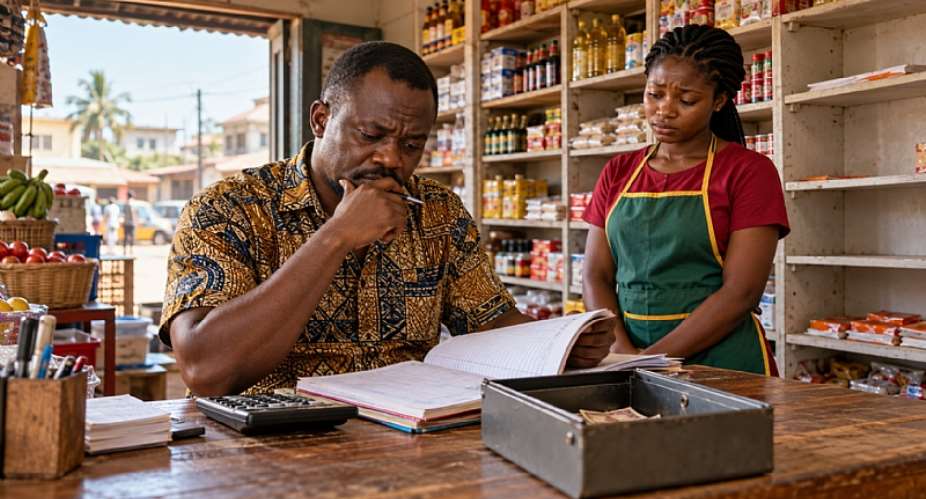
For many Ghanaians who have attempted to establish a small business, the experience is painfully familiar. An entrepreneur raises capital, rents a shop, purchases stock and employs someone to manage the business while attending to another job or travelling. Within a year, the enterprise is struggling or has collapsed completely.
When the owner investigates what went wrong, the explanations are often disturbingly similar: theft, pilfering, dishonesty, poor customer service, absenteeism and a general lack of commitment. Although inadequate financing, high operating costs, excessive taxation and weak economic conditions are frequently blamed for the failure of small businesses, the damaging relationship between some employers and employees receives far less attention.
Across Accra, Kumasi, Abomosu and other communities, many business owners have stories of losses caused by workers entrusted with their operations. A provisions shop owner returns to discover that goods worth thousands of cedis have disappeared, with no sales records or receipts to explain the shortage. A restaurant owner finds that food is regularly given to friends without payment. A building contractor discovers that cement, iron rods and other materials have been diverted to a different construction site. A bar owner counts the drinks in the morning but cannot reconcile the stock with the cash received at the end of the day.
The problem is not always dramatic or immediately visible. In many cases, it begins with seemingly small acts: a sachet of Milo taken without permission, a bottle of beer given away, a little cash withheld from the daily sales or a product sold without the transaction being recorded. When these losses occur repeatedly, they gradually drain the business of the working capital it needs to survive.
Poor work habits can be equally destructive. Some employees arrive hours after the agreed opening time, spend working hours on their mobile phones or treat customers as though they are a burden. Others falsely claim that there were no customers or that nothing was sold, even when sales were made and the money was pocketed. Customers who repeatedly encounter poor service eventually take their business elsewhere, leaving the owner to wonder why sales are declining.
Dishonesty cannot be justified, but addressing the problem requires an honest examination of its causes. Some employers pay extremely low wages, delay salaries and offer workers no meaningful incentive to support the growth of the business. An employee earning between GH¢500 and GH¢800 a month may struggle to meet basic living expenses. While financial hardship does not excuse stealing, unfair employment conditions can create resentment, weaken motivation and encourage some workers to seek improper ways of supplementing their income.
Many small businesses also operate without basic accountability systems. There may be no reliable inventory register, receipt book, daily sales record, point-of-sale system, CCTV camera or regular stocktaking procedure. The owner relies entirely on personal trust, sometimes leaving one worker in complete control of stock, sales and cash. Trust is important in business, but trust without verification exposes both the enterprise and the employee to unnecessary risk.
Recruitment is another challenge. Small-business owners frequently employ relatives, friends or people recommended by acquaintances without properly assessing their competence, attitude or employment history. Statements such as “he is my sister’s son” or “she comes from my hometown” are treated as sufficient qualifications. Yet family ties and community connections are not substitutes for honesty, discipline and the ability to perform the job.
In addition, some owners fail to provide adequate training or supervision. A worker is simply told to “take care of the shop” without being taught how to keep records, manage stock, serve customers, handle complaints or account for daily sales. The employer then disappears for long periods and expects the business to operate successfully. When problems emerge, the employee receives all the blame, although the absence of proper management contributed significantly to the failure.
If Ghanaian small businesses are to survive, both employers and employees must accept responsibility. Employers must build systems before relying on trust. Every business, regardless of its size, should maintain daily sales records, issue receipts, conduct frequent stock checks and separate responsibility for stock from responsibility for cash wherever possible. Affordable digital tools and simple CCTV systems can provide additional oversight.
Workers should be paid fairly, consistently and on time. Where possible, employers should introduce commissions, performance bonuses or profit-sharing arrangements so that employees benefit when the business grows. A worker who sees a clear connection between effort and reward is more likely to protect the business, serve customers well and contribute ideas for improvement.
Employment relationships should also be supported by written agreements setting out working hours, responsibilities, remuneration, rules and consequences for misconduct. Proper recruitment, background checks and probationary periods can help owners evaluate both competence and character before placing an employee in full control of business assets.
Employees, however, must also recognise that destroying a small business damages more than the owner. It eliminates jobs, discourages entrepreneurship, reduces household income and weakens the wider economy. A seemingly insignificant amount of stolen cash or stock can be the difference between a business surviving and closing down.
Integrity remains one of the greatest forms of personal capital. A good reputation can open doors to better employment, partnerships and future business opportunities. Workers who believe they are being underpaid should negotiate for improved conditions or resign honourably rather than treating theft as self-compensation.
The government cannot employ every graduate or provide work for every citizen. Ghana’s economic future therefore depends heavily on entrepreneurs and the survival of small and medium-sized businesses. However, these enterprises cannot thrive where workers are exploited, owners manage carelessly or employees abuse the trust placed in them.
This difficult conversation must be approached with fairness. Not every employee is dishonest, and not every business owner is responsible or just. Ghana has countless hardworking employees who protect their employers’ interests and business owners who genuinely care about their workers. The challenge is to create workplaces in which honest employees are rewarded, dishonest conduct is detected and employers are held to proper standards.
Small businesses will have a better chance of surviving when fair pay, responsible management, effective supervision and employee integrity operate together. Ghana must move beyond managing enterprises through informal trust alone and build systems that protect business owners while respecting and motivating the workers whose efforts keep those businesses alive.


 Allow the law to deal with defilement perpetrators - Director tells families
 Gov’t to develop policy for Ghanaian sign language in education
 Two Ada SHS students plead guilty to assault, slapped with 12-month bond
 Enlistment: GAF begins documentation, body selection from September 28
 Violent rainstorm rips off roofs, displaces residents in Krachi Nchumuru
 Ghana risks EU gas market access over methane emissions
 Tumu landlord gives road encroachers 2-week ultimatum to relocate for road const...
 Serbian President Aleksandar Vucic resigns
 Tigray TV station hit by drone, rebels advance in north Ethiopia
 Swiss reject plan to toughen neutrality


