




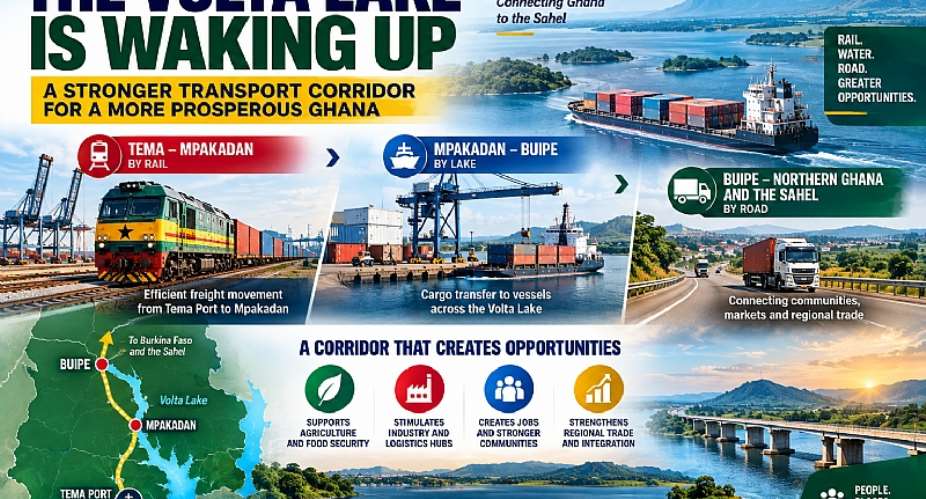
For decades, the Volta Lake has been viewed mainly through the lenses of hydropower, fishing and local passenger transport. Today, however, it is gradually emerging as something potentially more transformative: Ghana’s inland logistics highway.
The completion of the Tema–Mpakadan railway provides an important foundation. Government plans envisage freight moving from Tema by rail to Mpakadan, transferring onto vessels across the Volta Lake to Buipe, and continuing by road towards northern Ghana, Burkina Faso and other Sahelian markets. Plans for port infrastructure at Mpakadan, together with recently announced international financing for the wider logistics corridor, suggest that Ghana may finally be moving from separate transport projects towards genuine multimodal integration.
This is the right direction, but the Volta Lake must become more than a route for moving containers. Modern landing facilities can support agricultural communities, while logistics centres, cold-storage facilities and agro-processing industries could develop around strategic lake ports. Buipe and Mpakadan could become important economic nodes connecting southern and northern Ghana.
Safety, however, must remain central. Recent boat accidents, ageing vessels and unreliable ferry services demonstrate that modernising freight transport while leaving passenger transportation behind would be a serious policy failure. Investment must therefore include safer vessels, navigation aids, weather information, modern landing facilities and stronger emergency-response systems.
The real opportunity is to make rail, water and road operate as one transport system. Tema should connect efficiently to Mpakadan; Mpakadan to Buipe; and Buipe to northern Ghana and the Sahel.
Ghana already possesses the lake. The railway has reached its shores. The next challenge is integration.
The Volta Lake should no longer be treated as an underutilised geographical asset. It should become a corridor connecting communities, industries, markets and countries.
Author: Joseph Fuseini: ([email protected])


 We have cut cost of capital by more than half since Mahama took office – Ato For...
 Dr Bertha Ayi on how parents hurt children by raising them only on English
 Customs intercepts three firearms, 610 rounds of ammunition at Tema Port
 NDC to open nominations for 2026 regional executive elections on October 6
 Africa will be mostly self-sufficient in fuel by 2030: Dangote to AFP
 PRETAG threatens to intensify strike over unpaid teacher entitlements
 Lands Minister exits GoldBod Board as Minister's Chief Director takes over
 Court refuses bail for six accused in 3.9-tonne cocaine shipment case
 Philippines to open first-ever embassy in Ghana
 1992 Constitution review: Prof. Atsu Ayee and Dr Osae-Kwapong explain why Consti...


