




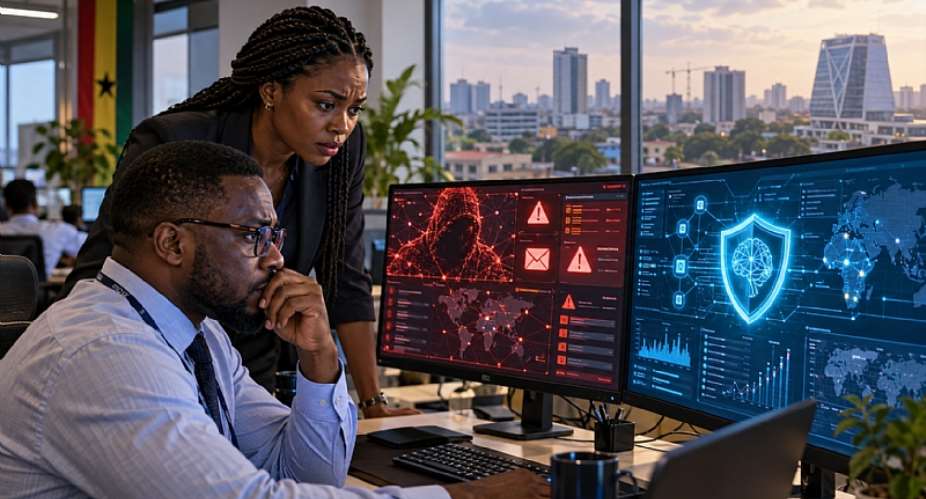
A suspicious email arrives in the finance department of a company in Accra. It appears to come from the managing director. The writing style sounds familiar. The message refers to an ongoing transaction and asks the accounts officer to make an urgent payment.
A few years ago, there might have been obvious warning signs. Poor grammar, strange wording or an unusual email format could expose the fraud.
Today, those clues are disappearing.
Artificial intelligence can help criminals produce convincing messages, imitate writing styles, analyse publicly available information about employees and create personalised scams within seconds. Voice cloning and synthetic images can make deception even more believable. What once required considerable technical skill, time and research can increasingly be automated.
This is why the next stage of cybersecurity may look very different from the one businesses have known.
It will increasingly be artificial intelligence attacking systems and artificial intelligence helping to defend them.
For Ghanaian businesses, this is not a distant technological argument. It concerns money, customer information, business continuity and trust.
Ghana's Cyber Security Authority recorded 3,876 cybersecurity incidents between January and July 2026. Online fraud accounted for about 47 percent of those incidents. The Authority has also reported that fraud cases across banks, specialised deposit taking institutions and payment service providers increased from 16,733 in 2024 to 24,778 in 2025.
Those figures should make every chief executive, accountant, entrepreneur and board member pay attention.
Cybersecurity can no longer be treated as something that belongs only to the information technology department.
Artificial intelligence is changing the attacker
Cybercriminals have always looked for the easiest route into an organisation. Sometimes that route is an outdated server. Sometimes it is a weak password. Very often, however, it is a human being.
Artificial intelligence makes attacks against people easier to scale.
A criminal can use publicly available information from company websites, professional profiles and social media to understand how an organisation works. Artificial intelligence can then help create convincing emails directed at specific employees.
A message to an accountant can be written in financial language. A message to a human resource officer can look like an employee request. A message to a chief executive can appear to come from a trusted supplier or board member.
The technology does not necessarily invent a completely new form of cybercrime. Its danger lies in making existing attacks faster, cheaper and more convincing.
IBM's 2026 X Force Threat Intelligence Index found a 44 percent increase in attacks beginning with the exploitation of public facing applications. IBM also warned that artificial intelligence is enabling criminals to identify weaknesses and scale activities more quickly.
The World Economic Forum reaches a similar conclusion. Its Global Cybersecurity Outlook 2026 found that 94 percent of respondents regarded artificial intelligence as the most significant driver of change in cybersecurity during 2026. Some 87 percent identified vulnerabilities associated with artificial intelligence as the fastest growing cyber risk during the previous year.
This does not mean artificial intelligence is suddenly responsible for every cyberattack. Password theft, phishing, ransomware, exposed systems and poor security practices remain major problems.
What is changing is the speed and scale at which criminals can exploit them.
Ghana has particular reasons to prepare
Ghana has become increasingly dependent on digital systems.
We send money through mobile platforms. Customers purchase products online. Banks deliver services through mobile applications. Universities maintain student information systems. Hospitals hold electronic records. Government services are gradually moving online. Businesses communicate with customers through email, social media and messaging platforms.
This digital transformation creates enormous economic opportunities.
It also creates a larger surface for cybercrime.
The Cyber Security Authority warned in April 2026 about criminals creating fake profiles that impersonate legitimate businesses on search engines and online map services. Between January and April alone, the Authority received 54 reported cases associated with this particular scheme, resulting in losses of GH¢266,195.
Such scams are particularly dangerous because they attack trust rather than technology alone.
A customer who believes that he or she is communicating with a legitimate company may willingly provide information to a criminal.
Artificial intelligence can make that deception more sophisticated.
Imagine a criminal system that can automatically identify potential victims, generate personalised messages, respond convincingly to questions and continue the conversation until payment information is obtained.
Now imagine that process operating against hundreds or thousands of people simultaneously.
That is the scale businesses must begin thinking about.
Defence must become intelligent too
The encouraging part of this story is that artificial intelligence is not available only to criminals.
Security teams can also use it.
Modern cybersecurity systems can examine enormous quantities of network activity and identify behaviour that appears unusual. They can detect suspicious login attempts, unusual movement of data, unexpected account activity or patterns associated with malicious software.
Instead of waiting for a human analyst to examine every event manually, intelligent systems can help determine which threats deserve immediate attention.
Microsoft's Digital Defense Report notes that defenders are using artificial intelligence and automation to reduce response times while attackers are also using the technology to expand phishing and intrusion campaigns. Microsoft reports that phishing supported by artificial intelligence has become significantly more effective, strengthening the case for faster detection and automated defence.
- This is where the idea of artificial intelligence against artificial intelligence becomes important.
- An attacker may use intelligent tools to generate thousands of convincing phishing messages.
- The defender may use intelligent systems to identify unusual communication patterns.
- An attacker may use automation to search continuously for vulnerabilities.
- The defender may use automated monitoring to identify weaknesses before criminals exploit them.
- An attacker may attempt to imitate a chief executive's communication.
The organisation may use identity verification systems and additional approval procedures to prevent one message from being enough to authorise a major financial transaction.
The battle therefore becomes one of speed, intelligence and preparedness.
But technology alone will not solve the problem.
The weakest password can defeat the smartest security system
There is a temptation to believe that organisations must immediately purchase expensive artificial intelligence security products.
That would miss the central lesson emerging from recent cybersecurity research.
IBM's 2026 findings emphasise that many successful attacks still depend on basic security weaknesses. Advanced protection becomes less useful when organisations fail to maintain proper authentication, update exposed systems or control access to sensitive information.
A company can purchase sophisticated security software and still suffer a breach because an employee reused a weak password.
It can deploy artificial intelligence and still lose money because one person was permitted to authorise a large transfer without independent verification.
It can build an expensive digital platform and still expose customers because old software was never updated.
The intelligent cybersecurity organisation therefore begins with the basics.
Every important account should have strong authentication. Access to business information should be limited according to employee responsibilities. Software should be updated. Important information should be backed up. Employees should know how to identify suspicious requests. Financial transactions should have clear verification procedures.
Artificial intelligence should strengthen these controls rather than replace them.
The boardroom must enter the conversation
Perhaps the biggest change Ghanaian businesses need is not technological at all.
It is managerial.
Cybersecurity must become a boardroom issue.
In April 2026, Ghana's Ministry of Communication, Digital Technology and Innovations called on corporate leaders to treat cybersecurity as a business priority, arguing that increased use of online services, cloud platforms and artificial intelligence had expanded the country's cyber threat landscape.
This is important because a cyberattack does not affect only computers.
- It can stop a company from operating.
- It can expose customer information.
- It can interrupt payments.
- It can damage a brand that took years to build.
- It can create regulatory and legal difficulties.
- Most importantly, it can destroy trust.
- That means directors should be asking clear questions.
- What information would cause the greatest damage if stolen?
- Who can access it?
- How quickly would we detect an intrusion?
- What would happen if our systems were unavailable tomorrow morning?
- Who would communicate with customers?
- Do we have secure backups?
- When did we last test our incident response plan?
These are business questions, not merely technical questions.
Ghana cannot wait for the attack
Ghana is simultaneously expanding its digital economy and increasing its ambitions in artificial intelligence. The country's National Artificial Intelligence Strategy, launched in April 2026, emphasises responsible adoption, data governance, infrastructure and workforce development.
Cybersecurity must grow alongside that ambition.
It would be a serious mistake to build increasingly intelligent businesses without building equally intelligent protection around them.
Companies should invest in cybersecurity professionals, regularly train employees, assess suppliers before granting them access to business systems and develop clear procedures for responding to incidents.
Small businesses should not assume they are too insignificant to attract criminals. Automation changes the economics of cybercrime. A criminal no longer needs to personally select every victim when software can search for vulnerable organisations at scale.
The era of saying, “Nobody will target my business,” is ending.
The real competition is about trust
There is something deeper at stake than computers.
Digital business depends on trust.
Customers must trust that their money will reach the right destination. They must trust that companies will protect their personal information. Employees must trust the systems they use. Businesses must trust suppliers and digital platforms.
Cybercrime attacks this foundation.
As artificial intelligence improves, criminals will become better at creating false identities, convincing messages and believable digital interactions. Businesses will therefore need stronger methods of establishing what is genuine.
The companies that succeed in this environment will not necessarily be those that adopt artificial intelligence fastest.
They will be those that combine innovation with security, human judgement and accountability.
Ghana is entering an important phase of its digital transformation. Artificial intelligence can increase productivity, support innovation and create entirely new services. But the same technology can strengthen those who seek to exploit weaknesses in our increasingly connected economy.
The cybersecurity contest ahead will therefore not simply be human beings fighting hackers behind computer screens.
Increasingly, intelligent systems will operate on both sides.
For Ghanaian businesses, preparation must begin before the suspicious email arrives, before the customer's money disappears and before the company's database is compromised.
In the coming cybersecurity battle, artificial intelligence will be used to attack and artificial intelligence will be used to defend.
The advantage will belong to organisations that understand one simple truth early enough.
In a digital economy, cybersecurity is no longer only about protecting technology. It is about protecting the business itself.
Philipa Serwaa
University of Energy and Natural Resources P.O. Box 214 Sunyani, Bono Region
E-mail: [email protected]


 ‘Russian sleeper cell’: Can Germany’s far-right AfD be barred from sensitive int...
 EU unlocks 710 mn euros' aid for crisis-hit communities
 Power cuts, rubble: millions come home to find Sudan's capital unlivable
 ‘I never said I’ll declare a state of emergency to end galamsey’ – Mahama
 Education minister to meet teacher unions on Monday over strike
 Multiple fibre cuts disrupt voice, data services across the North – NCA
 134 former NPP MMDCEs of Akufo-Addo administration demand terminal benefits
 V/R: One dead, two injured as grader knocks down pedestrians at Dzodze
 At least 16 people killed as Russia and Ukraine trade deadly air strikes
 ‘Those saying they are beginning to regret coming home If that is the thank you ...


