




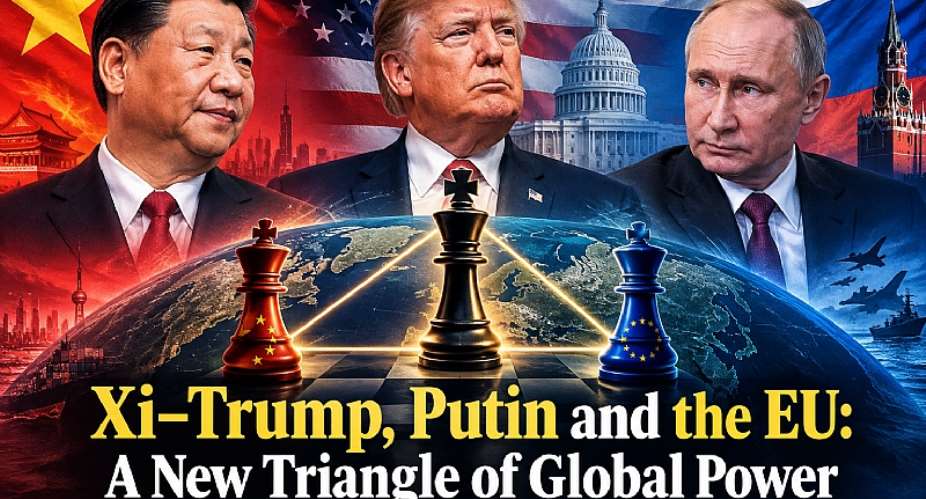
During a period of intense geopolitical recession, a fresh diplomatic wind appears to be moving through the international system. There is an emerging sense of responsibility among some of the world’s most powerful authorities, although beneath the diplomatic language, strategic competition remains intense. In geopolitics, sometimes the less a power speaks, the more its silence communicates; and the less visibly it moves, the more consequential its movement can become.
China appears to understand this equation particularly well. President Xi Jinping’s meeting with Donald Trump in Washington was among the most closely watched diplomatic encounters of the year. Rather than allowing every disagreement to dominate the encounter, both sides projected a degree of restraint and emphasised areas of mutual interest. The meeting therefore offered not a resolution of the US-China rivalry, but a temporary mechanism for managing it. The two sides extended their trade truce, while AI, technology, Taiwan and strategic competition remained major points of discussion.
Who Will Lead AI and Superintelligence?
The most significant emerging question is no longer simply who will dominate artificial intelligence, but who will determine the rules governing increasingly powerful AI systems.
China and the United States have discussed establishing channels for dialogue on AI risks and benefits, including mechanisms to address serious incidents. Xi has argued that AI should remain under human control and that the two countries should cooperate to prevent its misuse and abuse. Yet the Washington meeting did not produce a comprehensive agreement to halt or regulate the AI race.
That distinction matters. Cooperation on AI safety may become one of the few areas where strategic rivals are forced to communicate, because an uncontrolled technological competition could create risks extending beyond conventional national-security calculations.
The Contradictions Remain
The difficult questions, however, remain unresolved. Trade, tariffs, advanced technology, Taiwan, defence, orbital capabilities and industrial policy continue to divide Washington and Beijing.
The latest trade arrangement provides breathing space, not a permanent settlement. The United States wants to preserve its technological and strategic advantages, while China has little incentive to surrender its own leverage.
This is where diplomacy becomes more complicated than rhetoric. Neither side appears prepared to give the other complete strategic space. The real question is therefore not who can dominate the other, but whether both powers can establish boundaries within which competition does not become confrontation.
Is the EU Stuck Between the Past and the Present?
Europe is confronting a parallel strategic dilemma. The continent remains deeply connected to the American security architecture, yet several European governments are increasingly asserting independent diplomatic positions.
The recent European position on the Israeli-Palestinian conflict demonstrates this changing political atmosphere. Spain, Norway, France, the United Kingdom and other governments have supported measures concerning trade with Israeli settlements and reiterated support for a two-state solution.
This does not mean Europe has abandoned the United States or NATO. Rather, it suggests that European governments are attempting to create greater room for independent decision-making while maintaining the transatlantic alliance.
The larger strategic question is whether Europe can develop sufficient defence capacity and political coherence to carry a greater share of its own security responsibilities without turning strategic autonomy into another form of confrontation.
How Can Moscow Seize the Opportunity?
Moscow is also watching this transformation carefully.
On September 24–25, Vladimir Putin stated that Russia was not preparing for hostilities with Europe and argued that there was no real Russian motive for such escalation. Such statements should not automatically be interpreted as a breakthrough, particularly while the Ukraine war continues and European governments remain deeply concerned about Russian intentions. But diplomatically, the message provides an opening for discussing crisis-management mechanisms and possible negotiations.
For Moscow, a Europe increasingly capable of independent strategic decision-making could alter the balance of the wider geopolitical equation. For Europe, however, greater autonomy cannot mean dependence on another external power.
The most consequential development, therefore, may not be a formal alliance among China, Russia and Europe, nor a collapse of the transatlantic relationship. It may instead be the gradual emergence of a more fragmented but more autonomous international order.
This is where European leaders, particularly Emmanuel Macron and other advocates of greater European strategic capacity, face a historic challenge: building a security framework capable of engaging Washington and Moscow without becoming subordinate to either.
The geopolitical chessboard is changing. Xi and Trump may be attempting to manage competition; Putin is presenting negotiation as an alternative to confrontation; and Europe is searching for greater strategic autonomy.
The real test of the emerging order will be whether these competing ambitions can be converted into rules, dialogue and restraint—or whether the new multipolar chessboard simply produces new lines of confrontation.

 Credit Godfred Dame for Ghana's US$393 million tax arbitration victory against T...
 How can EOCO be accused of wanting to kidnap Baffour Awuah in full glare of the ...
 'She is not party operative' – Kwakye Ofosu defends EOCO officer
 Baffour Awuah wanted over alleged financial loss, dissipation of public funds an...
 Brazil is the main source of cocaine in Ghana by sea concealed in sugar containe...
 'The cacophony of noises surrounding my comments were pure mischief' — Chief Jus...
 ‘Judges must not abandon their humanity because of their judicial office’ – Chie...
 GTEC flags over 100 tertiary institutions as unrecognised
 Political protection may be behind decline in visible cocaine trafficking in Gha...
 Ghana identified as source of explosives used in Sahel conflicts — Crime Index r...


