




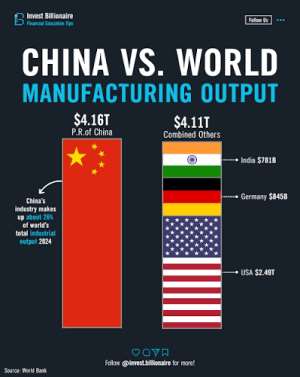
It is beyond doubt that the world is facing an existential crisis, which in large part is driven by the collapse of the United States; politically, economically, and culturally. The United States as the world’s hegemon is no more. This is not necessarily fatal for humanity, if we use this opportunity to create a new set of political economic relations throughout the world. In brief; We need a new paradigm. The current global system, which has been controlled in large measures over the last four-score years, by the fatal diseased ideology of a zero-sum thinking by the West, must be transcended.
Given that the collapse of the United States is empirically obvious, elements of the U.S. Establishment have begun to desperately look for other methods in an attempt to maintain the United States as the world’s superpower. This is the only way to comprehend the recently published article, How to Reindustrialize America: The Case for a Strategic Investment Fund, by Jake Sullivan, in the July 29, 2026, issue of Foreign Affairs. To understand the significance of Sullivan’s commentary, it is important to know that he served as the National Security advisor to President Joe Biden from 2021 to 2025, occupying a top policy post in the government. Foreign Affairs magazine is published by the Council of Foreign Relations, the premier think tank in the United States, representing the Anglo-American establishment, which is influential in all the affairs of government regardless of party. (1)
China “The Enemy” As The Motivator
Sullivan’s article is an attempt to persuade the American Establishment that the United States must reindustrialize to combat China, prevent it from surpassing the United States to become the new hegemon. Regrettably, America is responsible for outsourcing our industrial economy, not China. It has brought this calamity upon itself through wrongheaded policies. Sullivan, along with all elected and appointed government officials in Washington DC, blame China for using its expanding manufacturing capacity for the reduction of our country’s manufacturing sector. This is completely false. America did this to itself when the same Foreign Affairs recommended in the 1980s that the United States become a “postindustrial society,” a service economy and financial capital of the world, which would not require industry. As a result, we have experienced the reduction of over five million manufacturing jobs in this century, which has not abated under President Trump. Read: Xinhua Publishes Freeman’s Critique of the Post World War II “Rules Based Order” 
Jake Sullivan (courtesy of South China Morning Post)
From the opening paragraphs, Sullivan makes clear that is purpose for reindustrializing the United States is not for the betterment of American citizens, but to prevent China from becoming the premier global power.
Sullivan writes in his second paragraph:
The result [of China’s policy] is a market systematically tilted by state intervention… China’s strategy has created a technology ecosystem that now rivals–and in some areas surpasses–that of the United States…For China, industrial capacity has become a tool of coercion as well as competitiveness…
At the same time China was building its industrial strength, the United States was allowing much of its productive base to migrate abroad. For a few decades, that shift appeared to carry few strategic costs. America remained the world’s leading center of research and intervention even as manufacturing employment fell and supply chains stretched across. But the cost of separating innovation from production are now too great to ignore. As factories have moved offshore, the United States has lost much of its skilled workforce and the expertise to build at speed and scale. If it does not change course, the country could cede its technological edge, and, in time, its broader global leadership, to China. (emphasis added) 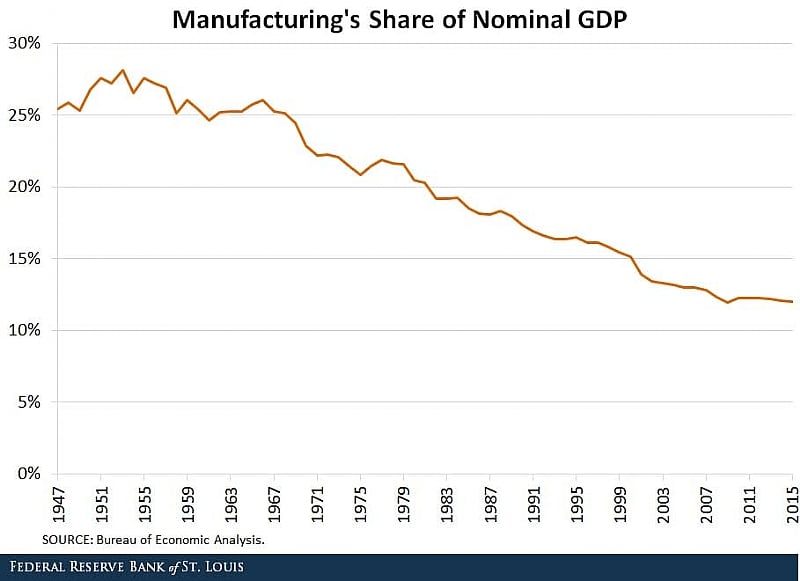
GDP Share Trend: Dropped steadily from ~15-16% in the late 1990s/2000 down to 9.4 to 9.5 of total U.S. GDP by the end of 2025
He continues in his essay:
The course of American manufacturing illustrates its dynamic. Once production ecosystems fragment, they’re exceedingly hard to rebuild. U.S. shipbuilding, for example, collapsed after the 1980s, when the government subsidies were withdrawn erasing supplier depth and design expertise. From the 1980s onward, the offshoring of U.S. transformer or machine tool manufacturing reduced procurement costs for downstream firms in the short term but wiped out the domestic base of engineers and component makers.
These were the effects caused by the fraud of globalization that went hand in hand with the Establishment’s dictated, post-industrial society, which accelerated the decline of America’s vital productive industries.
According to the rules based order, with their zero sum mindset, which contaminates Sullivan’s outlook, the United States must reindustrialize, not for the good of our country, but to stop China. This, glaring ideological defect, will lead to greater conflict throughout the world, if it is not superseded with a superior worldview. In other words, we need to establish a new set of beliefs, values, and policies, which coheres with the need to develop our nation and the rest of the world in accordance.
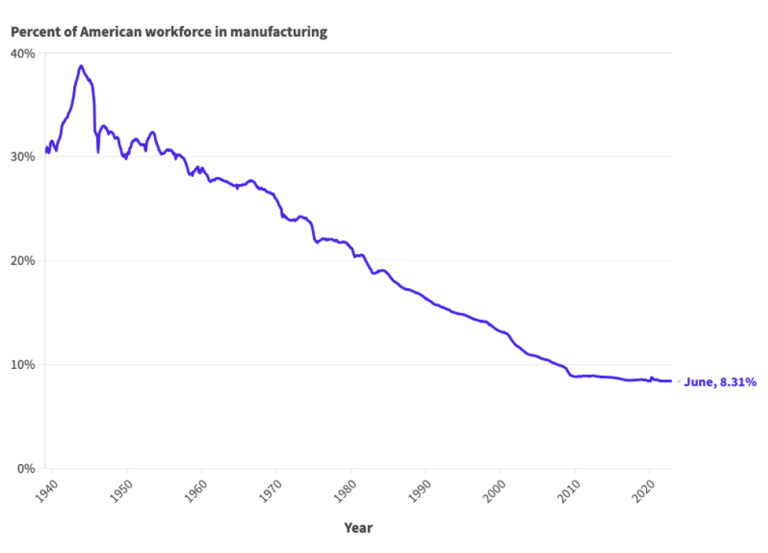
U.S. manufacturing contributed approximately $2.89 trillion, or roughly 9.4 t0 9.5%, of total U.S. GDP by the end of 2025.
Enter Alexander Hamilton
The scientific economic principles of Alexander Hamilton, which became the foundation for the school of economic thought known as the American System of Political Economy, will always work if they are properly comprehended and correctly applied. This has been the case throughout the history of the United States and the world when leaders adhered to Hamilton’s economic philosophy. (2)
Briefly, the American System rejects the Adam Smith free trade- let the marketplace decide- notion of economics and instead insists that the state acting for the public good, participates in fostering economic growth. The elementary tenets of Hamilton’s system that saved our debt ridden, agrarian based, young republic and created a once mighty industrial powerhouse, are:
1) The use of national banking in all of its forms following Article 10, section 8 of the Constitution.
2) The emission of productive credit as a tool for growing the economy.
3) The use of protective tariffs and bounties (subsidies) where needed to grow desired high technological manufacturing/scientific sectors.
4) the harmonization of public and private capital for the accomplishment of national works.
5) Large scale, long term infrastructure projects which uplift the standards of living of all people, increase society’s productive powers of labor, and enhance the cognitive powers of the population. (3) 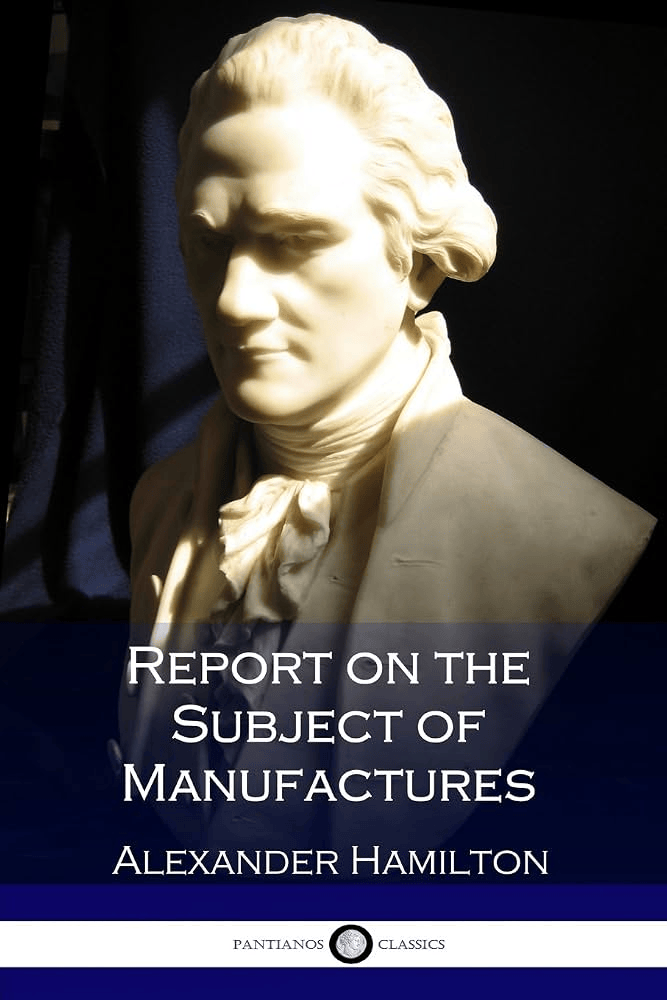
Amazon.sg
Sullivan Turns To Hamilton
Realizing that the United States has fallen significantly behind China in basic manufacturing and industrial production, Sullivan recognizes the need to reach for the sound economic policies of Alexander Hamilton, as he interprets them. He writes accurately:
Whenever the United States has faced existential tests, its leaders have turned to Hamilton’s logic.
Since its founding, the United States has treated finance as an instrument of sovereignty. In his nineteen 1791 Report on Manufacturers to the Congress, Hamilton made the case that economic independence was inseparable from the political independence. The young republic, he argued, had to use public credit to nurture productive industry and national strength. Hamilton envisioned a pragmatic model of state-enabled capitalism, in which loans “bounties” encouraged “infant manufacturers,” tariffs protected their strategic sectors, and public institutions channeled capital towards long-term national aims. Whenever the United States has faced existential tests, its leaders have returned to Hamiltonian logic. (emphasis added) Read: Nations Must Study Alexander Hamilton’s Principles of Political Economy 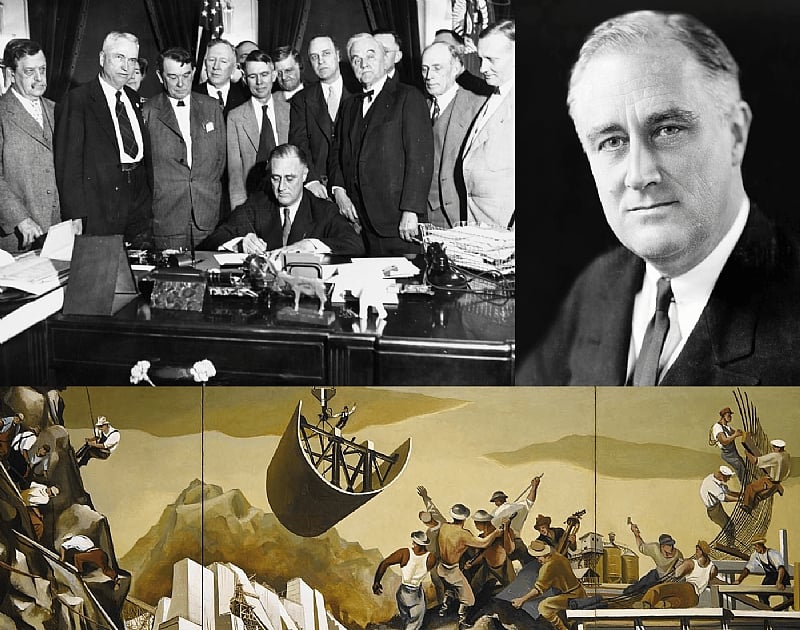
President Franklin Roosevelt initiates programs to rebuild America’s economy
Sullivan correctly identifies President Franklin Roosevelt’s Reconstruction Finance Corporation (RFC), as a Hamiltonian credit facility to counter the economic hardships of the Great Depression during the 1930s. The RFC also successfully built America’s military capability-the arsenal of democracy- that defeated the German Third Reich and Japan’s imperial army in World War II.
Sullivan writes:
When credit markets froze during the Great Depression and World War II, the Reconstruction Finance Corporation (RFC) created 1932, filled the gap and served as a strategic investor, financing banks, utilities, housing, and manufacturing, earning returns and restoring confidence in U.S. markets.
A Hamiltonian Proposal?
The RFC model used responsible public investment…showed that effectively deployed public capital can be used to invest in important industries private capital either unwilling or unable to finance by itself. (emphasis added)
Similar to President Roosevelt’s RFC, Sullivan proposes the creation a $50 billion U.S. Strategic Investment Fund (SIF) to attract private sector financing in an attempt to reverse the declining industrial base of the United States. He explains:
Throughout its history, the United States built institutions that channeled capital toward a national strategy. Resurrecting that tradition today would mean establishing a new kind of public investor: a U.S. strategic investment fund (SIF), a federally chartered market-facing public investor with its own balance sheet, designed to invest alongside private capital in strategically critical industries, both mature and emerging, where markets alone have proven insufficient…For more than two centuries, the United States has shaped its financial institutions to meet the strategic demands of the era. Hamilton’s treasury built national credit in the young republic. The RFC built industrial scale during the nation’s economic nadir… Each moment required the same act of imagination: treating capital as a tool of national purpose and industrial power. 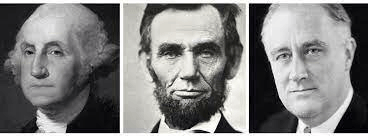
Three great American Presidents who applied Hamilton’s economic principles to industrialize the United States
Aspirations For Hamilton Today
Alexander Hamilton, our nation’s first Treasury Secretary, was a crucial contributor to the creation of the United States. The application of his scientific economic principles resulted in the industrial expansion of America. Hamilton’s four economic reports, written from 1789 to 1791, adopted by President George Washington, formed the true economic foundation of the United States, not Adam Smith. (4) His utilization of public productive credit and directed government issued capital were essential mechanisms to create America’s prosperous economy from a confederation of thirteen bankrupt colonies. Hamilton adopted the approach of dirigisme, rejecting so called laissez-faire capitalism. Throughout American and European history, nations have turned to Hamilton’s economic policies in times of crisis, when their countries needed industrial expansion or revitalization. There is clear identifiable evidence that China’s rapid economic growth over a relatively brief period of time, used similar economic modalities as those of Alexander Hamilton. Read: U.S. Establishment Admits Truth Of China’s Economic Superiority, But They Don’t Understand It
This essay by Jake Sullivan, following several articles in recent issues of Foreign Affairs, that reporton the United States falling behind China in industrial output, indicate awareness by some elements in the U.S. Establishment, that the United States is in serious decline, and are looking for a means to reverse it. Within the last hundred years, we have the examples of Presidents Franklim Roosevelt and John Kennedy, applying Hamiltonian policies to achieve their goals for our nation.
Economic development requires at a minimum; quality infrastructure, a robust manufacturing sector, a modern agricultural sector, a well-funded scientific vision, promotion of new technologies, quality education, and modern healthcare. Economic development is a good for humanity; it is a good in and for itself. The impetus for economic development need not require being provoked by an enemy image. A true reindustrialization of the United States could not be done in isolation. It would demand development for the rest of the world to be successful. The most moral and efficient path to reindustrialization of the United States would be to encourage all nations to emulate the American System while maintaining their complete sovereignty over their national economy. A community of sovereign nations cooperating in the pursuit of economic growth, the elimination of poverty and hunger, would remove the foremost causes for wars among nations. This presents an existential challenge for the leadership of the United States. The controlling ideology of the rules-based order with its dangerous zero-sum mindset is not congruent with Hamiltonian principles; in fact, it is antithetical to them. America would be incapable of achieving Sullivan’s objectives while upholding its ideological conviction that it must reign as the super-hegemon of the world.
1-The Council on Foreign Relations is a 100 year old arm of the Anglo-American establishment. Founded in 1921 as the American branch of the British Royal Institute for International Affairs, otherwise known as Chatham House, which was created two years earlier. Chatham House was created by Lord Alfred Milner, then acting as Secretary of State for the British Empire’s colonies, through a vast trust funded by the estate of race-patriot Cecil Rhodes.
2-Hamilton versus Wall Street: The Core Principles of the American System of Economics , Nancy Bradeen Spannaus, Americansystyemnow.com
3-Alexander Hamilton: Crash Course in Statecraft and the Rise of the American System, Mathew Ehret, [email protected]
4- The Vision of Alexander Hamilton: Four Economic Reports by Alexander Hamilton
1-The Council on Foreign Relations is a 100 year old arm of the Anglo-American establishment. Founded in 1921 as the American branch of the British Royal Institute for International Affairs, otherwise known as Chatham House, which was created two years earlier. Chatham House was created by Lord Alfred Milner, then acting as Secretary of State for the British Empire’s colonies, through a vast trust funded by the estate of race-patriot Cecil Rhodes.
2-Hamilton versus Wall Street: The Core Principles of the American System of Economics , Nancy Bradeen Spannaus, Americansystyemnow.com
3-Alexander Hamilton: Crash Course in Statecraft and the Rise of the American System, Mathew Ehret, [email protected]
4- The Vision of Alexander Hamilton: Four Economic Reports by Alexander Hamilton
Read:Sullivan: How to Reindustrialize America
Read my earlier articles on this topic:
Can U.S. Compete With China? Washington Establishment Has Serious Qualms
Tariffs Do Not Create Economic Wealth: Trump Is Wrong!
Lawrence Freeman is a Political-Economic Analyst for Africa, who has been involved in economic development policies for Africa for over 35 years. He is a teacher, writer, public speaker, consultant on Africa, and an analyst of global strategic relations. Mr. Freeman strongly believes that economic development is an essential human right. He is the creator of the blog: lawrencefreemanafricaandtheworld.com, also publishes on: lawrencefreeman.substack.com, “Freeman’s Africa and the World, and on X @lkfreemansafrica


 Bolgatanga: Man found dead by roadside in Sumbrungu as police investigate
 Ghana concludes cocoa freight negotiations for 2026/27 season
 Blakk Rasta accuses Gushegu NPP MP Alhassan Tampuli of funding Ghana Jollof atta...
 €225m Cocaine Shipment: Court to rule on bail application of six accused in 3.9-...
 BoG pilots cedi-based payment system for Ghana-China trade
 2026 BECE: Ten schools score zero percent in Adaklu as girls outperformed boys
 Gold shipments resume as Ghana rebuilds foreign exchange reserves — BoG governor
 ECG unions to stage nationwide protest over proposed private sector participatio...
 ‘That penalty is a joke’ — Queiroz rejects referee decision in Ghana’s loss to C...
 'Sceptics, naysayers, alarmists should be aware US ready to work with Ghana on r...


