




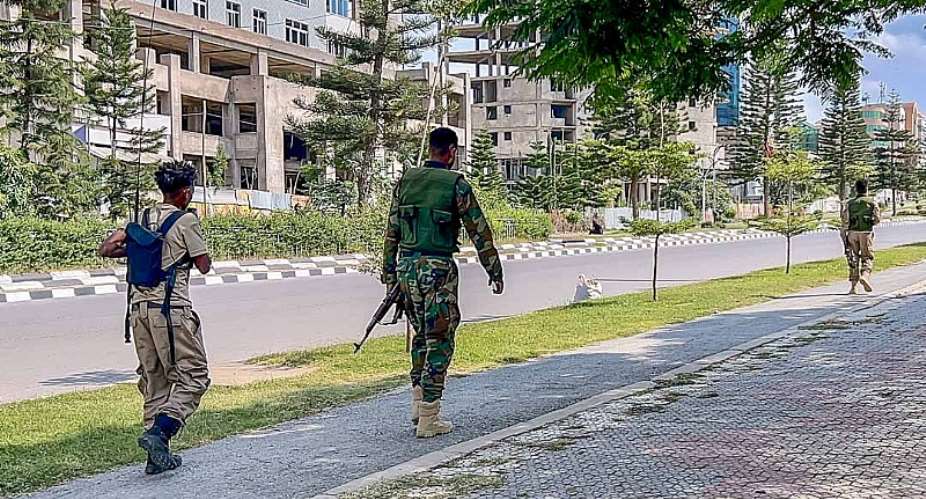
Northern Ethiopia is slipping into renewed war. After months of building tensions, on 23 September large-scale hostilities broke out between the Tigray People’s Liberation Front (TPLF) and Amhara Fano militias, on one side, and the federal government and allied Tigrayan forces on the other. Responsibility for the escalation lies primarily with the TPLF, which launched ground assaults in coordination with other rebels with whom it has joined hands in a new alliance that vows to overthrow Ethiopia’s government. The upsurge in fighting comes almost five months after the TPLF retook power in the Tigray region, dealing a blow to a 2022 peace deal that had ended the last Tigray war and leading Addis Ababa to mount an intensifying drone campaign against TPLF forces.
Much is unclear about how the two sides are faring on the battlefield, but many fear that further escalation in Tigray could draw in Eritrea, which is now closely aligned with the TPLF. Fighting in northern Ethiopia could also fuse dangerously with the war raging across the border in Sudan. African leaders backed by the U.S. and other outside powers should urge both sides to de-escalate and return to the negotiating table before hostilities spiral into a full-blown war that inflicts yet more suffering on civilians, while threatening to embroil other states.
A Shaky Deal Gives Way
The last war between the TPLF and Abiy’s federal government was one of the deadliest in the 21st century to date, killing hundreds of thousands. The roots of the conflict lie in the dramatic ascent of Abiy Ahmed to power in 2018. Abiy’s political base is in the Oromia region. His rise to the premiership ended the TPLF’s heavy-handed rule, and its decades-long political dominance, but also presaged a new struggle to come. TPLF leaders decamped to Tigray’s regional capital Mekelle to regroup.
Full-scale war erupted in 2020, when TPLF forces launched a surprise attack on the federal military’s northern command post. Momentum swung both ways before Abiy and his coalition gained the upper hand in 2022. Under heavy military pressure, the TPLF agreed to a deal in November of that year ending the fighting. Under that accord, signed in Pretoria, the TPLF promised to disarm, and the parties agreed that Tigray would have an interim administration governing with the approval of both sides.
While welcomed for bringing the conflict to an end, the Pretoria deal left a number of open wounds. The TPLF felt aggrieved by what it considered a lopsided settlement and, according to the government, it failed to honour its disarmament pledge. Eritrea, which had overcome enmity with the federal government to join the anti-TPLF campaign, felt it had been inadequately consulted on the final deal and wished the government had pushed to achieve a full battlefield victory. The status of hotly contested territories that the Amhara region had seized from Tigray during the conflict was left unresolved – leaving Tigrayans displaced from these areas languishing in temporary camps.
Shoring up the wobbly settlement would have required patient statecraft from outside actors pressing the former belligerents to compromise, but the diplomacy that occurred was unavailing. Instead, the deal slowly collapsed. In late April and early May, the TPLF ousted Tigray’s interim administration and reinstalled its head Debretsion Gebremichael as regional president. After wresting back control of the region, TPLF leaders launched a major conscription drive and made a series of comments suggesting that their goal is to remove Abiy from power. They also repeatedly warned of an imminent return to war. Dialogue between the TPLF and other key rebel groups to form an alliance also accelerated, though these groups have little in common besides opposition to the government.
The federal government, which was already cutting off federal funds and restricting fuel to the region as relations with the TPLF went into a rapid decline, began to launch occasional drone strikes on targets in Tigray. Shuttle diplomacy between Addis Ababa and Mekelle by the African Union’s envoy, former Nigerian President Olusegun Obasanjo, who oversaw the 2022 peace talks, appeared to make little progress toward direct negotiations or an off-ramp.
Regional tensions further poisoned the waters. Fuelled by its bitterness over the Pretoria agreement, and in line with the byzantine nature of alliance building in the region, Eritrea is now quietly aligned with its former enemy the TPLF. Meanwhile, Addis Ababa accuses Asmara of playing a central role in coordinating the opposition alliance that has formed against it.
There is also a Sudan angle. Ethiopia’s leaders are furious at the Sudanese army for hosting thousands of Tigrayan fighters in territory under its control, whom they fear could attack Ethiopia from across the border or return to Tigray to join in battling the government. Many of these fighters have aided Khartoum in its own civil war with the paramilitary Rapid Support Forces (RSF). Seeing the Sudanese army as part of a regional axis coordinating with Ethiopian opposition forces, Addis Ababa has reportedly responded by allowing arms flows to the RSF and permitting it to operate from Ethiopian territory near Sudan’s Blue Nile state, where the paramilitary has made a series of gains. Ethiopia is also a close ally of the United Arab Emirates (UAE), which is widely seen (despite its denials) as the RSF’s main backer. Meanwhile, the UAE’s Saudi rivals are aligned with the Sudanese army, as are Egypt and Eritrea, both arch-foes of Ethiopia.
Diplomats and mediators say the superheated regional climate – in which both continental and Gulf powers are lining up on different sides of the Horn’s overlapping conflicts – has made it an uphill struggle to ward off a return to war in northern Ethiopia.
Growing Tensions and a Return to War
Tensions only increased over the course of August and September. As the culmination of its coalition-building efforts, on 20 September, the TPLF announced it was forming an Alliance for Survival with six other groups, most prominently a major umbrella organisation of the Amhara Fano rebel movement, which launched an insurgency against the government in August 2023. A statement launching the alliance set out its objective as overthrowing Abiy’s government.
Then, on 22 September, the federal government responded with its biggest drone attack since August, targeting an apparent build-up of Tigrayan forces close to the Wollo area of the Amhara region where several anti-government groups are active.
By 23 September, large-scale ground fighting between the TPLF and government forces had begun, with the former taking over three Tigray airports that had been still under federal control in Mekelle and the major towns of Axum and Shire, replacing the federal police stationed with their own forces without a fight. The federal government cancelled all flights to the Tigray region.
Fighting in the north is now concentrated in two main areas. One is in the Amhara region close to the boundary with Southern Tigray, where Tigrayan forces and Amhara Fano launched a ground assault on federal forces on 23 September. The other hotspot is the boundary between Tigray and the Afar region to the east, where on the same day the TPLF launched an offensive against the government-backed anti-TPLF armed group the Tigray Peace Forces. Adding another combustible element, an anti-government group from Afar also joined the fray, fighting alongside the TPLF in two locations on the Tigray-Afar border. The multi-front offensive appears to be the first attempt by the new opposition alliance to carry out coordinated military action against the federal government.
Government officials and several diplomats blamed the TPLF for the erupting conflict. Getachew Reda, the former senior Tigrayan official who is now an adviser to Abiy, accused the TPLF of starting a new war. The U.S. ambassador to Ethiopia, Ervin Massinga, also put out a statement expressing “disappointment” with the “large-scale offensive” launched by the TPLF. Other sources in Ethiopia appear to confirm that the TPLF launched the major new assaults, in coordination with other groups. In a statement, the TPLF claimed that its actions were “defensive” in nature, responding to the government’s “open invasion” on 22 September when it launched its barrage of drone strikes on Tigrayan military targets.
Situation Report
At the time of publication, the heaviest fighting is centred in the North Wollo area in the Amhara region, near the boundary with Tigray, where the TPLF and Fano elements appear to be coordinating their offensive against federal positions. With the Tigrayans and Fano reportedly taking territory and threatening several major towns in northern parts of Amhara, including Weldiya and Lalibela, all eyes are on the federal government’s response. The situation looks set to deteriorate as the government throws more troops and weaponry at beating back the TPLF and its allies, though few believe the opposition groups have the punch to pose a direct threat to the federal authorities in Addis Ababa.
Should the government manage to halt or reverse the offensives beyond Tigray, a key question will then be whether Addis Ababa launches a large-scale ground war to remove the TPLF from power in Mekelle and restore federal control of most of Tigray. Privately, a senior government official stated that Addis Ababa will now seek to eliminate the TPLF as a threat, though another official suggested that the government would prefer to avoid a full-fledged war. To date, Abiy has appeared hesitant to get sucked into such a war in Tigray, but he may decide he has little alternative.
Beyond the risk of setting off an unpredictable spiral, a major escalation could also push the fighting close to the Ethiopia-Eritrea border, creating the potential for interstate conflict. There is also a risk of conflict erupting along the Sudan-Ethiopia border, in effect merging the two countries’ conflicts, given the federal government’s and TPLF’s ties to rival belligerents there. A major incursion into Tigray by the federal government would also almost assuredly lead to extensive destruction, displacement and mass casualties – in short, a humanitarian disaster.
Given the bad blood between the Ethiopian belligerents, outside engagement in the form of high-level diplomacy will likely be needed to prevent a plunge back into all-out conflict. Many have a role to play. Key African leaders, including Obasanjo (in his capacity as the AU’s High Representative for the Horn of Africa), as well as past and present heads of state, such as Kenyan President William Ruto and former Kenyan President Uhuru Kenyatta, should urgently push both sides to de-escalate and pursue an off-ramp into direct talks.
These leaders should urge the TPLF to halt its offensives and take its grievances to the negotiating table, while they should also engage with Abiy to avoid a major new ground invasion of Tigray and to allow time for emergency diplomacy. By way of support, Saudi Arabia should push its allies in Asmara, Khartoum and Cairo, all of which have significant disputes with Addis Ababa, to avoid meddling and further inflaming the situation. For its part, the UAE should press its allies in Addis Ababa toward diplomacy and avoid fanning the flames with large new arms transfers. The U.S., which has shuttled between Addis and Mekelle and backed Obasanjo’s mediation, as well as key European powers, should back all these efforts through their own continued outreach, including to the traditionally highly insular Eritrean government.
Averting a Nightmare Scenario
With wars already raging nearby in Somalia, Sudan and Yemen, not to mention those beyond, a major new conflict in Ethiopia is a nightmare scenario. The humanitarian consequences are potentially horrific – all the more so given what northern Ethiopia has already experienced in recent years – and there is a non-trivial risk that other countries get dragged into what could become a regional conflagration. A window is still open for averting these outcomes – but absent urgent diplomacy, it could close all too soon.
Originating at www.crisisgroup.org

 Bolgatanga: Man found dead by roadside in Sumbrungu as police investigate
 Ghana concludes cocoa freight negotiations for 2026/27 season
 Blakk Rasta accuses Gushegu NPP MP Alhassan Tampuli of funding Ghana Jollof atta...
 €225m Cocaine Shipment: Court to rule on bail application of six accused in 3.9-...
 BoG pilots cedi-based payment system for Ghana-China trade
 2026 BECE: Ten schools score zero percent in Adaklu as girls outperformed boys
 Gold shipments resume as Ghana rebuilds foreign exchange reserves — BoG governor
 ECG unions to stage nationwide protest over proposed private sector participatio...
 ‘That penalty is a joke’ — Queiroz rejects referee decision in Ghana’s loss to C...
 'Sceptics, naysayers, alarmists should be aware US ready to work with Ghana on r...


