




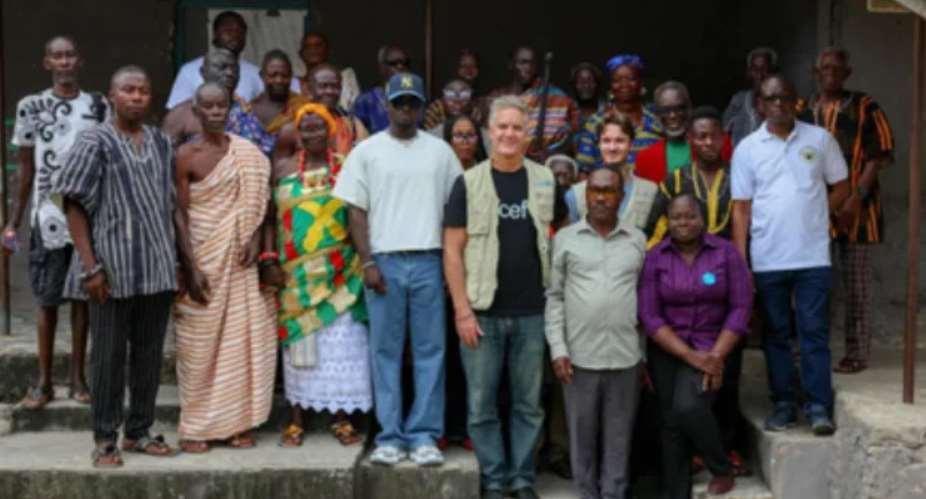
UNICEF Ghana Country Representative Andy Brooks, Afrobeats musician Kuami Eugene and officials of the Births and Deaths Registry (BDR) have led a field visit to Bepowase in the Ayensuano District of the Eastern Region as part of activities marking Birth Registration Month.
The visit to the community, which has a population of about 3,000, was aimed at drawing attention to the importance of birth registration and the right of every child to a legal identity and access to essential social services.
The delegation also engaged residents to better understand the challenges affecting birth registration in underserved communities while highlighting efforts to improve registration coverage in areas where performance remains low.
Ghana has recorded a decline in birth registration in recent years. In 2023, 663,226 births were registered, representing a 90.8% registration rate, compared with 677,140 births and a 92.3% rate in 2022.
When compared with the 786,468 live births recorded by the Ghana Health Service, the BDR figure for 2023 represented 84.3% of births captured by health facilities.
By the end of 2025, the number of registered births stood at 588,972, representing 73.4% of expected coverage.
Registration levels also vary significantly across regions. In 2023, Ashanti, Greater Accra and Northern recorded the largest shares of registered births, while Savannah, Ashanti, Upper East and Western exceeded their expected targets. Eastern Region, however, recorded relatively low coverage.
The disparity is also evident between urban and rural communities, with historical figures showing registration coverage of 73% in urban areas compared with 51% in rural communities.
One of the major challenges is geographical access. Registration offices and outreach services can be located far from rural, remote and island communities, while poor roads, seasonal inaccessibility and limited transport increase the cost and difficulty of accessing registration services.
A bottleneck study found that 66% of parents who had not registered their children cited lack of access to registration services.
Financial challenges also affect registration. Although registration is legally free for children below 12 months, parents may sometimes face unofficial charges. Late registration attracts official fees and additional procedures, which can create further difficulties for low-income families.
The BDR also faces shortages of funding, personnel and logistics. These constraints affect the availability of registration forms and certificates, transportation for outreach exercises and the ability of officers to reach communities. In some cases, children are registered without receiving their certificates immediately.
UNICEF Ghana Country Representative Andy Brooks said the decline in birth registration, from about 90% to roughly 74-75%, required renewed efforts to reach communities with low coverage.
He said UNICEF was supporting national, regional and district BDR services to improve registration, with communities such as Bepowase forming part of the targeted interventions.
According to him, the field visit was intended to provide an operational model that could help strengthen the registration system across the country.
“Failing to register a child leaves them legally invisible and omitted from child population counts, creating severe long-term consequences,” he noted. “And without accurate population figures, public services like schooling and healthcare cannot be planned properly.”
Mr Brooks explained that inaccurate population figures could affect the planning and delivery of essential services, including childhood vaccination programmes.
He advocated a continuous referral system in which health facilities immediately refer newborns to the BDR, allowing children to benefit from free registration during their first year.
He also called for schools to check birth certificates during enrolment to identify older children who may have missed registration.
“Because district registrars face logistical challenges covering over 60 communities, community chiefs play a critical role by ensuring local parents submit their details, allowing registrars to batch-process and deliver dozens of birth certificates during periodic visits,” he said.
The Regional Registrar for the Eastern Region, Edward Abrahams, said UNICEF remained the Registry’s primary source of support for its birth registration activities.
He, however, identified poor internet connectivity as one of the major operational challenges, particularly in communities where officers are expected to complete digital registrations.
“The registry is also severely understaffed and relies heavily on volunteers who have grown demotivated due to the lack of financial compensation or incentives,” he said.
“While occasional support from UNICEF allows team members to enter communities to register newborns, who qualify for free registration during their first 12 months, they frequently miss older children who have passed the free age limit,” he added.
Musician Eugene Kwame Marfo, popularly known as Kuami Eugene, also used the visit to stress the importance of registering children.
He said he was surprised by the lack of internet and cellular connectivity in Bepowase, describing it as his first experience of a Ghanaian village with virtually no network access.
He noted that about 80% of children in the community remained unregistered, a situation he said could make it difficult for families to secure legal identity and protection for their children.
According to him, birth registration is important not only for proving nationality or facilitating future travel but also for protecting children against risks such as abduction and trafficking by creating an official identity record.
As an artiste who organises his own children's festival, Kuami Eugene urged other celebrities and public figures to use their platforms, including TikTok, Instagram and Facebook, to promote social causes.
“I believe every public figure with a platform has a duty to help broadcast the necessity of registering children so that lack of identity ceases to be an ongoing crisis in Ghana,” he said.
The Assembly Member for the Bepowase Electoral Area, Esther Teiko, said birth certificates were important documents for proving Ghanaian citizenship and were needed for purposes including SHS enrolment, employment, security and international travel.
She said community outreach and public education had helped improve awareness about birth registration but identified several infrastructural challenges that continued to affect residents.
According to Madam Teiko, Bepowase currently has no telecommunication network coverage, forcing residents to walk nearly a kilometre to make phone calls.
“I want to plead with those outside or the government to come to our aid. We have no network coverage here. It makes us feel lost, as if we are not part of Ghana. It makes birth registration very difficult because it has been digitalised. So if stakeholders can help us get a network connection so we can link up with the rest of the nation, we would be very grateful,” she pleaded.
She also raised concerns about the poor condition of the road linking Bepowase to Adawso, saying the situation had discouraged commercial drivers and left residents largely dependent on motorbikes.
Madam Teiko further appealed for support to establish a functional computer laboratory at the local basic school.
She said the school, which has more than 200 pupils, relies largely on textbooks for ICT instruction because it lacks computers and network connectivity, potentially leaving students inadequately prepared for practical assessments.
She expressed appreciation to UNICEF and the BDR for selecting Bepowase for the intervention and welcomed assurances that digital processing would help speed up the issuance of birth certificates.
The Gyaasehene of Bepowase, Nana Osae Ababio II, also commended UNICEF Ghana for its support and efforts to educate residents about the importance of registering children at birth.
He pledged to encourage parents in the community to take birth registration seriously and ensure that their children are registered.
The chief also appealed to the government, private sector and individuals to support the community by addressing its telecommunications challenges and improving roads, healthcare facilities, school infrastructure and access to potable water.

 Bolgatanga: Man found dead by roadside in Sumbrungu as police investigate
 Ghana concludes cocoa freight negotiations for 2026/27 season
 Blakk Rasta accuses Gushegu NPP MP Alhassan Tampuli of funding Ghana Jollof atta...
 €225m Cocaine Shipment: Court to rule on bail application of six accused in 3.9-...
 BoG pilots cedi-based payment system for Ghana-China trade
 2026 BECE: Ten schools score zero percent in Adaklu as girls outperformed boys
 Gold shipments resume as Ghana rebuilds foreign exchange reserves — BoG governor
 ECG unions to stage nationwide protest over proposed private sector participatio...
 ‘That penalty is a joke’ — Queiroz rejects referee decision in Ghana’s loss to C...
 'Sceptics, naysayers, alarmists should be aware US ready to work with Ghana on r...


