




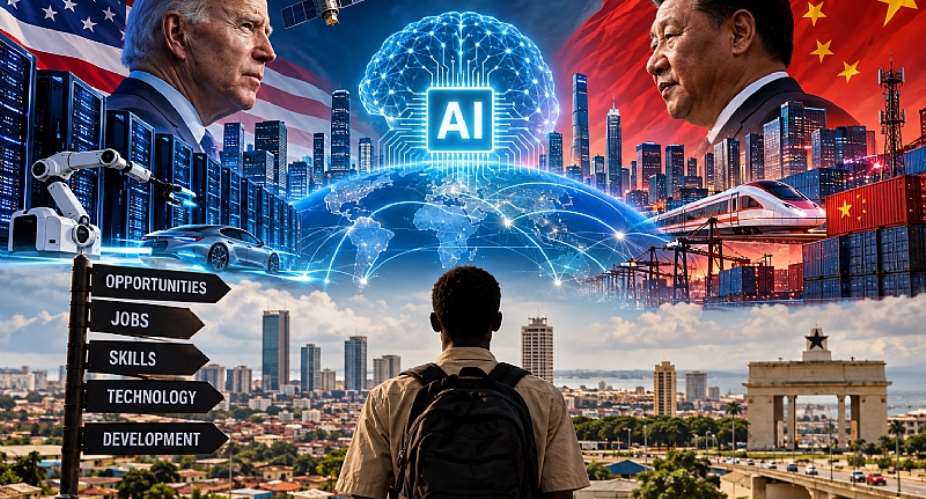
For much of modern history, the strength of a powerful country could be seen in its armies, warships, missiles and nuclear weapons. Today, another form of power is becoming increasingly important. It sits inside data centres, smartphones, research laboratories and computer chips. It is artificial intelligence.
The growing competition between the United States and China is therefore about much more than who can build the smartest chatbot. It is becoming a contest over who develops the most powerful artificial intelligence systems, manufactures or controls access to advanced computing infrastructure, attracts the best scientific talent and establishes the technological standards that other countries eventually adopt.
For developing countries, including Ghana and much of Africa, this should matter greatly.
We may not be building the world's largest artificial intelligence models today, but decisions being made in Washington and Beijing could determine what technologies we can access tomorrow, how much they cost, where our data is processed and whether our economies become producers or permanent consumers in the artificial intelligence age.
The United States has openly placed global technological leadership at the centre of its AI strategy. Its AI Action Plan calls for American hardware, models, software, applications and standards to be promoted internationally. China is pursuing its own expansive AI strategy and has placed particular emphasis on cooperation and capacity building with developing countries. In July 2026, China announced plans that include thousands of AI training opportunities and cooperation centres involving regions and organisations across the Global South.
This competition presents opportunities. It also presents a serious warning.
Developing countries must avoid becoming merely the marketplace in which somebody else's technological competition is fought.
The New Geography of Power
Artificial intelligence requires far more than clever software. Powerful AI systems depend on advanced computer chips, enormous quantities of data, reliable electricity, cloud infrastructure, skilled engineers and significant financial investment.
Control over these resources increasingly translates into economic and strategic influence.
The importance of advanced chips is already visible in tensions between Washington and Beijing. Access to high performance computing technology has become a sensitive issue in their wider relationship, while both countries continue investing heavily in domestic AI capabilities. Recent US China discussions have even considered mechanisms for communication over major AI safety incidents, demonstrating that AI is increasingly being treated not simply as a commercial technology but also as an international security issue.
The implications extend far beyond the two countries.
If tomorrow's agriculture, healthcare, banking, education, manufacturing, defence and public administration increasingly depend on artificial intelligence, then countries without meaningful AI capacity may discover that technological dependence has become another form of economic dependence.
That should concern Africa.
Africa Must Not Repeat an Old Pattern
Africa has experienced this pattern before.
We produce valuable raw materials and frequently import the finished products created from them. We export cocoa and import expensive chocolate. We export minerals that become components of sophisticated products manufactured elsewhere. We have often occupied the beginning of global value chains while other countries capture much of the value created at the end.
Artificial intelligence gives Africa an opportunity not to repeat that history.
The continent has something extraordinarily valuable in the AI economy: people, languages, cultures, local knowledge, growing digital markets and enormous quantities of potentially useful data.
But data alone does not create technological sovereignty.
If African information is collected while the infrastructure, algorithms and intellectual property needed to create value from it remain elsewhere, the continent may simply have discovered a new raw material to export.
Ghana should therefore think beyond using AI applications.
We should be thinking about building them.
What Does This Mean for Ghana?
Imagine two possible futures.
In the first, Ghana becomes an enthusiastic consumer of foreign artificial intelligence. Our schools use foreign educational systems. Our hospitals depend on imported diagnostic tools. Our banks use externally developed algorithms. Government institutions purchase foreign AI platforms. Businesses subscribe to overseas cloud infrastructure, while Ghanaian universities struggle to obtain the computing resources necessary to conduct serious AI research.
Everything appears modern.
Yet underneath that modernity is deep technological dependence.
Now consider another future.
Ghanaian universities train world class AI researchers. Local technology companies build systems for Ghanaian businesses. Agricultural AI understands crops, weather conditions and farming practices specific to Ghana. Healthcare systems are developed and validated using appropriate local data. Ghanaian language technologies understand Twi, Ewe, Ga, Dagbani and other indigenous languages. Local researchers participate in setting international standards rather than simply receiving them.
That is a fundamentally different future.
The difference between these possibilities will depend on decisions we make now.
Our Universities Must Become Part of the Strategy
No country can seriously discuss artificial intelligence sovereignty without discussing universities.
Ghana cannot build a competitive digital economy while advanced computing research remains underfunded and talented graduates lack access to the infrastructure required to experiment, innovate and commercialise ideas.
Our universities should become important centres of national AI development.
Computer science alone will not be sufficient. AI increasingly intersects with agriculture, medicine, engineering, mathematics, law, cybersecurity, education, economics and public administration.
A Ghanaian agricultural scientist working with an AI engineer could develop systems that identify crop diseases from images taken by farmers. Medical researchers could explore responsible diagnostic tools suited to local healthcare environments. Linguists and computer scientists could develop stronger technologies for Ghanaian languages.
Government, universities and industry therefore need a much closer relationship.
Research should not end with dissertations sitting on shelves. Promising ideas should have pathways into prototypes, companies and public services.
We Need Infrastructure, Not Only Training
Teaching young people to code is valuable, but skills without infrastructure have limits.
Advanced artificial intelligence requires computing power.
This means Ghana's AI strategy should include investment in reliable digital infrastructure, research computing, affordable connectivity, cybersecurity and energy.
Universities and technology start ups should not have to compete globally while operating with severely limited computational resources.
Regional cooperation could also help. Not every African country needs to reproduce every expensive piece of infrastructure independently. Shared research facilities, regional computing centres and collaborative datasets could allow African researchers to achieve a scale that may be difficult for individual countries.
The same logic that created regional cooperation in trade should increasingly apply to technology.
Our Data Must Have Value to Us
There is another question developing countries cannot afford to ignore: who benefits from our data?
Artificial intelligence becomes more capable through enormous amounts of information. African countries should therefore establish clear frameworks for data protection, responsible access and public interest use.
The answer is not to lock every dataset away.
Useful data can support research and innovation. But access must occur under rules that protect citizens and ensure that countries contributing valuable information are not excluded from the economic benefits created from it.
Data governance may eventually become as important to national development as management of traditional natural resources.
We Should Work With Both Without Becoming Dependent on Either
The growing US China technological competition creates a difficult environment for developing countries.
The temptation may be to choose one technological camp and accept whatever infrastructure, standards and systems it provides.
That would be shortsighted.
Ghana and other developing countries should evaluate technological partnerships according to their own national interests. Does an agreement develop local expertise? Does it create opportunities for Ghanaian companies? Are the terms surrounding data transparent? Can local researchers participate? Is knowledge transferred? Can the country maintain or adapt the technology independently?
These questions should matter regardless of whether the technology comes from Washington, Beijing or anywhere else.
Technology partnerships should build capacity, not permanent dependency.
The Real Race for Developing Countries
The most important technological competition for Ghana is ultimately not between the United States and China.
It is between preparedness and dependency.
Artificial intelligence could help developing countries address problems that have resisted conventional approaches for decades. It could help farmers make better decisions, support doctors working with limited resources, improve tax administration, strengthen disaster forecasting, personalise education and increase the productivity of small businesses.
But none of those benefits is automatic.
Countries that invest in people, infrastructure, research and responsible governance will be better positioned to shape AI around their needs. Countries that simply wait for technology to arrive may find themselves paying indefinitely for systems designed elsewhere.
The United States and China clearly understand that artificial intelligence will influence economic and strategic power in the decades ahead. Their investments, policies and diplomatic activities demonstrate how seriously they regard the technology. The question is whether developing countries recognise the significance of this moment with the same urgency.
Africa missed important opportunities during earlier industrial transformations. It does not have to miss this one.
Ghana does not need to defeat America or China in an artificial intelligence race. That is not the objective.
Our objective should be much more practical: build enough local capacity that, regardless of who leads the global race, Ghana can choose its technologies intelligently, protect its interests, create its own solutions and participate meaningfully in the wealth that artificial intelligence generates.
The new global arms race may indeed be technological.
But developing countries should refuse to remain spectators.


 Bolgatanga: Man found dead by roadside in Sumbrungu as police investigate
 Ghana concludes cocoa freight negotiations for 2026/27 season
 Blakk Rasta accuses Gushegu NPP MP Alhassan Tampuli of funding Ghana Jollof atta...
 €225m Cocaine Shipment: Court to rule on bail application of six accused in 3.9-...
 BoG pilots cedi-based payment system for Ghana-China trade
 2026 BECE: Ten schools score zero percent in Adaklu as girls outperformed boys
 Gold shipments resume as Ghana rebuilds foreign exchange reserves — BoG governor
 ECG unions to stage nationwide protest over proposed private sector participatio...
 ‘That penalty is a joke’ — Queiroz rejects referee decision in Ghana’s loss to C...
 'Sceptics, naysayers, alarmists should be aware US ready to work with Ghana on r...


