




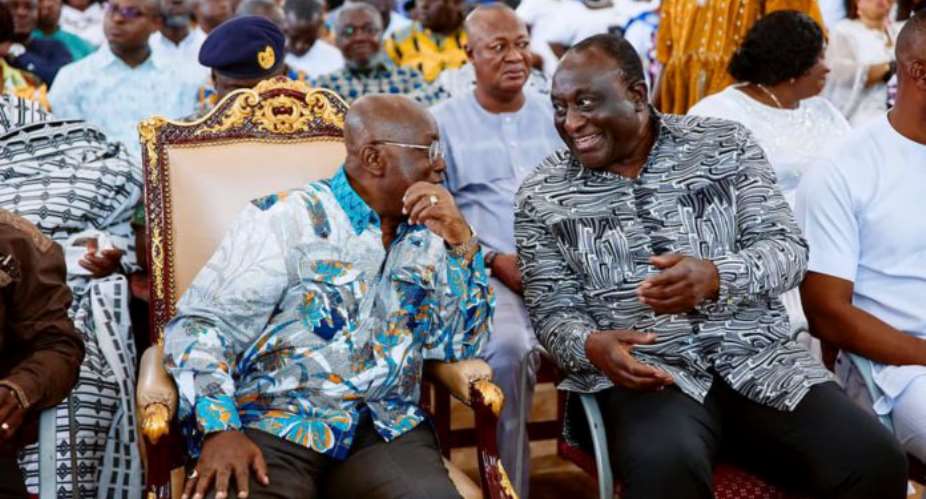
Founder and leader of the United Party (UP), Alan Kwadwo Kyerematen, has attributed Ghana’s economic crisis between 2021 and 2023 largely to domestic borrowing and fiscal decisions under the past Akufo-Addo administration, challenging the view that the Russia-Ukraine war was the main driver of the country’s economic difficulties.
Speaking at a public lecture at the British Council on Wednesday, September 24, Mr Kyerematen said the country’s economic downturn should be assessed in the context of the government’s borrowing and expenditure decisions during the period.
He argued that the rapid accumulation of public debt eventually contributed to a debt crisis, which compelled Ghana to implement the Domestic Debt Exchange Programme as part of efforts to restore fiscal sustainability.
“I am not allowed to examine this period, but the point is that after the growth star status, we went into a sharp decline, borrowing as if there were no limits to how much we could go,” he said.
According to Mr Kyerematen, the deterioration in the country’s fiscal position contributed to weaker economic growth and increased pressure on public finances.
He acknowledged that the Russia-Ukraine conflict had disrupted global supply chains and contributed to economic pressures but maintained that domestic fiscal conditions were also significant factors.
“And so obviously, we went into a debt crisis from 2021 to 2023. Yes, there is no denying the fact that it disrupted global supply chains, and that partly accounted for the reasons why things were going down,” he said.
Mr Kyerematen further linked the debt crisis to the subsequent implementation of the Domestic Debt Exchange Programme and negotiations for an IMF-supported programme.
Ghana’s debt sustainability challenges intensified in 2022, with debt sustainability assessments placing the present-value debt-to-GDP ratio at around 100%, significantly above the 55% benchmark under the IMF framework.
The government launched the Domestic Debt Exchange Programme in December 2022 as part of measures to restore debt sustainability and facilitate negotiations for an IMF-supported programme.
 Expired driver’s licence attracts delinquency charge of up to GH¢148 – DVLA
 Ghana needs an enterprise economy with African characteristics, not copying othe...
 Court reinstates Bolgatanga Technical University Vice-Chancellor Alnaa, two seni...
 Christian Council demands action against financiers behind drug trafficking
 'Facts don’t support Ghana being a cocaine hub under Mahama's gov't’ – Majority ...
 NACOC arrests surged from 73 in 2024 to 217 in 2025 under NDC – Majority defend ...
 Gov’t drug strategy now targets criminal networks – Agalga
 Akufo-Addo's govt reckless borrowing, not Russia-Ukraine war, caused post-2020 e...
 Rising drug busts due to concrete institutional changes by NDC govt – Majority
 'This is not one man job' — Majority calls for stronger inter-agency cooperation...


