




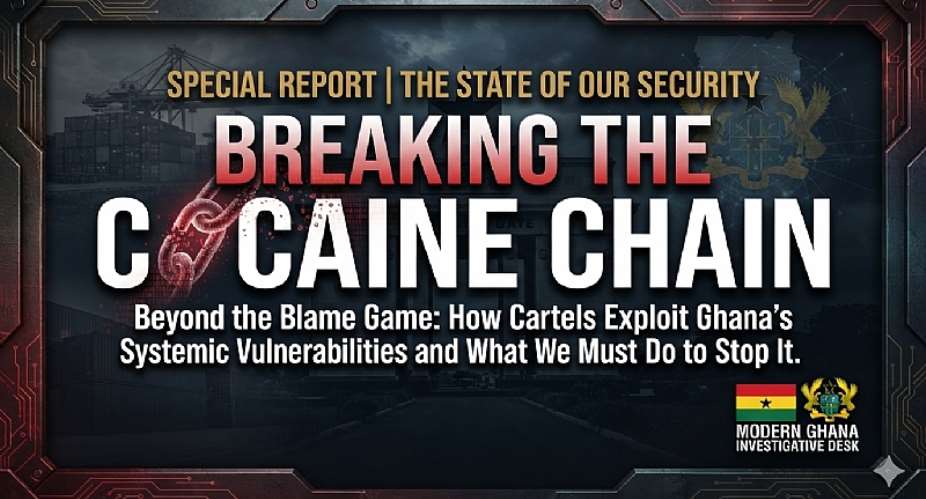
For over three decades, Ghana has proudly worn the badge of West Africa’s beacon of democracy and stability. Yet, beneath the veneer of peaceful transitions and political rhetoric lies a dark, corrosive cancer that threatens the very fabric of our statehood: our status as a premier transit hub for global cocaine trafficking. From the mid-1990s through the major multi-tonne busts of 2026, our political history is marred by a relentless timeline of narcotics scandals spanning both sides of the partisan divide. Whether under the NDC or the NPP, the story remains frustratingly consistent—massive interceptions, brief media storms, low-level arrests, and the complete evasion of the true kingpins. This is no longer just a law enforcement failure; it is a national security crisis. If left unchecked, the sheer volume of illicit wealth flowing through our borders will systematically buy our institutions, corrupt our elections, and turn Ghana into a fully functional narco-state. It is time to look beyond our borders, learn from global fortresses of security, and wage an uncompromising, bipartisan war against transnational syndicates.
The Anatomy of Ghana's Systemic Vulnerability
The persistence of the cocaine trade in Ghana is not accidental. It is fueled by precise operational and institutional vulnerabilities that cartels exploit daily:
- The Transnational Network Shell: Local networks do not operate in isolation. They serve as highly sophisticated logistics wings for South American and European cartels, utilizing decentralized cells that remain completely functional even when individual couriers are busted.
- Porous Maritime and Aerial Gateways: With an extensive, weakly patrolled coastline and overwhelming cargo volumes moving through the Tema Port and Kotoka International Airport, syndicates easily hide illicit shipments among thousands of legitimate containers.
- The Infiltration of Democratic Finance: The skyrocketing cost of political campaigns in Ghana creates an active vulnerability. Without strict, transparent tracking of campaign financing, dirty narcotics money can quietly fund political ambitions, buying future institutional immunity.
- Compromised Enforcement Mechanisms: The historical disappearance of drug evidence from state custody and occasional indictments of senior security personnel prove that the financial muscle of these kingpins is capable of bending local law enforcement.
- Economic Camouflage: Narco-dollars are heavily laundered into the local economy through fast-growing sectors like luxury real estate, automobile imports, hospitality, and front export-import companies, making it difficult to separate illicit wealth from legal commerce.
Global Blueprints: How Developed Nations Fight the Cartels
Ghana does not need to reinvent the wheel. Developed nations across Europe, North America, and Asia have successfully suppressed or dismantled major trafficking operations by deploying structural, legal, and technological fortresses:
SINGAPORE: Absolute Legal Deterrence and Zero-Tolerance Infrastructure
- The Capital Penalty: Singapore utilizes some of the world's strictest drug laws, where trafficking specific quantities of narcotics carries a mandatory death penalty, acting as a massive psychological barrier for cartels.
- Unified Command (CNB): The Central Narcotics Bureau operates as a singular, highly specialized agency with sweeping powers to arrest, detain, and intercept, free from regular bureaucratic or political interference.
CANADA: Advanced Port Security and Financial Intelligence
- Integrated Border Enforcement Teams (IBETs): Canada utilizes cross-border, multi-agency intelligence units linking national police, border services, and international allies to share real-time tracking data before ships ever dock.
- FINTRAC Tracking: Canada's financial intelligence unit strictly monitors real estate and high-value cash transactions, forcing individuals to explicitly prove the legal origin of wealth before it enters the economy.
EUROPE: Technology-Driven Maritime Shielding and Joint Taskforces
- MAOC-N Coordination: European nations coordinate through the Maritime Analysis and Operations Centre (Narcotics) in Lisbon, combining satellite tracking, naval assets, and military intelligence to intercept motherships far out at sea.
- Automated AI Port Scanning: Major hubs like Rotterdam rely heavily on automated, high-energy container scanning and AI anomaly detection to flag suspicious cargo without slowing down commercial trade.
The Path Forward: Strategic Recommendations for Ghana
To permanently break the back of the narco-trade, the government of Ghana, civil society, and the judiciary must adopt a radical, institutional overhaul:
- De-politicize the Narcotics Fight: Establish a truly independent, well-funded national anti-narcotics commission whose leadership is insulated from political appointments, changes in government, or partisan influence.
- Pass Rigid Campaign Financing Laws: Enact aggressive legislation requiring total transparency and auditing of all political party donations and campaign funding sources to stop cartels from buying political favor.
- Deploy Full-Scale Port Automation: Remove human discretion from the clearing chain by investing in advanced, mandatory container scanners and AI tracking software at Tema Port, Takoradi Port, and KIA.
- Weaponize Unexplained Wealth Orders (UWOs): Empower the Office of the Special Prosecutor and EOCO to seize luxury assets and real estate from individuals who cannot definitively prove their wealth was generated through legal economic activities.
- Strengthen West African Maritime Alliances: Deepen joint intelligence sharing and naval patrols with regional neighbors and international bodies like the UNODC to secure the Gulf of Guinea from maritime drops.
The recurring multi-tonne cocaine interceptions recorded over the decades are not victories to be celebrated; they are systemic warnings of a deeper institutional rot. Every time a major drug shipment slips through our borders, or a kingpin evades justice because a courier took the fall, a piece of Ghana’s sovereignty is bartered away. We can no longer afford the luxury of partisan finger-pointing, where the NDC and NPP simply weaponize drug busts for electoral points. This trade undermines legitimate businesses, finances corruption, and endangers our youth. Ghana must choose whether it wants to remain a respected sovereign republic or slowly devolve into a shadow playground for transnational syndicates. The solution requires absolute political will, advanced technology, legislative teeth, and an unyielding commitment to tracking the money, exposing the front businesses, and hunting down the true architects. The clock is ticking, and our national security cannot wait.
✍️ Submitted by:
Retired Senior Citizen
For and on behalf of all Senior Citizens of the Republic of Ghana 🇬🇭
Teshie-Nungua
[email protected]


 Expired driver’s licence attracts delinquency charge of up to GH¢148 – DVLA
 Ghana needs an enterprise economy with African characteristics, not copying othe...
 Court reinstates Bolgatanga Technical University Vice-Chancellor Alnaa, two seni...
 Christian Council demands action against financiers behind drug trafficking
 'Facts don’t support Ghana being a cocaine hub under Mahama's gov't’ – Majority ...
 NACOC arrests surged from 73 in 2024 to 217 in 2025 under NDC – Majority defend ...
 Gov’t drug strategy now targets criminal networks – Agalga
 Akufo-Addo's govt reckless borrowing, not Russia-Ukraine war, caused post-2020 e...
 Rising drug busts due to concrete institutional changes by NDC govt – Majority
 'This is not one man job' — Majority calls for stronger inter-agency cooperation...


