




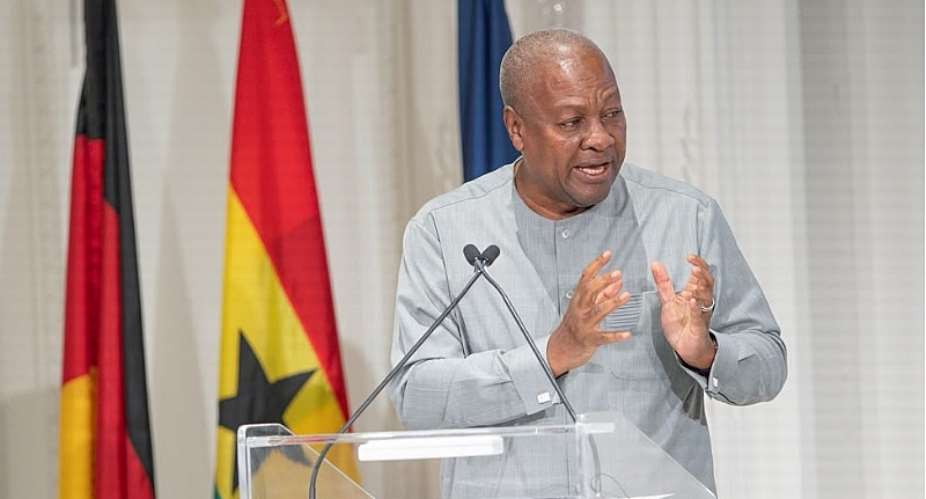
President John Dramani Mahama has reiterated the need for the remains of enslaved Africans located at museums across the globe to be given dignified resting places, stating that human remains are not collectibles or specimens to be kept in museums.
The President said this in his address on the margins of the 81st United Nations General Assembly Meeting in New York.
Giving historical accounts of artifacts of African origin and the remains of Africans that had been kept in museums outside the continent by their colonial masters, President Mahama said imagine for a moment Africa before the distant galleries of London, Paris, Berlin, New York became the main repositories of their artefacts and their history.
“Imagine a continent where history was not locked behind glass cases across the oceans but lived amongst our people. History in Africa was carved into sacred wood. It was cast in real bronze artefacts. It was forged in iron. It was woven in kente clothes,” he said.
President Mahama said it was written in manuscripts, and it was embodied in secret objects through which regenerations, remembered who they were and where they came from; stating that then imagine that those treasures were torn from their homes.
“They were seized by punitive expeditions. They were stripped from royal compounds and palaces and carried away after conquests and scattered all across the globe.”
He said, for generations, Africa’s history, our memory, and identity had been held far from the hands that created them.
The President said this was not a story about static objects and artefacts in museum cases across the world, it was a story about a proud and dignified people, Africans.
“It’s about our dignity. It is a story about an unfinished journey towards justice. Ghana knows this pain very well. In 1874, British forces attacked and destroyed the city of Kumasi, and they looted the Palace of the Asantehene,” he said.
President Mahama said a century and a half later, in 2024, a portion of that heritage was returned, including a sacred Pomponsuo sword.
He noted that its return reminded them that these were not mere relics of a bygone era, but they belong to living traditions, active institutions and communities that still were here.
“We see this across our whole continent. We saw it in 1897 in Benin City. We saw it at Magdala in Ethiopia and Abumi in Benin. And we see it in the most heartbreaking form. The removal of the physical remains of our ancestors,” he said.
President Mahama said in 1838, King Badu Bonsu II of Ahanta, rebelled against the Dutch colonial domination, the Dutch authorities executed him by hanging and after that, decapitated him.
He said that his head was sent to the Netherlands for phenomenology studies, and the head was preserved in a jar of formaldehyde for 170 years.
The President said this head was rediscovered by a Dutch journalist in 2002, and the head was finally returned to Ghana in 2009.
“And this is where I say emphatically, human remains are not collectibles. They are not specimens. They are our ancestors. They are fathers and mothers. They are kings and elders. Restoring them is not a matter of legal ownership. It is a fundamental test of our shared human dignity.” 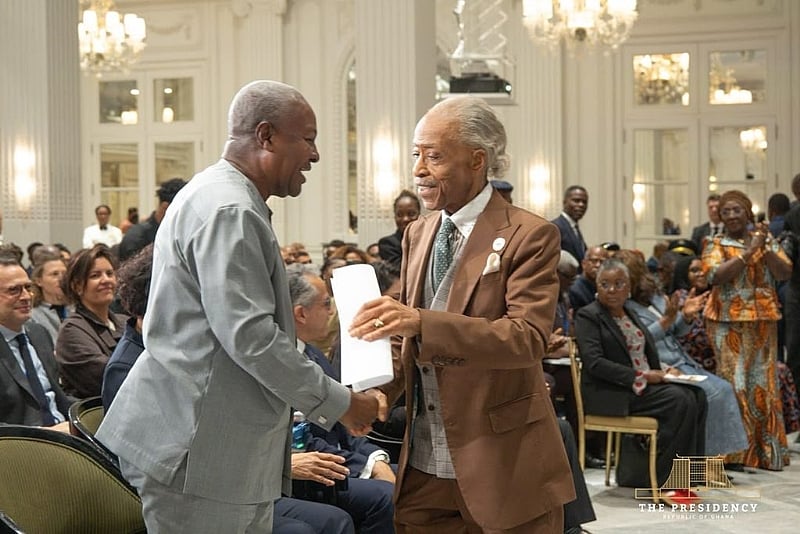
President Mahama said on 25th March this year, the UN General Assembly took a historic step by adopting Ghana’s Resolution 80/250, 123 member states declared the Trafficking of Enslaved Africans as a Gravest Crime Against Humanity and called for the prompt and unhindered restitution of our cultural property, our sacred artefacts and our national archives.
“That resolution was an indispensable moment of global truth. But the truth is not a destination. Truth is the starting line.”
He said in June, Ghana convened a High-Level Consultative Conference in Accra, and that leaders from Africa, the Caribbean and all around the African diaspora gathered to answer one fundamental question, What Comes Next?
“Our answer was clear. We must move from acknowledgement to action and from commitments to implementation,” he said.
“And so, the adoption of the Accra Next Steps, commitment for Reparatory Justice, provides that blueprint.”
President Mahama on the sidelines of the 81st UN General Assembly unveiled three pillars of the “Next Steps” for attaining global Reparatory Justice agenda. 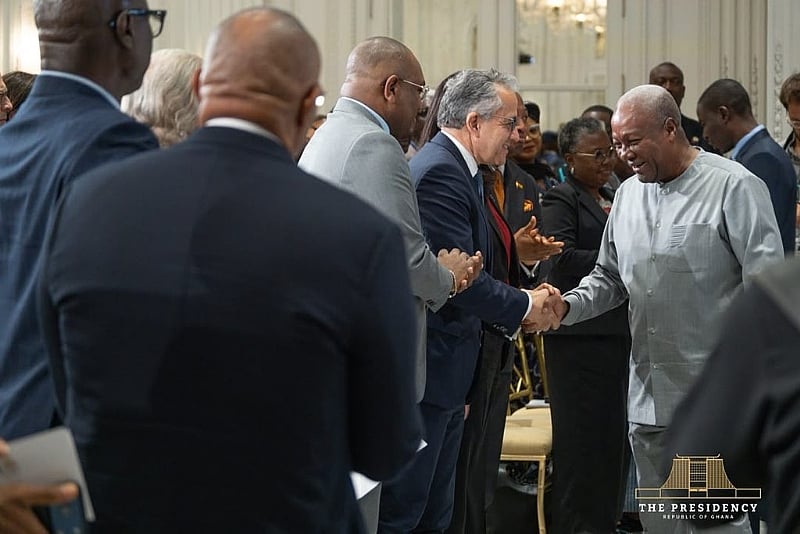
GNA

 Those behind EOCO ‘abuses’ will be held accountable – Sammi Awuku
 Raymond Archer should have been sacked by now – Kwadaso MP on EOCO-Baffuor Awuah...
 September 24: Cedi sells at GHS12.20 on forex market, GHS11.60 on BoG interbank
 'GMA is monitoring Ghana's marine space blindly’ – Miracles Aboagye
 Alagumgube welcomes Gurene as BECE subject, calls for more teachers and learning...
 Mahama calls for return of Africa’s cultural heritage at UNGA 81 side event
 ECOWAS directors meet in Lagos to align 2027–2029 expenditure plans
 Lordina Mahama urges African leaders to build stronger healthcare systems for wo...
 Speaker Bagbin summons Parliament for September 29 sitting
 Kwesi Pratt warns against abuse of free expression amid Ghana Jollof controversy


