




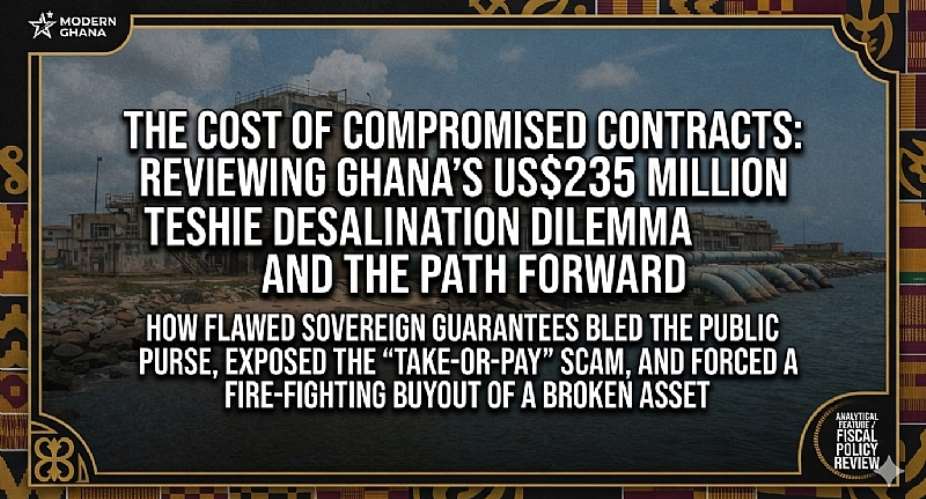
Ghana once again finds itself entangled in a multi-million-dollar international legal web, raising questions about the management of public-private partnerships (PPPs) and sovereign liability. On September 17, 2026, an International Chamber of Commerce (ICC) arbitration tribunal ordered Ghana Water Limited (GWL) to pay approximately US$235 million to Befesa Desalination Developments Ghana Limited, a subsidiary of the Spanish infrastructure group Cox. This staggering judgment debt follows the termination of a 25-year "take-or-pay" Water Purchase Agreement signed over a decade ago. Alarmingly, this penalty is nearly double the US$126 million originally spent to construct the facility, which has sat completely idle since October 2025. With the state guarantee triggered, the taxpayer is once again left to foot the bill for institutional oversights. In a desperate bid to mitigate the financial damage, the government is actively negotiating to purchase the plant entirely at a discounted rate. This critical review breaks down how Ghana arrived at this crossroads and explores the structural reforms necessary to protect the public purse.
Key Facts and the Genesis of the Crisis
Understanding the escalation of this dispute requires looking at the technical, structural, and financial breakdowns that crippled the project:
- The Take-or-Pay Trap: The original deal bound Ghana to a 25-year agreement requiring the state to pay for a fixed volume of treated water regardless of whether the utility could distribute or sell it profitably.
- Operational Inefficiencies: Despite being West Africa's first desalination plant, the facility suffered from recurrent power supply outages, high production costs, and severe structural vulnerability to adverse weather conditions.
- Financial Delays and Termination: Broader fiscal constraints led to persistent payment defaults by GWL, forcing the eventual termination of the contract and triggering parallel international arbitration against both the utility and the state.
- Dismissal of Counterclaims: The ICC tribunal substantially rejected Ghana's US$144.5 million counterclaims, leaving the nation fully exposed to the US$235 million debt, with interest backdated and accruing from April 1, 2026.
Critical Review: Why Buying the Plant is a Strategic Necessity
The Office of the Attorney-General and Ministry of Justice has indicated that negotiations are advanced to acquire the Teshie Desalination Plant below the arbitral award threshold. While some critics question spending more money on a troubled asset, a direct buyout represents the most logical exit strategy for several reasons:
- Averting Compounding Judgment Debt: Paying a negotiated lower fee to acquire the asset prevents the immediate enforcement of the full US$235 million award and halts the accumulation of high-interest penalties.
- Restoring Water Security: The shutdown has forced residents of Teshie, Nungua, Spintex, and Sakumono to rely on expensive water tankers. Complete state ownership allows the government to refurbish the plant and restore water flow to an estimated one million citizens.
- Eliminating Private Royalties: Transitioning the plant into a fully state-owned asset permanently dismantles the restrictive, long-term private equity terms that made water production economically unviable under the previous arrangement.
Policy Recommendations and Suggestions
To turn this crisis into a turning point for national project management, Ghana must adopt aggressive legal and structural changes:
- Mandatory Parliamentary Scrutiny for PPPs: All international commercial agreements, particularly those involving long-term "take-or-pay" clauses or sovereign guarantees, must face rigorous independent financial auditing and parliamentary approval.
- Establish an Arbitral Risk Unit: The Ministry of Justice should establish a permanent technical and legal task force to monitor state-guaranteed projects in real time, identifying contractual breaches before they escalate to international courts.
- Transition to Hybrid Energy Solutions: To make the plant cost-effective upon acquisition, the Ministry of Sanitation and Water Resources should integrate dedicated solar or hybrid power systems to bypass the high grid-electricity costs that plagued its initial operation.
- Enforce Strict Institutional Accountability: State officials and executives who oversee the signing of structurally flawed or unviable public contracts must face professional and legal consequences to deter future negligence.
The Teshie desalination plant crisis serves as a sobering reminder of the financial perils associated with poorly structured public procurement and state guarantees. While the government's current strategy to buy out the plant is a necessary fire-fighting measure to stop the bleeding of scarce national resources, it must not become standard practice. True victory will not come from merely negotiating down a judgment debt, but from ensuring that Ghana never signs away its economic sovereignty in such lopsided agreements again. Moving forward, transparent contract management, rigorous engineering assessments, and a unyielding commitment to the public good must guide every major infrastructural investment. Only by institutionalizing these reforms can Ghana protect its treasury, secure its natural resources, and provide its citizens with the dependable public utilities they rightly deserve.
✍️ Submitted by:
Retired Senior Citizen
For and on behalf of all Senior Citizens of the Republic of Ghana 🇬🇭
Teshie-Nungua
[email protected]

 Expired driver’s licence attracts delinquency charge of up to GH¢148 – DVLA
 Ghana needs an enterprise economy with African characteristics, not copying othe...
 Court reinstates Bolgatanga Technical University Vice-Chancellor Alnaa, two seni...
 Christian Council demands action against financiers behind drug trafficking
 'Facts don’t support Ghana being a cocaine hub under Mahama's gov't’ – Majority ...
 NACOC arrests surged from 73 in 2024 to 217 in 2025 under NDC – Majority defend ...
 Gov’t drug strategy now targets criminal networks – Agalga
 Akufo-Addo's govt reckless borrowing, not Russia-Ukraine war, caused post-2020 e...
 Rising drug busts due to concrete institutional changes by NDC govt – Majority
 'This is not one man job' — Majority calls for stronger inter-agency cooperation...


