




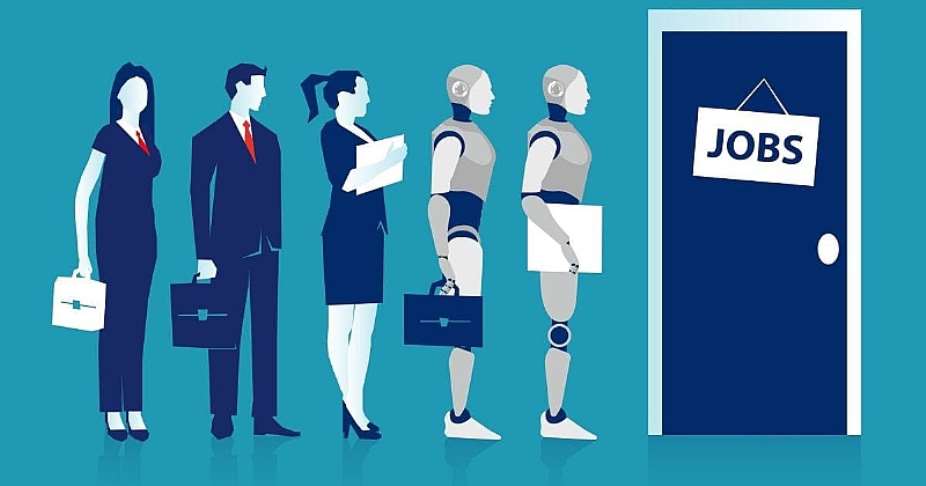
Two labour rulings in China pose a question African governments cannot ignore: when artificial intelligence displaces a worker, who should bear the cost—the employee, the firm or society? Debate has focused on privacy, intellectual property, bias and regulation. These cases bring the issue into the workplace, where the consequences are immediate and deeply human.
The first case involved Zhou, who worked in quality assurance for large language models at a technology company in Hangzhou. After deciding that upgraded AI systems could perform much of his work, the company offered him a lower-level position with a steep pay cut. He refused and was dismissed. A Hangzhou court ruled against the employer and awarded compensation, finding that the adoption of AI was a deliberate business decision rather than an unforeseeable “major change in objective circumstances” justifying dismissal under China’s Labor Contract Law. It also found the proposed salary reduction unreasonable.
The second case, publicised by Beijing labour authorities in December 2025, involved Liu, who had spent years collecting map data manually. His employer introduced automated AI collection, closed his department and terminated his contract. The arbitration panel rejected the argument that automation was an external shock that made continued employment impossible. Technological upgrading may raise productivity, it concluded, but firms cannot simply transfer the costs of transition to workers.
Neither ruling opposes AI or modernisation. Both hold that employers considering replacing workers with AI should first explore retraining, redeployment, consultation and reasonable alternative positions. Firms that choose to automate should manage the transition.
Africa is not insulated from this dispute. Although large-scale AI-driven job replacement remains limited, adoption is spreading across African workplaces. Banks, telecommunications companies, business-process outsourcing firms and public administrations are introducing AI into customer service, document processing and routine analysis—the functions through which many young people gain their first foothold in formal employment. As adoption accelerates, governments will need the administrative capacity and legal frameworks to ensure that firms manage disruption before displacement becomes widespread.
The rulings expose a widening gap between the incentives to automate and the safeguards available to workers—a mismatch likely to deepen as AI spreads across factories and offices. In many Western economies, firms retain broad freedom to reorganise around new technologies. Employees may receive compensation, but a payout rarely limits the underlying power to replace labour.
Worker protection often remains weak in practice across Africa, even for employees formally covered by labour law. An ILO study of eight West African countries found that 88% of employees experienced multiple violations of their labour rights, including breaches of minimum-wage, leave and social-security provisions. Broader World Justice Project data reinforce this concern: many African countries score poorly on measures covering equal pay, protection from discrimination, freedom of association and collective bargaining, and safeguards against child and forced labour. Taken together, the findings suggest that legal protections often fail to provide effective safeguards in the workplace.
This enforcement gap heightens Africa’s vulnerability: AI is advancing before many economies have generated enough formal, productive and decent work for their young populations. Persistent unemployment, widespread informality and limited social protection increase the risk. AI may eliminate some jobs, but it may also transform the entry-level and support roles that provide a route into formal employment. Clerical, administrative and other highly digitised professional and technical roles are among those most exposed to generative AI. Whether that exposure leads to displacement or better work will depend on how employers and governments deploy the technology—and whether its adoption advances human dignity, social justice and the common good.
This exposure need not lead to widespread displacement. Governments should begin by requiring firms adopting AI at scale to assess the employment effects before jobs are lost, consult workers and unions where they exist, offer retraining or redeployment where practicable, and show that dismissal is a last resort. This obligation should sit at the centre of AI strategies otherwise focused on innovation, start-ups, data centres and digital infrastructure. It would correct the imbalance exposed by the Chinese cases: firms decide whether to automate, while workers and the public may bear much of the cost.
Legal safeguards should be matched by economic policy that makes AI a source of wider opportunity rather than a means of cutting headcount. This requires sustained investment in digital and vocational skills, data governance, local-language AI, cybersecurity, cloud infrastructure and productive applications in agriculture, health, education, climate resilience, public finance and trade. Workers need credible pathways from tasks that machines can perform to jobs that depend on judgement, supervision, trust, contextual knowledge and accountability.
Those pathways require stronger social protection before displacement gathers pace. Millions of workers in Africa’s informal economy remain outside contributory social-insurance systems, leaving governments poorly prepared for a disorderly transition. AI-related job losses in the formal sector would increase demand for income support, retraining and employment services. Governments should therefore combine portable benefits and targeted cash support with retraining funds, public employment services and employer-backed reskilling. Without these measures, displacement could deepen inequality, frustrate young people and erode trust in institutions.
Implementing these legal, economic and social-protection measures will require capable institutions. Public bodies need the expertise to assess AI systems, negotiate with technology companies and measure labour-market effects. Labour ministries, regulators, competition authorities, data-protection agencies, education systems and investment bodies must work together. Without sufficient public expertise, regulation will falter, allowing firms to set the terms of workplace adoption before worker protections take effect.
Together, these measures would create a framework for sharing AI’s productivity gains while safeguarding human dignity and social stability. Firms should benefit from innovation, but not retain the gains while shifting the costs to the public through unemployment and exclusion. Policy should reward responsible adoption, require consultation with national authorities and subject restructuring with serious social or political consequences to closer scrutiny.
The Chinese rulings offer an early warning. Africa should not allow artificial intelligence to enter the workplace chiefly as a substitute for already scarce employment. Governments must prepare before displacement gathers pace. The principle is clear: those who choose to automate should bear responsibility for the transition, so that AI expands decent work rather than narrows young Africans’ routes into formal employment.
Anthony Ohemeng-Boamah writes on international development and socio-economic transformation, with a particular focus on Africa.


 Expired driver’s licence attracts delinquency charge of up to GH¢148 – DVLA
 Ghana needs an enterprise economy with African characteristics, not copying othe...
 Court reinstates Bolgatanga Technical University Vice-Chancellor Alnaa, two seni...
 Christian Council demands action against financiers behind drug trafficking
 'Facts don’t support Ghana being a cocaine hub under Mahama's gov't’ – Majority ...
 NACOC arrests surged from 73 in 2024 to 217 in 2025 under NDC – Majority defend ...
 Gov’t drug strategy now targets criminal networks – Agalga
 Akufo-Addo's govt reckless borrowing, not Russia-Ukraine war, caused post-2020 e...
 Rising drug busts due to concrete institutional changes by NDC govt – Majority
 'This is not one man job' — Majority calls for stronger inter-agency cooperation...


